
Compression molding is a molding process where material is placed directly into a heated mold cavity and then shaped under pressure. In many regions, the same process is also called compression moulding. It is commonly used for rubber parts, silicone components, thermoset plastics, composite panels, and some compression molded plastic parts.
The process is different from injection molding. In compression molding, the material charge is loaded into the mold before the mold closes. In injection molding, melted plastic is injected into a closed mold through a screw, nozzle, runner, and gate system.
Compression molding works well for parts that need heat, pressure, curing, or a relatively simple mold shape. Rubber seals, gaskets, silicone pads, electrical insulators, thermoset handles, composite panels, and large flat molded parts are common examples.
For buyers comparing molding processes, the useful question is not only “What is compression molding?” The more important question is whether compression molding or injection molding is the better fit for the part. That depends on material, part geometry, production volume, tolerance, wall thickness, surface finish, and tooling budget.
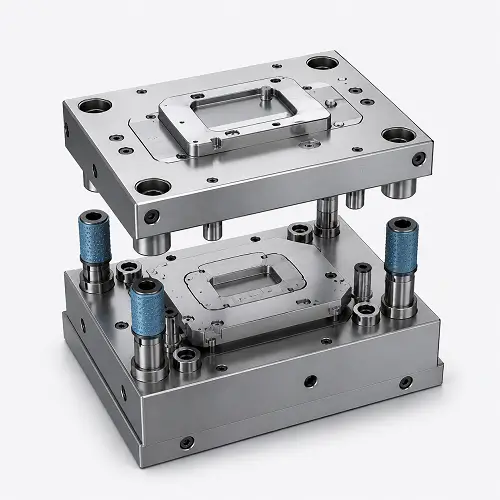
What Is Compression Molding?
Compression molding is a manufacturing process that uses a compression mold, heat, and pressure to form a part. A measured amount of material is placed inside the mold cavity. The mold closes under pressure, the material spreads into the cavity, and the part cures, flows, or cools into its final shape.
The material may be rubber compound, silicone rubber, thermoset plastic, BMC, SMC, prepreg composite, powder, sheet, or a thermoplastic charge. The exact material form depends on the product and the compression molding process.
In simple terms, the process works like this: load the material, close the mold, apply heat and pressure, let the material cure or solidify, open the mold, and remove the part.
Compression molding plastic parts is possible, but the process is especially common for rubber compression molding, silicone compression molding, thermoset plastics, and composite compression molding. For thin-wall thermoplastic parts with ribs, bosses, clips, snap fits, and tight repeatability, injection molding is usually more common.
A compression mold may look simple from the outside, but the details still matter. Cavity loading, charge weight, parting line, venting, mold temperature, pressure, curing time, flash control, and trimming allowance all affect final part quality.
Compression Molding vs Injection Molding: What Is the Difference?
Compression molding and injection molding both make molded parts, but the material enters the mold in different ways.
In compression molding, material is placed into the open mold cavity first. The mold then closes, and pressure spreads the material through the cavity. Heat and pressure shape the part. Rubber and thermoset materials usually cure inside the mold.
In injection molding, plastic pellets are melted in a barrel and injected into a closed mold. The molten plastic flows through the sprue, runner, and gate into the cavity, cools, and is ejected as a finished thermoplastic part.
That difference changes where each process works best.
Compression molding is often better for rubber, silicone, thermoset plastics, composite materials, large parts, thick-wall parts, and simpler shapes. Injection molding is usually better for high-volume thermoplastic parts, complex plastic housings, thin walls, snap fits, ribs, bosses, small precision parts, and parts that need fast cycle times.
A compression mold may have a simpler material delivery system because there is no injection runner system in the same way. But compression molding still needs control over material placement, pressure, temperature, curing time, flash, and trimming.
An injection mold is usually more complex. It needs proper gate design, runners, cooling, venting, ejection, and sometimes slides or lifters. The benefit is speed and repeatability once the tool is stable.
So the choice is not about which process is “better.” Compression molding and injection molding serve different materials, shapes, and production goals.
How Does the Compression Molding Process Work?
The compression molding process is also known as a press molding process because the mold is closed by a compression molding press or compression molding machine. The basic steps are not hard to understand, but the quality depends on control at each step.
Material Preparation
The first step is preparing the material charge. The charge must match the part volume, shrinkage, material behavior, and expected flash. Too little material can cause incomplete filling. Too much material can create heavy flash and extra trimming.
For rubber compression molding, the material may be prepared as a cut rubber blank. For silicone rubber compression molding, the charge may be weighed and placed into the cavity. For thermoset plastics, the charge may be powder, pellets, or a preform. For composite compression molding, the charge may be SMC, BMC, prepreg, or another fiber-reinforced form.
Good material preparation reduces variation before the mold ever closes.
Loading the Material into the Compression Mold
The prepared charge is placed into the mold cavity by hand or by automated loading. Placement matters. If the charge sits too far from the main flow area, the material may spread unevenly, trap air, leave voids, or create thickness variation.
This is one reason compression molding depends heavily on setup discipline. The material charge, location, and mold temperature need to stay consistent from cycle to cycle.
Mold Closing and Pressing
After loading, the mold closes under pressure. The pressure forces the material to spread across the cavity and take the shape of the part.
Closing speed, pressure, and mold temperature all affect the result. If the mold closes too fast, air can be trapped. If pressure is too low, the material may not fill the cavity well. If pressure is too high or the charge is excessive, flash can become harder to control.
This is where terms like pressure molding, press molding process, and compression molding press come from. The material is not injected into the mold. It is pressed into shape.
Compression Molding Machine and Press Control
A compression molding machine, also called a compression molding press, uses heated platens and controlled pressure to close the mold and form the material. The machine must control mold temperature, pressure, closing speed, and curing time.
These settings are not minor details. Temperature affects cure and flow. Pressure affects filling and flash. Closing speed affects trapped air. Curing time affects strength, dimensions, and part stability. If one of these settings drifts, the molded part may change even when the mold itself is unchanged.
For rubber, silicone, thermoset, and composite compression molding, press control is often just as important as mold design.
Heating, Curing, or Cooling
Rubber and thermoset materials usually cure inside the heated mold. Curing time depends on material chemistry, part thickness, mold temperature, and pressure.
Thermoplastic compression molding works differently. The material may soften under heat and then cool into shape. Some specialty materials, such as PTFE or UHMW, may use compression molding or related press molding methods because they do not always process like standard injection molding plastics.
Composite compression molding uses heat and pressure to consolidate fibers, resin, and layers into a stable part. Prepreg compression molding also depends heavily on temperature, pressure, and cure time.
Demolding and Trimming
After the part cures or solidifies, the mold opens and the part is removed. Many compression molded parts need trimming because flash forms around the parting line.
Trimming may be simple on a rubber gasket, or more involved on a composite panel or thermoset part. Some parts may also need post-curing, cleaning, machining, inspection, or secondary assembly.
Flash should be considered before the mold is built. If the trim area is poorly planned, the part may be difficult or expensive to finish.
Compression Molding Materials
Compression molding materials cover several material families. The process is often chosen because certain materials respond well to heat and pressure inside a mold.
Thermoset Plastics
Thermoset plastics are common in compression molding because they cure under heat and pressure. Once cured, thermoset materials do not remelt like standard thermoplastics.
Phenolic, epoxy, melamine, BMC, and SMC are common examples. These materials are used when the part needs heat resistance, electrical insulation, stiffness, chemical resistance, or dimensional stability.
Thermoset compression molded parts may include electrical components, handles, knobs, appliance parts, insulating covers, and industrial molded products.
Rubber and Silicone Materials
Rubber compression molding is one of the most common uses of the process. Rubber material can be placed into the mold, compressed, heated, and cured into seals, gaskets, pads, dampers, covers, bushings, and other flexible parts.
Silicone compression molding and silicone rubber compression molding are used when the part needs flexibility, temperature resistance, chemical resistance, or soft-touch performance. Silicone rubber parts are common in sealing, medical-related, automotive, electrical, and consumer applications.
Rubber compression moulding is often practical for low to medium production volumes, larger rubber parts, and shapes where direct material loading makes sense.
Composite Materials
Composite compression molding is used for fiber-reinforced parts, SMC panels, BMC components, prepreg compression molding, and structural molded products. The process applies heat and pressure to consolidate fibers and resin inside the mold.
Compression molding composites can be used for automotive panels, electrical housings, industrial covers, brackets, and fiber-reinforced structural parts. These parts often need stiffness, heat resistance, and strength-to-weight performance.
Composite parts need careful control of material placement, fiber orientation, temperature, cure time, and pressure. Poor setup can lead to voids, weak areas, surface defects, or dimensional variation.
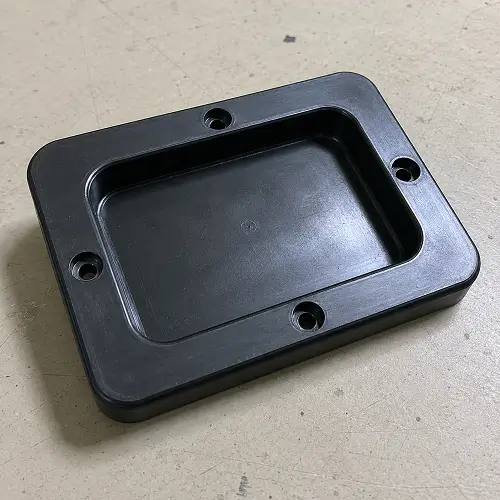
Thermoplastics
Thermoplastic compression molding is less common than thermoplastic injection molding, but it is used in some specialty cases. PTFE compression molding, UHMW compression molding, and foam compression molding are examples where standard injection molding may not be the easiest route.
Foam compression molding may be used for cushioning pads, insulation parts, protective inserts, and lightweight molded components where controlled compression and shape retention matter.
For common thermoplastics such as ABS, PP, PC, PA, POM, and TPU, injection molding is often more efficient for high-volume complex parts. Still, compression molding of plastics can make sense for certain material forms, thick parts, simple shapes, or specialty applications.
The material should guide the process choice. A silicone seal, a composite panel, and a thin-wall ABS housing should not be forced into the same molding method.
Compression Mold Design Considerations
Compression mold design has a large effect on part quality. The process may look simple, but small design mistakes can create flash, trapped air, uneven flow, surface defects, poor curing, or difficult demolding.
Cavity loading is one of the first details to consider. The material charge must be placed where it can flow properly as the mold closes. Poor charge placement can cause incomplete filling, air traps, uneven thickness, or excessive flash.
Parting line design is also important. Compression molding often creates flash at the mold split line. The parting line should be placed where flash can be trimmed without damaging function or appearance.
Draft angle helps the part release from the compression mold. Even rubber and thermoset parts may need draft depending on geometry, surface texture, and cavity depth.
Wall thickness should be reviewed early. Thick sections may need longer cure time. Uneven wall sections can create internal stress, poor cure, sink-like appearance problems, or dimensional variation.
Venting is needed because air and gas must escape as the mold closes and the material flows. Poor venting can cause voids, burn marks, weak areas, and incomplete filling.
Mold temperature and curing time must match the material. If the mold is too cold, the material may not flow or cure properly. If the mold is too hot, the material may cure too fast, degrade, or create surface problems.
Insert placement also needs attention. Inserts can be used in compression molded parts, but they must stay positioned during mold closing and material flow. If inserts shift, the part may fail assembly or dimensional inspection.
Trimming allowance should be designed into the part and mold. Many compression molded parts need flash removal, and the trim line should be practical for production.
Common Compression Molding Defects
Compression molding defects often come from material placement, charge weight, air trapping, curing control, mold temperature, or parting line design.
Flash is one of the most common issues. Some flash is expected in many compression molded parts, but excessive flash increases trimming work and may point to too much material, poor parting line fit, excessive pressure, or mold wear.
Voids can form when air is trapped inside the material or when the material does not flow evenly. Poor venting, uneven charge placement, or incorrect pressure can make this worse.
Incomplete filling happens when the charge is too small, the material does not flow far enough, the mold temperature is wrong, or pressure is not sufficient.
Poor curing can lead to weak parts, unstable dimensions, tacky surfaces, or poor heat resistance. This is common when curing time, mold temperature, or material preparation is not controlled well.
Surface marks can come from dirty mold surfaces, trapped gas, poor material flow, or damaged cavity surfaces.
Dimensional variation may come from inconsistent charge weight, unstable press settings, uneven heating, poor cure control, or inconsistent trimming.
Many compression molding problems can be reduced by controlling material weight, charge location, mold temperature, pressure, venting, and cure time.
Common Compression Molded Parts and Products
Compression molded parts are used in many industries because the process works well with rubber, thermosets, and composites. The parts are often flexible, heat-resistant, insulating, durable, or structurally reinforced depending on the material.
Common compression molding products include rubber seals, rubber gaskets, silicone pads, shock-absorbing parts, electrical insulators, thermoset knobs, handles, appliance parts, automotive rubber components, composite panels, fiber-reinforced covers, industrial pads, and large flat molded parts.
Compression molded plastics are often used where thermoset strength, heat resistance, electrical insulation, or thick-wall geometry matters more than thin-wall high-speed production.
Compression molded rubber is common where sealing, vibration damping, flexibility, or temperature resistance is required. Composite compression molding is common when parts need stiffness, strength, and larger surface area.
These examples show why compression molding remains useful even though injection molding is more common for many thermoplastic production parts. The two processes serve different needs.
Advantages of Compression Molding
Compression molding has practical advantages when the material and part design match the process.
The process works well with rubber, silicone, thermoset plastics, and composites. These materials often need heat, pressure, or curing behavior that fits compression molding better than standard injection molding.
Compression molding can also be suitable for large parts and thick-wall parts. Since the material is placed directly into the cavity, the flow path can be shorter than in injection molding. That can help with some large or heavy molded products.
Tooling may be simpler in certain applications. A compression mold may not need the same runner, gate, screw, and injection system requirements as an injection mold. This can reduce tooling complexity for some parts.
Compression molding can produce strong parts, especially when using thermosets or fiber-reinforced composites. Heat and pressure help consolidate the material into a durable molded product.
Material waste can be controlled when charge size is accurate, although flash and trimming still need attention.
For the right part, compression molding is a mature and useful manufacturing process.
Limitations of Compression Molding
Compression molding also has limits. It should not be treated as a replacement for every molding process.
Cycle time can be slower, especially for rubber, thermoset, or thick parts that require curing. The mold may need to stay closed long enough for the material to cure or solidify properly.
The process is not ideal for many thin-wall, complex thermoplastic parts. Small ribs, snap fits, bosses, clips, fine details, and tight repeatability are often easier to manage with injection molding.
Flash is common. Trimming may be needed after molding, which adds labor, time, and cost.
Material placement affects quality. If the charge is not placed consistently, the part may show voids, flow variation, thickness problems, or incomplete filling.
Automation can be more limited than injection molding, depending on material and part design. Some compression molding processes still need manual loading and part trimming.
For high-volume small thermoplastic parts, injection molding usually has better repeatability, shorter cycles, and stronger automation potential.
When Should You Choose Compression Molding?
Compression molding is a good choice when the material and geometry fit the process.
It is often suitable for rubber parts, silicone rubber parts, thermoset plastic parts, composite components, prepreg parts, thick-wall parts, large flat parts, and parts that need heat and pressure curing.
It can also be practical for lower or medium production volumes where a simpler mold and direct material loading make sense. For some parts, the mold may cost less than a complex injection mold, especially when the shape is simple and the material is well suited to compression molding.
Choose compression molding when the part does not need thin-wall details, high-speed production, complex molded features, or extremely tight repeatability across high-volume thermoplastic production.
The best candidates are parts where the material benefits from being pressed and cured inside the mold.
When Injection Molding May Be Better
Injection molding may be better when the project uses thermoplastic materials and needs high repeatability, complex geometry, or higher production efficiency.
If the part is made from ABS, PP, PC, PA, POM, TPU, PE, PMMA, or similar thermoplastics, injection molding is often the first process to review. This is especially true for housings, covers, clips, connectors, medical plastic parts, consumer product shells, electronic enclosures, and small precision plastic components.
Injection molding is stronger when the part has thin walls, ribs, bosses, snap fits, threaded features, living hinges, tight assembly requirements, or cosmetic surfaces. The process also works well when production quantities grow and cycle time becomes important.
Injection molding tooling may cost more at the start, but once the mold and process are stable, production can be fast and repeatable.
If your project requires thermoplastic injection molded parts instead of compression molded parts, JeekMould can review the CAD model, material, quantity, tolerance requirements, and part geometry before tooling begins.
Conclusion
Compression molding is a press molding process that uses heat and pressure to shape material inside a mold cavity. It is widely used for rubber, silicone, thermoset plastics, composite materials, and some specialty plastic parts. It can produce seals, gaskets, electrical insulators, composite panels, thermoset parts, rubber pads, and large molded products.
The compression molding process is different from injection molding. Compression molding places material into the mold before closing. Injection molding melts plastic and injects the material into a closed mold. That difference affects material choice, mold design, cycle time, part complexity, and production volume.
Compression molding is a good fit for rubber parts, thermoset parts, composite parts, thick-wall components, and large simpler shapes. Injection molding is usually better for complex thermoplastic parts, thin-wall housings, small precision parts, snap fits, and high-volume production.
The right process depends on material, part geometry, tolerance, surface requirement, production volume, and tooling budget. If the project needs plastic injection molded parts, JeekMould can review the CAD files and recommend a practical molding approach before tooling starts. Upload your CAD files for DFM feedback and an injection molding quotation.