
Custom Overmolding Services
JeekMould provides custom overmolding services for plastic and metal parts that need soft-touch grip, sealing, shock absorption, surface protection, or improved appearance. We support TPE, TPU, TPV, LSR, and other overmolding materials for handles, housings, buttons, grips, seals, and functional plastic components.
If required, JeekMould can sign an NDA before project discussion!
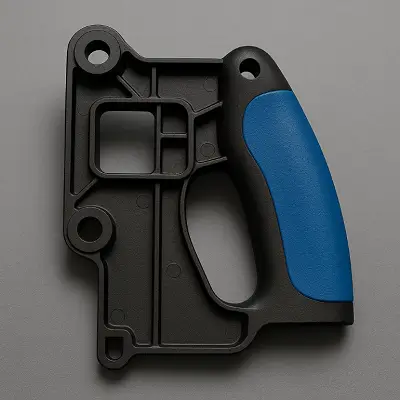
What is overmolding?
Overmolding is a secondary molding process that adds a soft material layer over a rigid plastic or metal base part. The base part is molded first, then placed into another mold where TPE, TPU, TPV, silicone, or another elastomer is molded over selected areas.
This process helps create soft-touch surfaces, non-slip grips, sealing edges, impact protection, color contrast, and stronger product feel without separate adhesive bonding or manual assembly.
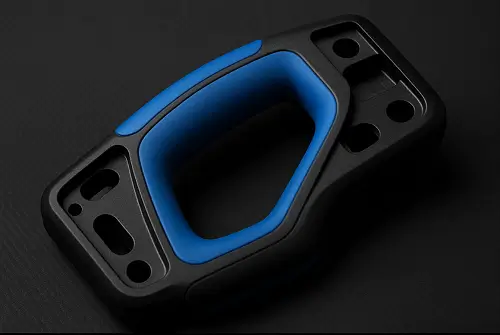
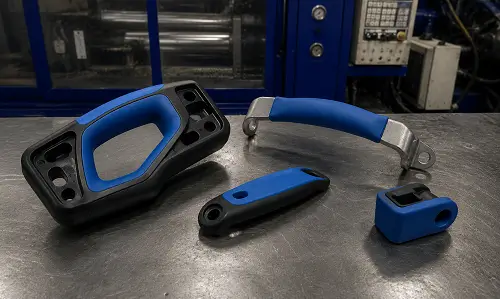
Plastic and Metal Overmolding
JeekMould supports plastic overmolding and metal overmolding for parts that require grip, sealing, insulation, impact protection, or improved product feel. Common base parts include rigid plastic housings, metal handles, inserts, brackets, terminals, and functional components. Soft materials such as TPE, TPU, TPV, and silicone can be molded over selected areas based on bonding, surface, and application requirements.
Common Overmolded Parts
- Soft-touch handles and grips
- Wearable device parts and protective covers
- Sealing edges and gasket-like features
- Buttons, knobs, and control parts
- Metal parts with soft overmolded surfaces
- Industrial spacers, pads, covers, and protective components
- Housings that need shock absorption or surface protection
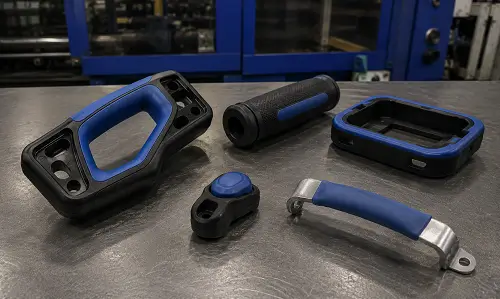
Overmolding Industry Applications
Why is overmolding chosen?
Our overmolding capabilities span from rapid prototyping to mass production, achieving strong bond interfaces, consistent surface quality, and reliable mechanical properties through strict process control.
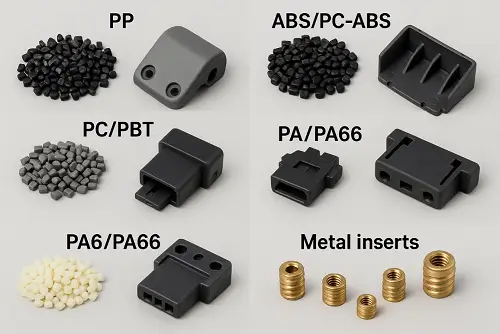
Material Component Assembly for Overmolding Technology
Overmolding Vs. Insert Molding Vs. Two-color molding
First, mold the rigid plastic body, then overmold it with soft rubber or other materials.
Overmolding vs Insert Molding vs Two-Shot Molding
Engineering-grade comparison for process selection| Category | Overmolding | Insert Molding | Two-Shot Molding |
|---|---|---|---|
| Typical Materials |
PC/ABS + TPE/TPU
PA12 + TPE
Focus on chemical compatibility & mechanical interlock.
|
PA6/PA66 + GF
PC/ABS + Brass/SS inserts
Inserts: brass, stainless steel, copper, aluminum.
|
PC + TPE
PC + PMMA
PC/ABS + PC
Two polymers shot A→B in one mold system.
|
| Bonding Mechanism | Chemical adhesion + undercuts/ribs for mechanical lock. | Polymer encapsulates pre-placed metal/plastic insert for mechanical/functional integration. | In-mold sequential shots achieve the strongest polymer-to-polymer interface. |
| Mold Structure | Single mold; second shot gate/seal design; venting around soft-touch areas. | Nest features for insert location; anti-shift locks; robust ejector layout. | Rotary/transfer/Index plate; dual runners; precise registration between shots. |
| Production Flow | Shot A (rigid) → Shot B (over-mold). Same or separate press depending on scale. | Load insert (manual/robot) → Inject → Cool → Eject → (Deburr if needed). | Shot 1 (A material) → Index → Shot 2 (B material) → Eject (one cycle). |
| Automation Level | Medium; pick-and-place optional. | Low–Medium; robotics reduce variation but add cost. | High; integrated turntable/transfer with minimal labor. |
| Tooling Cost (relative) | Medium (above single-shot). | Medium–High (locator/fixtures for inserts). | High (1.5–3× single-shot depending on mechanism). |
| Unit Cost (relative) | Medium. | Highest (insert cost + placement labor/robotics). | Lowest at volume (cycle efficiency, no secondary handling). |
| Cycle Time | Medium; second shot adds time but cooling is shared smartly. | Longest; insert loading drives takt time. | Shortest per finished part; two shots in one cycle. |
| Economical Volume | ~1k–50k pcs. | ~1k–30k pcs (beyond that, robotization advised). | ≥5k pcs strongly recommended; scales best at tens/hundreds of thousands. |
| Performance & Feel | Soft-touch grip, impact absorption, premium tactile zones. | Structural reinforcement, threads, conductivity, EMI shielding. | Best cosmetic alignment, crisp color breaks, sealed interfaces. |
| Precision Demands | Moderate; manage flash at soft interfaces. | High on insert location (X/Y/θ, Z flush), ejection support. | High; inter-shot registration and shrinkage harmony. |
| Primary Risks | Adhesion failure, over-flow/flash, color mismatch. | Insert shift, voids around inserts, poor wetting, burn marks. | Process window narrow; warpage from mismatch; sealing lines visible. |
| Common Applications | Tool grips, handset bumpers, seals, wearable soft zones. | Threaded bosses, metal terminals, heat-spreading bases, sensor seats. | Dual-color keys, transparent lenses with opaque frames, premium housings. |
| Surface Finish Options | Texture + soft matte; tactile micro-patterns. | Functional finish; often secondary machining at inserts. | Best visual quality; polish/texture split by shot. |
| Serviceability / Changes | Moderate; gate/parting adjustments feasible. | Moderate; fixture and nest re-work may be required. | Difficult; mechanism changes are costly and time-consuming. |
| Yield (typical) | ~95–98% with tuned adhesion. | ~90–96% (human placement variability dominates). | ~97–99% at maturity; strong SPC fit. |
| Lead Time (tooling) | 3–5 weeks (part-size dependent). | 3–6 weeks (fixtures + nests). | 5–10 weeks (rotary/transfer system, dual hot runner). |
| Cost Levers | Material compatibility, rib/undercut strategy, shared cooling. | Insert design for automation, locator tolerance, ejection support. | Shot order, shared cores, runner design, registration control. |
Common Issues in Overmolding
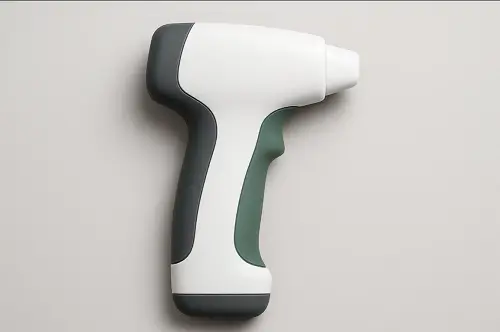
Is the bond between the overmolded layer and the substrate secure?
Bond strength primarily depends on material compatibility, surface energy, and interfacial structures (e.g., undercuts, grooves).
Common PC/ABS + TPE/TPU systems provide reliable bonding. Avoiding sharp thin edges in soft rubber areas reduces peel risk.
What are key design considerations for overmolding cosmetic parts?
Ensure uniform wall thickness and a draft angle of 1–3°. Position soft rubber termination edges in concealed areas whenever possible.
Include venting at flow termination points to prevent cosmetic defects like soft rubber flash or mold marks.
Can overmolded layer colors or materials be flexibly changed?
Yes. Overmolding is a separate secondary injection process, enabling seamless switching between multi-color or multi-material variants without requiring new tooling.
What are the mold development and production lead times?
Typical mold lead time is 3–5 weeks.
Following sample approval (T1), formal production can commence within 3–7 days.