
Injection mold steel selection affects far more than the first tooling quote. The steel used in a mold can influence mold life, tooling cost, surface finish, corrosion resistance, wear resistance, repair work, maintenance frequency, and long-term production stability.
For customers, mold steel can be confusing because the same plastic part may receive very different tooling quotes. One supplier may quote a P20 mold. Another may recommend 718, H13, S136, or NAK80. That price difference is not always just supplier margin. Steel choice changes machining time, polishing work, heat treatment, durability, repairability, and how well the mold handles the selected plastic resin.
There is no single best mold steel for every injection mold. A simple PP cover, a transparent PC lens, a glass-filled nylon bracket, a flame-retardant electrical housing, and a high-volume automotive part may all need different steel choices.
The right mold steel depends on plastic material, expected production volume, surface finish, mold life target, part geometry, corrosion risk, wear risk, and tooling budget.
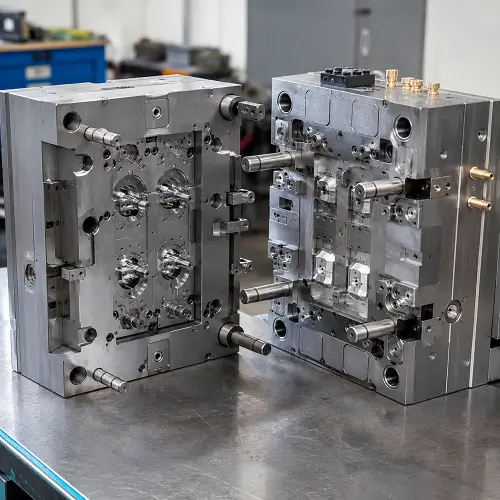
Quick Answer: How Do You Choose Injection Mold Steel?
Injection mold steel should be selected based on resin type, expected production volume, surface finish, mold life, part geometry, corrosion risk, wear risk, and tooling cost. P20 is often used for general-purpose molds. 718 is common for more stable production molds. H13 is used where wear resistance and durability matter. S136 is chosen for corrosion resistance and high polish. NAK80 is often used for cosmetic and precision molds that need good polishability and dimensional stability.
A mold running standard PP or ABS does not need the same steel as a mold running 30% glass-filled nylon. A low-volume prototype mold does not need the same steel package as a high-volume production mold. A transparent or high-gloss part may need better polishing steel than a hidden structural bracket.
Good mold steel selection is not about choosing the most expensive steel. The right steel is the one that matches the resin, part design, tool life target, surface requirement, and production plan.
What Is Injection Mold Steel?
Injection mold steel is the metal used to manufacture the core, cavity, inserts, slides, lifters, mold base plates, shutoff areas, and other tooling components in a plastic injection mold.
Different parts of the same mold may use different steel. The mold base may use one material, while the cavity insert may use a higher-grade steel for polishing or corrosion resistance. A gate insert or shutoff insert may use hardened steel because that area sees more wear. Slides and lifters may need wear-resistant contact surfaces or wear plates.
That is why mold steel selection is not only a material purchasing decision. It is part of mold design.
The steel must handle repeated clamping pressure, injection pressure, resin flow, cooling and heating cycles, polishing or texture requirements, corrosion risk, moving component wear, and future repair work.
A poor steel choice may not fail immediately, but problems can appear later as flash, corrosion, surface defects, dimensional drift, gate wear, shutoff wear, or extra maintenance.
Why Injection Mold Steel Selection Matters
Injection molds operate under pressure, heat, movement, and repeated cycles. The steel has to hold part geometry while resisting wear, corrosion, polishing damage, and repair problems.
A lower-cost steel can make sense for simple low-volume parts. But if that same steel is used for abrasive glass-filled resin or long-term production, the mold may wear too quickly. Gates may enlarge. Shutoffs may lose fit. Parting lines may flash. Cavity surfaces may scratch or corrode. Dimensions may drift after repeated cycles.
A higher-grade steel can improve durability, surface finish, and mold life, but it also increases tooling cost. If the project only needs a few thousand parts, the customer may not need the highest mold steel grade.
The best steel choice balances four things:
| Selection Factor | Why It Matters |
|---|---|
| Plastic material | Abrasive, corrosive, transparent, or high-temperature plastics require different steel choices |
| Production volume | Higher volume usually needs stronger steel and better wear control |
| Surface finish | Polished, textured, transparent, or cosmetic parts need suitable cavity steel |
| Tooling budget | Steel choice affects mold cost, machining time, heat treatment, polishing, and repair |
The goal is not to overbuild every mold. The goal is to avoid choosing steel that is too weak, too hard to maintain, or unsuitable for the resin and production plan.
Common Injection Mold Steel Grades
Common injection mold steel grades include P20, 718, H13, S136, and NAK80. These steels are not a simple low-to-high ranking. Each steel has a different role.
P20 may be practical for general-purpose molds. H13 may be better for wear and high-stress areas. S136 may be better for corrosion resistance and mirror polishing. NAK80 may be useful for cosmetic and precision surfaces. 718 may offer better stability and production performance than basic pre-hardened options in many production molds.
The right choice depends on the project.
P20 Mold Steel
P20 is one of the most common plastic injection mold steels. It is a pre-hardened mold steel used for many general-purpose molds, especially when the part does not require extreme wear resistance, high corrosion resistance, or mirror polishing.
P20 is popular because it has a practical balance of cost, machinability, toughness, and mold performance. It can be used for many standard plastic parts made from PP, PE, ABS, PS, and similar materials.
For low-volume and medium-volume production, P20 can be a reasonable steel choice when the resin is not highly abrasive and the part surface requirement is moderate.
P20 may not be the best choice for every project. If the mold runs glass-filled material, high-volume production, corrosive resin, or clear optical parts, another steel or local hardened inserts may be needed.
Typical use cases for P20 include general plastic housings, covers, enclosures, standard consumer plastic parts, medium-volume molds, cost-controlled production molds, and parts without extreme surface or wear requirements.
P20 is often selected when the customer needs a reliable mold but does not need a high-cost hardened production tool.
718 Mold Steel
718 mold steel is commonly used for plastic injection molds that need better performance than basic cost-driven mold steel. It is often treated as a stronger production option for molds that require good dimensional stability, better polishability, and longer service life than simpler tooling steels.
718 is often used for medium to higher production volumes, larger molds, and parts that need more stable molding performance. It can be a good choice when P20 may be too basic, but the project does not necessarily require H13 or stainless mold steel.
For many plastic injection molds, 718 offers a practical balance between tool life, machining, polishing, and cost.
Typical use cases for 718 include production molds, larger plastic molds, parts with moderate cosmetic requirements, molds requiring better stability than basic P20 tooling, medium-to-high volume plastic parts, and mold cores or cavities for general engineering plastics.
718 is not automatically better for every part. If the resin is highly abrasive, H13 or hardened inserts may be more suitable. If the material is corrosive or the part is transparent, S136 may be a better choice.
H13 Mold Steel
H13 is a hot-work tool steel known for heat resistance, toughness, and wear resistance. In injection molding, H13 is often used where the mold needs durability under repeated cycles, higher temperatures, abrasive resins, or high-stress contact.
H13 can be heat treated for stronger wear performance. It is often selected for high-volume production molds, glass-filled plastics, shutoff areas, slides, lifters, gate inserts, or mold areas that see repeated pressure and friction.
A mold does not always need to be made entirely from H13. In many cases, H13 may be used only in high-wear areas while other mold sections use different steel. This can control cost while protecting the areas that wear fastest.
Typical use cases for H13 include high-volume production molds, glass-filled plastic molds, gate inserts, shutoff inserts, slides, lifters, high-wear mold components, and molds exposed to higher molding temperatures or repeated stress.
H13 costs more than basic mold steel and may require more careful machining and heat treatment planning. It is usually chosen when durability matters more than the lowest initial tooling price.
S136 Mold Steel
S136 is a stainless mold steel commonly used when corrosion resistance, high polish, and clean cavity surfaces are important. It is often selected for transparent parts, optical parts, medical-related plastic parts, high-gloss cosmetic parts, and resins that may create corrosion risk.
S136 can take a high polish when processed properly. That makes S136 useful for clear PC, PMMA, transparent ABS, optical covers, lenses, light guides, and other appearance-sensitive plastic parts.
S136 is also useful when the resin or additive may attack normal mold steel. Some flame-retardant materials, PVC-type materials, or corrosive additives may require better corrosion resistance.
Typical use cases for S136 include transparent plastic parts, optical or light-transmitting components, medical-related plastic parts, high-gloss cosmetic parts, corrosive plastics or additives, molds requiring better rust resistance, and parts where cavity surface quality is critical.
S136 is not always needed for hidden structural parts. If the part has no high-gloss surface requirement and the resin is not corrosive, a less expensive steel may be enough.
NAK80 Mold Steel
NAK80 is a pre-hardened mold steel known for good polishability, stable machining, and suitability for cosmetic mold surfaces. It is often used for appearance parts, precision components, and molds that need good surface quality without extensive post-hardening work.
NAK80 can be useful when a part needs a clean surface finish, fine detail, or stable mold dimensions. It is often considered for electronic housings, cosmetic covers, precision plastic parts, and molds where polishing performance is important.
Typical use cases for NAK80 include cosmetic plastic parts, precision molded components, electronic housings, parts requiring good surface finish, molds with fine details, moderate-volume production molds, and parts where stable machining and polishability matter.
NAK80 is not a universal replacement for H13 or S136. If the mold needs stronger wear resistance against glass-filled resin, H13 or hardened inserts may be better. If the mold needs strong corrosion resistance for transparent or corrosive materials, S136 may be better.
Injection Mold Steel Comparison Table
| Mold Steel Grade | Main Strength | Typical Production Fit | Common Uses | Watch-Outs |
|---|---|---|---|---|
| P20 | Cost-effective, machinable, general-purpose | Low to medium production, often suitable for prototype, low-volume, or moderate production molds | Standard PP, PE, ABS parts, covers, housings, general plastic parts | Not ideal for heavy glass-filled materials, strong corrosion risk, or high-polish transparent parts |
| 718 | Better stability and production performance than basic mold steel | Medium to higher production, often used when better mold life and dimensional stability are needed | Larger molds, production molds, engineering plastic parts, better cosmetic molds | May still need hardened inserts for abrasive resins or high-wear shutoff areas |
| H13 | Wear resistance, toughness, heat resistance | High-volume production or high-wear mold areas, often suitable for long-life tooling when heat treated properly | Glass-filled plastics, gate inserts, shutoffs, slides, lifters, high-stress areas | Higher tooling cost, heat treatment planning, and machining control are needed |
| S136 | Corrosion resistance and high polish | Medium to high production where corrosion resistance, clean surface, or polish retention matters | Transparent parts, high-gloss parts, optical parts, medical-related parts, corrosive plastics | Higher cost; not always necessary for hidden structural parts |
| NAK80 | Good polishability and dimensional stability | Medium production, cosmetic parts, precision molds, appearance-focused tooling | Electronic housings, cosmetic covers, precision plastic parts, fine-detail molds | Not the best choice for heavy abrasion or strong corrosion risk |
Mold steel does not decide mold life by itself. A P20 mold running standard ABS may last longer than a poorly maintained H13 mold running abrasive glass-filled resin. Steel grade should be reviewed together with resin, expected production volume, part geometry, heat treatment, surface finish, and maintenance plan.
Does Mold Steel Decide How Long an Injection Mold Lasts?
Mold steel has a strong influence on mold life, but steel grade alone does not decide how many shots an injection mold can produce. A stronger steel can improve wear resistance, polish retention, corrosion resistance, and repair life, but actual mold life also depends on resin type, mold design, heat treatment, maintenance, molding pressure, and production conditions.
For example, P20 may work well for a low-volume ABS or PP part. H13 may be a better choice for glass-filled nylon, high-wear shutoffs, or long-run production. S136 may be selected for transparent parts or corrosive materials because surface quality and rust resistance matter. NAK80 may be useful when cosmetic finish and stable machining are more important than heavy abrasion resistance.
If the project has a clear mold life target, such as prototype tooling, low-volume production, or high-volume production, the steel should be selected together with the SPI mold class and expected part quantity. A mold intended for a few thousand parts does not need the same steel package as a mold expected to run for hundreds of thousands or millions of cycles.
Steel grade is only one part of injection mold life expectancy. Resin type, part geometry, heat treatment, maintenance, and production conditions also affect how long the mold can produce acceptable parts.
How to Choose Mold Steel by Plastic Material
The plastic material is one of the most important factors in mold steel selection. Different plastics create different wear, corrosion, polish, and maintenance requirements.
Standard PP, PE, ABS, and PS
Standard PP, PE, ABS, and PS are usually less abrasive than filled engineering plastics. For many parts made from these resins, P20 or 718 may be enough, depending on expected volume and surface requirements.
If the part is low volume and not cosmetic, a cost-controlled steel choice may be practical. If the part is medium or higher volume, or the mold needs more stability, 718 or a better steel package may be selected.
For these materials, steel selection often depends more on production volume, part size, tolerance, and surface finish than on resin wear.
Glass-Filled Plastics
Glass-filled plastics are abrasive. Common examples include glass-filled nylon, glass-filled PC, glass-filled PBT, and glass-filled PPS. Glass fibers can wear gates, runners, cavity surfaces, slides, lifters, shutoffs, and ejector areas.
For these materials, mold steel needs better wear resistance. H13, hardened inserts, wear-resistant gate inserts, or local surface treatments may be considered. A mold made from softer steel may run at first, but wear can appear later as gate enlargement, flash, rough surfaces, or dimensional drift.
When the part uses glass-filled resin, mold steel selection should not be based only on the lowest tooling cost.
Flame-Retardant Plastics
Flame-retardant plastics can create more gas, residue, or corrosive byproducts depending on the material grade. These resins may affect vents, cavity surfaces, gates, and polishing areas.
The mold may need better venting, easier cleaning access, corrosion-resistant steel, or surface treatment. S136 may be considered when corrosion or surface cleanliness is a major concern. For less demanding parts, other steel choices may still work if maintenance is well planned.
Corrosive Plastics
Some plastics and additives can attack mold steel. PVC and some flame-retardant or chemically aggressive materials may increase corrosion risk.
When corrosion is a concern, stainless mold steel such as S136 may be more suitable than standard P20. Corrosion can damage cavity finish, block vents, increase sticking, and reduce mold life.
Steel choice should also consider storage and maintenance. A corrosion-resistant steel helps, but poor cleaning or poor storage can still damage the mold.
Transparent and High-Gloss Plastics
Transparent and high-gloss plastics expose mold surface defects easily. A small scratch, rust spot, polishing mark, or EDM mismatch can show clearly on the molded part.
For clear PC, PMMA, transparent ABS, optical covers, lenses, and high-gloss cosmetic parts, S136 or NAK80 may be considered because polishing and cavity surface quality matter. The mold steel must support the required finish without frequent polishing damage or corrosion risk.
For transparent parts, mold steel is not only about mold life. The steel also affects appearance quality.
How Mold Steel Affects Mold Life
Mold steel has a direct effect on injection mold life. Harder, more wear-resistant, or corrosion-resistant steels can support longer production when matched correctly to the resin and mold design.
A mold running standard ABS may last well with a general-purpose steel. A mold running abrasive glass-filled nylon may wear quickly if the steel is too soft. A transparent part may reject molded parts because of surface scratches long before the mold stops opening and closing.
Steel affects mold life through gate wear, runner wear, cavity surface wear, shutoff wear, slide and lifter wear, parting line wear, corrosion resistance, polish retention, and repair frequency.
Mold life is not only the number of cycles before the tool breaks. It is the number of cycles the mold can produce acceptable plastic parts.
How Mold Steel Affects Tooling Cost
Mold steel affects tooling cost in several ways. Higher-grade steel usually costs more as raw material, but that is only part of the cost. Machining, heat treatment, polishing, grinding, EDM work, repair difficulty, and lead time can also change.
A lower-cost steel may reduce the initial mold quote. That can be the right decision for a prototype or low-volume project. But if the mold wears early, needs repeated repairs, or creates unstable parts, the long-term cost may become higher.
A higher-grade steel may increase the upfront mold cost, but it can reduce downtime, improve mold life, reduce wear, and support more stable production. This matters most when production volume is high or part quality requirements are strict.
The right tooling cost decision is not always the lowest mold price. It is the steel choice that fits the production plan.
How Mold Steel Affects Surface Finish and Polishing
Surface finish is one of the biggest reasons mold steel selection matters. The cavity surface becomes the plastic part surface. If the steel cannot polish well, hold texture well, or resist corrosion, the molded part may show defects.
For high-gloss or transparent parts, polishability is critical. S136 and NAK80 are often considered when a clean cavity surface is needed. P20 may be good enough for many standard parts, but may not be ideal for demanding optical or high-gloss surfaces.
Texture also depends on steel quality. A steel with poor consistency may not etch or texture evenly. That can create visible differences across the molded part.
For hidden structural parts, surface finish may not require premium steel. For cosmetic covers, lenses, medical-related covers, and display parts, steel choice becomes more important.
Mold Steel for Prototype, Low-Volume, and Production Molds
Mold steel should match the expected production stage.
Prototype Molds
Prototype molds are used for samples, testing, fit checks, and early design validation. The steel choice usually focuses on speed and cost control. Aluminum or lower-cost steel may be used depending on the part and material.
The goal is not long mold life. The goal is to make usable samples quickly and learn whether the design works.
Low-Volume Molds
Low-volume molds need better stability than prototype tools, but they may not need the highest production steel. P20 or similar steel may be enough for many low-volume projects if the resin is not abrasive and surface requirements are moderate.
If the material is glass-filled, corrosive, or cosmetic, local inserts or better cavity steel may still be needed.
Production Molds
Production molds need stronger steel planning because the tool will run repeatedly. 718, H13, S136, NAK80, or mixed-steel designs may be selected depending on material, surface finish, and mold life target.
A production mold often uses different steel in different mold areas. The cavity may need polishability. The gate insert may need wear resistance. Slides may need hardened wear surfaces. The mold base may use a practical structural steel.
High-Volume Molds
High-volume molds require long mold life, stable dimensions, easy maintenance, and wear resistance. H13, hardened steel, stainless mold steel, wear-resistant inserts, and better cooling design may be used depending on the part.
For high-volume molds, steel selection should happen early. A weak steel choice can create repeated maintenance problems later.
How to Match Mold Steel to Project Requirements
A simple low-volume PP part may not need premium steel. P20 may be enough when the part has moderate surface requirements, simple geometry, and limited production volume.
A glass-filled nylon bracket needs a different review. The mold may need H13, hardened inserts, or wear-resistant local components around gates, shutoffs, slides, and other high-contact areas.
A transparent PC or PMMA part needs clean cavity surfaces and strong polish retention. S136 may be more suitable when corrosion resistance, high polish, and surface cleanliness matter.
A cosmetic electronic housing may use NAK80, S136, or another polish-friendly steel depending on surface requirements, texture, expected volume, and part geometry.
A high-volume production mold should not be judged by steel grade alone. The full tooling package matters: steel, heat treatment, cooling design, ejector system, wear inserts, venting, maintenance access, and mold base strength.
Common Mistakes in Injection Mold Steel Selection
One common mistake is choosing steel only by price. A low-cost steel may save money upfront but create wear, corrosion, flash, or surface defects later.
Another mistake is choosing the most expensive steel for every mold. A low-volume PP part may not need premium hardened stainless steel. Overbuilding the tool can increase cost without real benefit.
A third mistake is ignoring the resin. Glass-filled materials, flame-retardant resins, transparent plastics, and corrosive materials all change the steel requirement.
A fourth mistake is treating the whole mold as if every area needs the same steel. Many molds use different steels or inserts in different areas. The cavity, core, slides, lifters, shutoffs, and gate inserts may not all need the same material.
A fifth mistake is separating steel choice from maintenance. Even good steel needs cleaning, lubrication, rust prevention, vent maintenance, and cooling channel care.
FAQ: Injection Mold Steel Selection
What is the best steel for injection molds?
There is no single best steel for all injection molds. P20 is common for general molds, H13 is useful for wear resistance, S136 is good for corrosion resistance and high polish, NAK80 is often used for cosmetic molds, and 718 is common for stable production tooling.
Is P20 good for injection molds?
Yes, P20 is widely used for general plastic injection molds. It is cost-effective, machinable, and suitable for many standard PP, PE, ABS, and PS parts. It may not be ideal for highly abrasive, corrosive, or high-polish applications.
When should H13 be used for injection molds?
H13 is often used when the mold needs better wear resistance, toughness, or heat resistance. It can be useful for glass-filled plastics, high-volume molds, gate inserts, shutoffs, slides, lifters, and other high-wear mold areas.
Why is S136 used for plastic injection molds?
S136 is used when corrosion resistance and high polish are important. It is often selected for transparent parts, high-gloss parts, medical-related plastic parts, optical parts, and plastics that may create corrosion risk.
Is NAK80 good for cosmetic plastic parts?
NAK80 can be a good choice for cosmetic plastic parts because it has good polishability and dimensional stability. It is often used for appearance parts, precision parts, and electronic housings.
Does mold steel decide mold life?
Mold steel strongly affects mold life, but it does not decide mold life alone. Resin type, part geometry, heat treatment, mold design, molding conditions, maintenance, and expected production volume all affect how long an injection mold can produce acceptable parts.
How does mold steel affect tooling cost?
Mold steel affects raw material cost, machining time, heat treatment, polishing, repair work, maintenance, and mold life. Higher-grade steel costs more upfront, but it may reduce wear, downtime, and long-term repair costs in production.
Conclusion
Injection mold steel selection should match the plastic material, production volume, mold life target, surface finish, part geometry, and tooling budget. P20, 718, H13, S136, and NAK80 are common injection mold steel grades, but they are not simple levels from cheap to expensive. Each steel has a different role.
P20 works well for many general-purpose molds. 718 is often used for more stable production tooling. H13 is suitable for wear-resistant and high-stress mold areas. S136 is useful for corrosion resistance and high-polish surfaces. NAK80 can be a practical choice for cosmetic and precision plastic parts.
For buyers, the key point is that steel choice affects more than the mold quote. Mold steel can affect mold life, maintenance, part quality, surface finish, production stability, and long-term cost. If your project needs injection mold making services or molded plastic part production, Upload your CAD files for DFM feedback, mold steel review, and an injection molding quotation.