
ABS is usually the better choice for cost-sensitive injection molded housings, covers, control panels, and appearance parts. It produces a good molded surface, is relatively easy to process, and works well with textures, painting, printing, and decorative finishes.
Polycarbonate is more suitable when a molded part needs greater impact resistance, better heat resistance, or transparency. Protective covers, clear inspection windows, lighting components, safety-related housings, and products exposed to repeated drops are common examples.
Both materials can produce reliable injection molded parts, but choosing PC simply because it is stronger may increase the material cost and molding difficulty without improving the product. An indoor equipment housing may perform well in ABS, while a transparent machine guard or drop-resistant handheld enclosure may justify polycarbonate.
When neither material alone provides the right balance, a PC/ABS blend may offer better impact and heat resistance than ABS while remaining easier to process than pure PC.
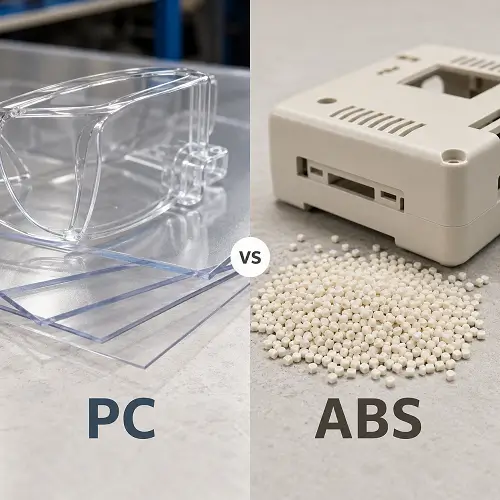
ABS vs Polycarbonate Comparison Chart
| Property | ABS | Polycarbonate |
|---|---|---|
| Impact resistance | Good for most housings and consumer products | Generally much higher |
| Stiffness | Good and grade-dependent | Good and grade-dependent |
| Heat resistance | Suitable for normal indoor products | Generally higher |
| Low-temperature toughness | Grade-dependent | Usually better |
| Transparency | Normally opaque | Clear grades are available |
| Molded appearance | Excellent for textured and cosmetic parts | Good, but clear parts require tighter control |
| Painting and plating | Common and relatively easy | Possible, but more process-sensitive |
| Scratch resistance | Moderate | Also scratches without a coating |
| Chemical resistance | Moderate and chemical-dependent | Can develop stress cracking with some chemicals |
| Typical density | About 1.03–1.07 g/cm³ | About 1.19–1.22 g/cm³ |
| Molding shrinkage | Relatively low | Relatively low |
| Drying control | Normally dried before molding | More sensitive to residual moisture |
| Processing temperature | Lower | Higher |
| Relative cost | Usually lower | Usually higher |
| Typical molded parts | Housings, covers, panels, knobs, bezels | Protective covers, clear parts, impact-resistant housings |
These are general differences between ABS and polycarbonate. High-impact ABS, flame-retardant ABS, optical PC, reinforced PC, and other modified grades may produce different results.
Which Is Better for Injection Molding: ABS or Polycarbonate?
ABS is normally the more practical starting point for a molded part that needs a good appearance, stable dimensions, adequate impact resistance, and a competitive production cost.
It is widely used for electronic housings, appliance covers, control panels, equipment enclosures, knobs, bezels, automotive interior parts, and consumer products. ABS also flows more easily than PC in many ordinary molds, helping it fill ribs, bosses, clips, lettering, and textured surfaces without extremely high processing temperatures.
Polycarbonate becomes the better option when impact failure is a real product risk. A handheld enclosure that must pass repeated drop tests, a protective machine cover, or a clear safety component may require the additional toughness of PC.
PC also performs better at elevated temperatures. However, it normally requires more careful drying, higher processing temperatures, suitable gate dimensions, and tighter control of residual stress.
The basic choice is:
Choose ABS for economical housings, cosmetic surfaces, easier molding, and secondary finishing. Choose polycarbonate for higher impact resistance, better heat resistance, and transparent structural parts.
This does not mean ABS is weak or that PC is always better. The material should match the actual loads and working environment of the finished product.
What Injection Molded Parts Are Suitable for ABS and Polycarbonate?
ABS is most suitable for molded products where appearance, cost, and normal everyday durability matter more than extreme impact performance.
Common ABS injection molded parts include:
| ABS Part | Why ABS Is Suitable |
|---|---|
| Electronic housings | Good surface appearance and sufficient everyday impact resistance |
| Appliance covers | Easy to texture, color, paint, or print |
| Control panels | Stable dimensions and clear molded details |
| Knobs and bezels | Good appearance and comfortable surface feel |
| Automotive interior trim | Suitable for decorative and functional interior components |
| Equipment enclosures | Lower cost than PC for normal indoor use |
| Consumer product shells | Supports complex shapes, clips, ribs, and bosses |
ABS is often enough for a router housing, office device cover, appliance panel, instrument enclosure, or indoor control box. Using PC for these parts may add cost without providing a useful performance improvement.
Polycarbonate is more appropriate when the molded part must resist stronger impacts, higher temperatures, or remain transparent.
| Polycarbonate Part | Why Polycarbonate Is Suitable |
|---|---|
| Transparent protective covers | Combines visibility with high impact resistance |
| Machine inspection windows | Allows viewing while protecting the operator or equipment |
| Drop-resistant handheld housings | Better resistance to sudden impact and cracking |
| Lighting covers and components | Clear grades and better heat performance |
| Electrical equipment housings | Useful where impact and temperature requirements are higher |
| Safety-related guards | Greater toughness than standard ABS |
| Transparent structural parts | Provides more impact resistance than acrylic in many applications |
A polycarbonate part is not automatically suitable for every transparent application. Clear components require an appropriate optical-grade resin, polished mold surfaces, good venting, clean material handling, and a gate position that limits visible flow marks and residual stress.
ABS vs Polycarbonate: Which Is Stronger?
Polycarbonate is generally stronger when the comparison refers to impact resistance and resistance to sudden breakage.
A PC component can normally absorb more impact energy before cracking than a similar standard ABS part. This is why PC is used for protective covers, guards, safety components, and products that must survive repeated drops.
ABS still provides enough toughness for many molded housings. An indoor control panel or appliance cover does not normally experience the same impact load as a machine guard or handheld device. In these cases, ABS may provide the required durability at a lower production cost.
Strength also depends on the geometry of the part. A PC component can still crack when it contains sharp internal corners, highly stressed screw bosses, thin snap fits, deep notches, or excessive molded-in stress.
Likewise, a properly designed ABS housing with smooth transitions, suitable wall thickness, and reinforced mounting features may perform reliably throughout the expected product life.
For customers comparing polycarbonate vs ABS, the useful question is not simply which material is stronger. The real question is whether the product needs the additional impact performance of PC.
ABS vs Polycarbonate Heat Resistance
Polycarbonate generally provides better heat resistance than ABS. It is more suitable for parts installed close to lighting systems, heat-producing electronics, motors, machinery, or other elevated-temperature environments.
ABS still works well for many indoor electronics, household appliances, control panels, and equipment housings. Its thermal performance only becomes a concern when the product must remain stiff under higher temperatures or continuous mechanical load.
A higher material processing temperature does not represent the safe working temperature of the finished part. Heat-deflection temperature, applied load, exposure time, ventilation, and the exact resin grade must also be considered.
Flame resistance is another grade-specific requirement. Standard ABS and standard PC should not automatically be treated as flame-retardant materials. Electrical products requiring a particular flammability rating must use a tested resin grade with the required documentation.
For a normal indoor enclosure, ABS may already provide enough thermal performance. PC or PC/ABS becomes more relevant when the housing is close to a heat source or must retain impact resistance at a higher temperature.
ABS vs Polycarbonate Surface Finish and Transparency
ABS is often selected for visible product housings because it produces a consistent molded surface and accepts textures, colors, paint, printing, and plating.
It is commonly used for appliance shells, control panels, consumer electronics, dashboard components, handles, knobs, and covers. Molded textures can hide minor scratches and flow marks while giving the product a more uniform appearance.
Polycarbonate can also produce a high-quality surface, but transparent PC parts are more demanding. Mold polish, gate position, flow length, weld lines, drying, venting, contamination, and residual stress can all affect clarity.
A mold designed for textured ABS will not produce a clear PC component simply by changing the resin. Transparent PC normally requires polished cavity surfaces, an appropriate clear grade, clean handling, and a gate design that reduces visible defects.
Polycarbonate is highly impact resistant, but it is not naturally scratch-proof. Clear guards, lenses, and display covers may need a hard coating when long-term abrasion resistance is important.
For an opaque appearance housing, ABS is normally easier and more economical. PC should be selected when transparency, impact resistance, or heat performance creates a clear product advantage.
ABS vs Polycarbonate Chemical and Outdoor Resistance
Neither ABS nor polycarbonate is resistant to every chemical.
ABS can tolerate water, dilute acids, and some household cleaning products, but oils, fuels, alcohols, solvents, and aggressive cleaners may cause discoloration, swelling, softening, or cracking.
Polycarbonate is vulnerable to environmental stress cracking when certain chemicals contact a part that is already under mechanical or molded-in stress. Cracking may develop around screw bosses, snap fits, press-fit features, or sharp corners after assembly.
This means a cleaning agent that appears harmless during a short material test may still damage a PC housing after repeated exposure.
Standard ABS also has limited outdoor weathering performance. Long-term sunlight can cause color fading, surface degradation, and loss of impact strength unless a UV-stabilized grade or protective coating is used.
Polycarbonate may yellow or lose clarity outdoors without suitable UV stabilization. Outdoor products should therefore use a grade designed for weather exposure rather than relying only on the general polymer name.
ABS vs Polycarbonate Weight and Density
Polycarbonate is normally heavier than ABS for the same molded volume.
Typical unfilled ABS grades have a density of approximately 1.03–1.07 g/cm³, while unfilled PC is commonly around 1.19–1.22 g/cm³.
For two parts using the same CAD geometry, the PC version will usually consume more resin by weight. This can affect material cost and shipping weight across high-volume production.
Part weight can be estimated by multiplying the solid CAD volume by the value in a plastic density chart. The exact grade datasheet should still be used for the final quotation because fillers, flame retardants, impact modifiers, and glass fiber can change the density.
A lighter ABS part is not automatically better. PC may allow a design to survive a required impact test without adding thick walls or large reinforcing ribs. The complete part design should be considered rather than comparing density alone.
ABS vs Polycarbonate Injection Molding Differences
ABS and polycarbonate are both amorphous polymers. They generally provide lower molding shrinkage and more predictable dimensional behavior than semi-crystalline plastics such as PP and PE.
However, the two materials do not use the same molding conditions.
Drying ABS and Polycarbonate
ABS is normally dried before molding because moisture can produce splay, bubbles, surface defects, and inconsistent cosmetic results.
Polycarbonate requires stricter moisture control. Processing wet PC at a high melt temperature can break down the polymer chains and reduce impact performance. A molded part may look acceptable while becoming more brittle than expected.
The dryer temperature, drying time, dew point, hopper condition, and time between drying and molding all need to follow the material supplier’s instructions.
Processing Temperature and Flow
ABS generally processes at a lower temperature and fills ordinary product geometries more easily. It is well suited to housings containing ribs, bosses, clips, molded lettering, and textured surfaces.
Polycarbonate normally requires a higher melt temperature and greater injection pressure, particularly in thin-wall parts or cavities with long flow paths.
An undersized gate may fill ABS without difficulty but create excessive shear or incomplete filling with PC. The molding machine, nozzle, hot runner, heaters, and temperature controls must also be compatible with the selected PC grade.
Gates and Residual Stress
Polycarbonate is more sensitive to residual stress around gates, sharp corners, screw bosses, snap fits, and press-fit features.
A very small gate can create high shear and leave stress near the gate area. Sharp internal corners concentrate the load and increase the risk of cracking during assembly or chemical exposure.
Suitable radii, balanced filling, good venting, and controlled packing help reduce these problems.
ABS is more forgiving in many ordinary housings, but poor gate placement or unbalanced filling can still produce weld lines, sink marks, distortion, and weak clips.
Wall Thickness and Cooling
Consistent wall thickness helps ABS and PC fill, pack, and cool more evenly.
Thick screw bosses, rib intersections, and sudden changes in section can remain hot longer than the surrounding walls. This may produce sink marks, internal stress, longer cycle times, or warpage.
For PC, unnecessary thick sections also increase cooling time and can make residual stress harder to control. A thinner, uniform structure supported by ribs is often better than adding solid material around every load-bearing feature.
Which Has Lower Injection Molding Shrinkage?
ABS and polycarbonate both have relatively low injection molding shrinkage, and their typical ranges may overlap.
The final result depends on the exact resin grade, filler content, melt temperature, mold temperature, packing pressure, gate freeze time, cooling balance, and flow direction.
A mold built for one ABS grade should not automatically use the same cavity allowance when the material changes to PC. Even a small dimensional difference may affect screw-hole locations, snap-fit engagement, flatness, sealing surfaces, and assembly clearance.
Glass-filled ABS or PC can show lower average shrinkage, but the fiber orientation may cause different shrinkage along and across the flow direction. This can produce twisting or flatness problems even when the average shrinkage value appears low.
Use the selected commercial resin’s processing data before finalizing the cavity dimensions. A generic ABS or PC value is useful during early material comparison but is not enough for final mold manufacturing.
ABS vs Polycarbonate Cost
ABS normally costs less than polycarbonate and is generally easier to process. This makes it attractive for high-volume housings, panels, covers, and cosmetic parts that do not require extreme impact or heat resistance.
Polycarbonate can increase the molded-part cost through a higher resin price, stricter drying, higher processing temperatures, and more demanding process control.
Clear PC components may also have a higher rejection rate because black specks, splay, scratches, flow marks, and other cosmetic defects are easier to see.
The additional cost is justified when PC prevents cracking, heat distortion, or product failure. A protective guard or drop-resistant enclosure should not be changed to ABS only to reduce the resin price.
Final cost also depends on part weight, wall thickness, machine size, cavity count, cooling time, inspection requirements, surface quality, scrap rate, and production volume.
When Should PC/ABS Be Used?
PC/ABS is useful when standard ABS does not provide enough heat or impact resistance, but pure polycarbonate is more expensive or difficult to process than the product requires.
A suitable PC/ABS grade can offer:
- better impact resistance than standard ABS;
- better heat performance than standard ABS;
- good molded appearance;
- easier flow and processing than many pure PC grades;
- better dimensional control for structural appearance parts.
PC/ABS is widely used for automotive interior components, electronic housings, instrument panels, control equipment, computer parts, and structural covers.
The blend is normally opaque, so it is not a replacement for clear polycarbonate.
PC/ABS is also not one fixed formulation. Different ratios, flame-retardant systems, impact modifiers, and fillers produce different shrinkage, stiffness, heat resistance, and processing requirements.
Can an ABS Mold Be Used for Polycarbonate?
An existing ABS mold may be able to run polycarbonate, but the material should not be changed without checking the mold and finished-part requirements.
PC runs at a higher processing temperature, so the molding machine, nozzle, hot-runner system, heaters, seals, and temperature controls must be suitable.
The flow path and gate also need to be reviewed. A gate that fills ABS easily may be too restrictive for PC, especially in a long or thin part.
Shrinkage differences can move critical dimensions outside tolerance. Filling the cavity successfully does not prove that the finished PC part will match the original ABS component.
The part design may also create new problems. Sharp corners, highly stressed bosses, thin snap fits, and press-fit features may crack because PC reacts differently to molded-in and assembly stress.
Transparent PC adds another limitation. A textured ABS mold with visible machining marks and an ordinary gate will not automatically produce an optically clear component.
Some molds can change from ABS to PC after a controlled material trial. Other projects require a larger gate, improved venting, cavity correction, design changes, or a switch to PC/ABS.
How to Choose Between ABS, Polycarbonate, and PC/ABS
Choose ABS for ordinary housings, appliance covers, control panels, knobs, bezels, and other cosmetic parts where cost, surface quality, and ease of molding are important. It is usually enough for indoor products that experience normal handling rather than severe drops or high temperatures.
Choose polycarbonate for transparent protective parts, machine guards, high-impact housings, lighting components, and products exposed to stronger impact or moderately higher temperatures.
Choose PC/ABS when the product needs more impact and heat resistance than ABS but does not require the transparency or full performance of pure PC. This is often a suitable choice for strong electronic housings, automotive interiors, and equipment covers.
Before selecting the resin, define the actual product requirements: drop height, working temperature, chemical exposure, transparency, surface finish, flammability, assembly stress, tolerances, and annual quantity.
The material should be selected before the mold shrinkage allowance, gate size, cooling design, and cavity dimensions are finalized.
Conclusion
ABS is usually the better material for economical injection molded housings, cosmetic covers, control panels, appliance parts, and components requiring texture, paint, printing, or decorative finishing.
Polycarbonate is more suitable for transparent protective covers, machine guards, high-impact housings, lighting parts, and components that must retain performance at higher temperatures.
PC/ABS fills the gap between them when a product needs better toughness and heat resistance than ABS but does not require clear polycarbonate.
Choosing the material before tooling helps prevent later problems with filling, shrinkage, dimensions, cracking, surface quality, and production cost. JeekMould can review your ABS, PC, or PC/ABS grade together with the part geometry, wall thickness, tolerances, appearance requirements, assembly method, and expected production volume.