
Polycarbonate is usually selected for transparent injection molded parts that may be dropped, struck, exposed to heat, or used as protective components. Acrylic, also known as PMMA, is generally a better fit when the part needs high optical clarity, a glass-like appearance, better surface hardness, and a lower material cost.
A machine guard, impact-resistant transparent housing, or protective equipment cover will normally favor polycarbonate. A display window, indicator lens, light guide, or decorative transparent cover may achieve a better appearance with acrylic without requiring the additional toughness of PC.
The decision should begin with how the finished part will be used—not with which resin appears to have the better overall specification sheet. Impact, transparency, scratching, working temperature, outdoor exposure, cleaning chemicals, assembly stress, and optical requirements can all change the answer.
For customers comparing acrylic vs polycarbonate, the simplest distinction is:
Choose polycarbonate when the transparent part must resist impact or perform a protective function. Choose acrylic when clarity, surface appearance, and light transmission matter more than impact strength.
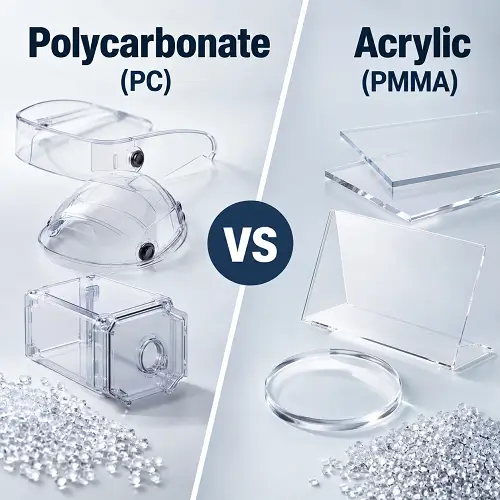
Polycarbonate or Acrylic? Start with the Part Requirement
The correct material becomes easier to identify when the part requirements are considered first.
| Your Injection Molded Part Needs | Better Starting Material | Why |
|---|---|---|
| Resistance to drops or strong impact | Polycarbonate | Higher impact toughness |
| A safety or protective function | Polycarbonate | Lower risk of sudden breakage |
| Better performance near a heat source | Polycarbonate | Generally better heat resistance |
| A transparent structural component | Polycarbonate | Better suited to mechanical loading |
| High clarity and a glass-like appearance | Acrylic | Strong optical appearance |
| Better resistance to light surface scratching | Acrylic | Generally harder surface |
| A display, indicator, or decorative function | Acrylic | Appearance is more important than toughness |
| Long-term outdoor visual appearance | Acrylic or UV-stabilized PC | Depends on impact and weathering requirements |
| Lower material and molding cost | Acrylic | Often more economical |
| A clear part with both impact and optical requirements | Grade-specific PC or PMMA | Final choice requires part testing |
This table provides a starting point rather than a final resin specification. Optical PC, UV-stabilized PC, impact-modified PMMA, heat-resistant PMMA, coated grades, and other formulations can behave differently from standard materials.
When Polycarbonate Is the Better Choice
Polycarbonate is the stronger candidate when a transparent molded part must do more than provide visibility.
A machine guard, protective cover, clear electrical enclosure, or safety window may be hit during normal use. Even when the impact is unlikely, the consequences of sudden breakage can justify selecting PC instead of acrylic.
Transparent handheld housings and exposed equipment covers also benefit from polycarbonate when the product must survive drops, knocks, or assembly loads. A decorative window may only need to remain clear, but a transparent housing secured by screws or snap fits must also tolerate concentrated stress around its mounting features.
Heat can move the decision toward PC as well. Transparent parts installed near lighting systems, power supplies, motors, electronics, or industrial equipment may need to retain their shape and mechanical performance at temperatures where standard PMMA becomes less suitable.
Typical polycarbonate injection molded parts include:
- transparent machine guards and safety covers;
- protective equipment windows;
- clear electrical and electronic housings;
- impact-resistant handheld product components;
- transparent structural covers;
- lighting parts exposed to higher temperatures;
- clear components secured by screws or mechanical fasteners.
Polycarbonate combines transparency with impact and heat performance, but the exact result remains grade-dependent. PC resin families include optical, UV-stabilized, flame-retardant, high-flow, coated, and impact-modified options designed for different service conditions.
PC is not automatically necessary for every clear part. Using it for a low-load indoor display window may increase resin cost, drying requirements, processing temperature, and molding difficulty without creating a meaningful product advantage.
When Acrylic Is the Better Choice
Acrylic is often preferred when the customer will judge the part primarily by how it looks.
Clear PMMA can produce a bright, glass-like appearance that works well for display windows, decorative covers, lighting components, indicator lenses, and products where visual quality is more important than maximum impact resistance.
Surface appearance is another reason to consider acrylic. Uncoated PMMA generally has a harder surface than uncoated PC and may retain its appearance better under light handling and cleaning. This is useful for transparent components that are viewed closely but are unlikely to receive a strong impact.
Typical acrylic injection molded parts include:
- display and control-panel windows;
- indicator lenses;
- light guides;
- decorative transparent covers;
- indoor lighting components;
- cosmetic packaging covers;
- transparent appliance details;
- clear parts where color and optical appearance are important.
Acrylic is especially suitable when the product is used indoors, mechanical loading is limited, and the main requirements are clarity, gloss, color, and surface quality. JeekMould’s acrylic molding guide also identifies transparent covers, display windows, light guides, lighting lenses, and cosmetic parts as common PMMA molding applications.
Acrylic should not be treated as a direct lower-cost substitute for PC in a protective component. A part may look clearer in PMMA but fail a drop, impact, or stressed-assembly requirement that the original polycarbonate part could withstand.
Which Is Stronger, Acrylic or Polycarbonate?
Polycarbonate is stronger when the comparison refers to impact resistance and resistance to sudden breakage.
A PC component can normally absorb greater impact before cracking. Acrylic has a harder surface, but it is more brittle and more sensitive to notches, concentrated loads, and sudden impacts.
This distinction is important because surface hardness and impact toughness describe different types of performance.
Acrylic may resist light scratching better during ordinary handling. The same acrylic component may still crack when dropped onto a hard surface. Polycarbonate may survive the drop but show visible surface scratches afterward.
Part geometry can be just as important as the polymer. Sharp internal corners, thin sections around holes, highly stressed snap fits, press-fit features, and poorly designed screw bosses can weaken either material.
A PC part with excessive molded-in stress may develop delayed cracks after assembly or chemical exposure. A PMMA display window with smooth radii, uniform walls, and low assembly stress may remain reliable for many years.
For a machine guard or protective cover, impact performance normally has priority and polycarbonate is the safer starting point. For a display lens or decorative clear cover, acrylic’s surface appearance may provide greater value.
Acrylic Glass vs Polycarbonate: Clarity, Scratches, and Outdoor Appearance
Acrylic is also known as PMMA or acrylic glass. Searches for Plexiglass vs polycarbonate, Plexiglass acrylic vs polycarbonate, or acrylic glass vs polycarbonate generally refer to the same basic comparison between PMMA and PC.
Clarity and Optical Appearance
Acrylic normally provides the better glass-like appearance. A well-designed and correctly molded PMMA part can achieve high clarity, strong light transmission, and a bright polished surface.
Polycarbonate can also produce clear parts, but the final appearance may be more affected by flow marks, scratches, contamination, residual stress, and molding conditions.
The resin alone does not determine optical quality. A transparent polymer will copy the condition of the cavity surface. Machining marks, EDM texture, scratches, rust, poor polishing, and contamination may all become visible on the finished part.
Gate position and flow direction matter as well. A visible gate mark, weld line, jetting pattern, or flow line across a display window may cause the part to be rejected even when its dimensions are correct.
Acrylic is therefore often the better choice for display windows, light guides, indicator lenses, and decorative clear parts. Polycarbonate is preferred when the part must remain transparent while providing impact protection.
Scratch Resistance
Uncoated acrylic generally provides better resistance to light surface scratching than uncoated polycarbonate.
This does not mean acrylic is more durable under every condition. A light abrasive contact may leave a mark on PC while having less effect on PMMA, but a stronger impact may crack the acrylic part while the polycarbonate remains intact.
A clear PC component can receive a hard coating when both impact resistance and long-term abrasion resistance are required. The coating adds another production step and should be included in the cost and quality plan.
Cleaning methods should also be considered. Rough cloths, abrasive particles, and unsuitable cleaners can damage either material, particularly when the surface must remain optically clear.
Outdoor Appearance
Acrylic generally has strong natural weathering and UV performance, making it a common starting point for outdoor lighting, lenses, signage components, and decorative parts where long-term clarity matters. Official PLEXIGLAS product information also highlights transparency, UV protection, weather resistance, and long-term optical quality as key PMMA characteristics.
Standard PC may yellow or lose surface quality during extended UV exposure unless the selected grade includes suitable stabilization or protection. UV-stabilized and coated PC grades are available when the outdoor part still requires polycarbonate’s impact resistance.
An outdoor protective cover may therefore use UV-stabilized PC, while an outdoor decorative lens with limited impact exposure may favor PMMA. The outdoor environment does not automatically determine the material; impact risk and long-term visual appearance must be evaluated together.
Heat, Cleaning Chemicals, and Assembly Stress
A transparent part often experiences several stresses at the same time. Heat, cleaners, adhesives, screws, clips, and molded-in stress should therefore be considered together rather than as isolated material properties.
Polycarbonate generally provides better heat resistance. It is more suitable for transparent components positioned close to lighting systems, electronic assemblies, machinery, or other heat sources.
Acrylic works well in many indoor lighting, display, and decorative applications, but the grade must still be checked when the part is exposed to elevated temperatures or carries a load.
The molding temperature of a resin should not be confused with the safe working temperature of the final part. A molded component may soften, creep, or distort under load well before the material reaches its processing temperature.
Chemical contact can create a different problem. Polycarbonate may develop environmental stress cracks when certain cleaners, solvents, oils, or adhesives reach an area already stressed by screws, clips, press fits, or the molding process.
Acrylic can also craze, whiten, soften, or crack after contact with unsuitable alcohols, solvents, adhesives, or cleaning agents. Small surface lines may appear before the damage develops into a visible crack.
A short material test on an unloaded sample may not reproduce what happens in the assembled product. A transparent housing secured tightly by screws can react differently from a flat resin plaque exposed to the same cleaner.
Projects involving repeated disinfection, automotive fluids, industrial chemicals, adhesives, or aggressive cleaners should be tested using the actual resin grade, molded geometry, assembly method, and exposure conditions.
What Changes During Polycarbonate and Acrylic Injection Molding?
PC and PMMA are both amorphous polymers. They generally show lower and more uniform molding shrinkage than semi-crystalline materials such as PP and PE, but transparent parts introduce stricter cosmetic and process requirements.
The question is not simply whether both materials can fill an injection mold. The selected resin changes material preparation, melt temperature, gate design, mold finish, stress control, cooling, and the acceptable defect level.
Drying and Melt Flow
Polycarbonate requires strict moisture control. Processing wet PC at a high melt temperature can degrade the polymer and reduce the impact performance of the molded part.
The component may still appear visually acceptable, which makes moisture-related degradation difficult to identify through appearance alone. Drying temperature, drying time, dew point, hopper condition, and material exposure after drying should follow the resin supplier’s instructions.
PMMA also requires appropriate drying. Residual moisture or surface contamination can create silver streaks, bubbles, haze, and inconsistent clarity.
PC normally runs at a higher melt temperature and may be more difficult to fill through a small gate, thin wall, or long flow path. A gate that works for acrylic is not automatically suitable for polycarbonate.
Excessive shear near a restricted gate may produce stress, discoloration, visible flow marks, or inconsistent mechanical performance. Increasing pressure alone is not always the correct solution; gate size, melt temperature, mold temperature, flow length, venting, and wall thickness should be reviewed together.
Mold Finish, Gates, and Residual Stress
Transparent molded parts reproduce the cavity surface in detail. An ordinary polished surface that is acceptable for an opaque housing may still show machining lines, waviness, haze, or distortion in a clear component.
Acrylic display windows and light guides may require optical polishing and carefully controlled surface geometry. Clear PC guards also need a clean, well-finished cavity so users can see through the part without unacceptable distortion.
Gate location should be selected with both appearance and stress in mind. A gate placed in the main viewing area can leave a visible mark, while melt flowing around holes or openings may create weld lines across the transparent surface.
A small gate may also create excessive shear. This is especially important for PC because molded-in stress around the gate can combine with chemicals or assembly pressure and lead to delayed cracking.
PMMA is more brittle and can crack around holes, corners, threads, and fasteners when local stress is too high. Radii, mounting clearances, and controlled screw torque matter for both materials.
Uniform wall thickness helps the cavity fill, pack, and cool more evenly. Sudden transitions can create flow hesitation, optical distortion, shrinkage differences, and internal stress. Thick clear sections also need more cooling time and may show different optical behavior from surrounding walls.
Ribs and screw bosses should support the part without creating visible sink marks on the opposite surface. These defects are much harder to hide on a clear cover than on a painted or textured housing.
The selected grade’s injection molding shrinkage data must be confirmed before final cavity dimensions are approved. PC and PMMA are both relatively low-shrink materials, but a small grade-to-grade difference can still affect hole positions, flatness, snap engagement, sealing surfaces, and optical alignment.
Can the Same Mold Run Polycarbonate and Acrylic?
The same mold may be able to produce parts in PC and PMMA, but successful filling does not prove that the replacement material is acceptable.
The two materials use different processing temperatures and may not flow through the gate and cavity in the same way. A gate sized for PMMA may create excessive restriction or stress when the mold is changed to PC.
The molding machine, nozzle, heaters, hot-runner system, seals, temperature controllers, and mold cooling must also be compatible with the processing requirements of the replacement grade.
Finished dimensions may change even when both materials have relatively low shrinkage. A small dimensional shift can affect screw-hole locations, lens alignment, snap fits, sealing areas, and assembly clearances.
Changing from PC to acrylic may improve clarity, surface hardness, and material cost, but it can reduce impact resistance and tolerance to assembly stress. Screw bosses, clips, mounting holes, and press-fit areas that work in PC may crack when molded in PMMA.
Changing from acrylic to PC may improve impact and heat performance, but filling can become more difficult. Higher temperature, greater injection pressure, gate modification, improved venting, or changes to the packing process may be required.
The mold surface creates another limitation. A textured cavity, visible machining marks, or a gate positioned in the viewing area will not produce an optical-quality part simply because clear resin is injected.
Filling the cavity successfully does not prove that the replacement material will meet the original dimensions, clarity, assembly strength, or impact requirement.
A controlled material trial may show that the existing mold can run both materials after process adjustment. Other projects need a larger gate, better venting, cavity corrections, design changes, or a different resin grade.
How Much Does the Material Choice Affect Cost?
Acrylic is often less expensive than polycarbonate, but resin price is only one part of the cost of a clear injection molded component.
PC generally requires stricter drying, higher processing temperatures, and more demanding filling conditions. A thin or long-flow PC part may need a larger gate, greater injection pressure, or a molding machine with more suitable processing capability.
Transparent parts also create cosmetic costs that do not appear in the price per kilogram. Black specks, bubbles, silver streaks, haze, scratches, flow lines, gate marks, and contamination can cause rejection even when the dimensions meet the drawing.
Packaging may need to prevent scratching during storage and transportation. Optical parts may require more inspection, cleaner handling, or protective films than ordinary opaque molded components.
Acrylic can provide a lower total cost for display windows, indicator lenses, light guides, and decorative covers where severe impact is unlikely.
Polycarbonate may provide better lifetime value for a guard, protective housing, or drop-resistant component because it reduces the risk of cracking, warranty claims, replacement, or safety failure.
The correct question is therefore not simply whether acrylic is cheaper than polycarbonate. The customer should compare the cost of producing a part that meets the real performance requirement.
Choose the Material Before the Mold Is Finalized
Material selection should happen before the mold shrinkage allowance, gate size, cooling layout, cavity finish, and critical dimensions are finalized.
Begin with the impact requirement. A machine guard, exposed cover, handheld housing, or safety-related component that may be struck or dropped should normally begin with polycarbonate.
Next, consider what users expect to see through the part. Acrylic is often the stronger choice for a display window, light guide, decorative lens, or transparent cover where brightness, clarity, and surface appearance matter most.
Working temperature may move the project toward PC. Long-term outdoor appearance may favor PMMA, although UV-stabilized polycarbonate should be considered when impact resistance remains essential.
Cleaning products, adhesives, lubricants, and other chemicals must be identified before production. The same applies to screws, snap fits, press fits, and continuous assembly loads that can create local stress.
The optical requirement should also be defined clearly. “Transparent” may mean that the user only needs to see whether a component is moving, or it may require low haze, controlled distortion, high gloss, uniform light transmission, and no visible flow lines.
Only after these requirements are understood should material and production cost determine the final choice.
A useful project decision is:
- use polycarbonate for impact-resistant, protective, heat-exposed, or structurally loaded transparent parts;
- use acrylic for appearance-focused, optical, decorative, and lightly loaded transparent parts;
- use the exact grade—not only the general material name—to confirm flow, UV stability, heat resistance, impact performance, and molding shrinkage.
Conclusion
Polycarbonate and acrylic can both produce transparent injection molded parts, but they solve different product problems.
Polycarbonate is usually the better choice for machine guards, protective covers, clear electrical housings, drop-resistant components, safety parts, and transparent structures exposed to impact, heat, or mechanical loading.
Acrylic is generally more suitable for display windows, light guides, indicator lenses, decorative covers, cosmetic components, and indoor lighting parts where clarity, surface appearance, and scratch resistance matter more than maximum toughness.
Changing between PC and PMMA can affect filling, gate design, residual stress, optical quality, dimensions, assembly strength, and production cost. The material should therefore be selected before the mold design and cavity dimensions are finalized.
JeekMould can review the selected PC or PMMA grade together with your part geometry, transparency requirements, wall thickness, tolerances, assembly method, working environment, surface expectations, and production quantity before tooling begins.