
Automotive injection molding is used to make plastic car parts that need repeatable shape, stable fit, molded details, and reliable production quality. The process is common for interior trim, exterior covers, clips, brackets, connector housings, lighting parts, ducts, caps, panels, and many other automotive plastic components.
For most buyers, the goal is not to study the injection molding process in detail. The goal is simpler: confirm whether the plastic part can be molded, understand what affects material choice and mold cost, and find a supplier that can review the CAD file before tooling starts.
Plastic injection molding for automotive parts works well when the part needs built-in features such as ribs, bosses, mounting holes, clips, texture, or assembly details. A good molded part is not just about shape. The part also needs to fit into the vehicle, hold up during use, and meet the appearance or performance requirement for its location.
In the market, these projects may be described as automotive injection molding, automotive plastic molding, injection molded automotive parts, or injection moulding automotive parts. The wording changes, but the manufacturing need is usually the same: reliable molded plastic parts for vehicle assemblies.
What Is Automotive Injection Molding?
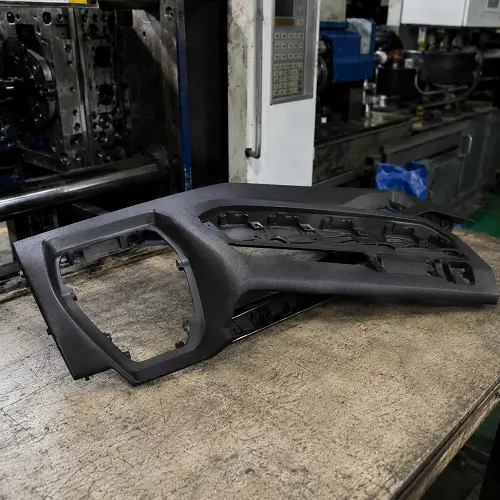
Automotive injection molding is the process of melting plastic resin and injecting the material into a metal mold to form car parts and vehicle components. After the plastic cools, the mold opens and the finished part is ejected.
The same process can make a small clip, a connector housing, a dashboard trim, a sensor cover, a bracket, a cap, or a larger interior panel. The mold creates the part shape and also forms many details directly into the plastic, including screw bosses, ribs, snap fits, holes, textures, logos, and mounting features.
This is why injection molding is widely used for plastic parts in automotive products. A molded part can be designed to assemble with other parts, hide fasteners, reduce weight, and repeat the same shape over many production cycles.
Automotive injection molding is not the same as making a simple plastic product. A car part often has to work inside a larger assembly. The part may need to resist heat, stay stable under vibration, match a surface texture, hold screws, clip into another part, or survive outdoor exposure.
A trim cover and an under-hood bracket are both automotive plastic parts, but the mold design and material choice will not be the same.
Why Automotive Parts Use Injection Molding
Automotive parts use injection molding because the process can combine shape, function, and production repeatability. Once the mold is built correctly, the same part can be produced again and again with stable dimensions.
Plastic also gives designers more freedom than many metal processes. A molded car part can include mounting points, curved surfaces, clip features, thin walls, stiffening ribs, and decorative surfaces in one piece. This helps reduce secondary operations and can simplify assembly.
Weight reduction is another reason plastic is used in vehicles. Plastic cannot replace metal in every area, but it works well for covers, housings, ducts, trims, brackets, caps, connectors, and support parts. When the material is chosen correctly, a plastic part can reduce weight while still meeting the function of the component.
Injection molding also gives customers many material choices. PP, ABS, PC/ABS, nylon, PBT, POM, TPE, TPU, and glass-filled materials are all used in automotive plastic molding. The right material depends on where the part sits in the vehicle and what the part needs to do.
For production volume, injection molding can also make cost sense. The mold requires upfront investment, but the part price becomes more practical when the same component is produced in repeated batches.
Common Injection Molded Automotive Parts
Automotive injection molded parts are easier to understand when they are grouped by vehicle area.
Interior parts usually focus on appearance, touch, color, texture, and fit. Dashboard trim, console covers, air vents, seat components, speaker grilles, switch housings, storage covers, and decorative panels all need clean surfaces. A small flow mark, gloss mismatch, or poor texture can become a quality problem even when the basic shape is correct.
Exterior parts need stronger environmental performance. Mirror housings, grille pieces, sensor covers, protective covers, trim parts, and wheel arch components may face sunlight, rain, heat, cold, road dirt, and impact. These parts often need UV resistance, weather resistance, and stable appearance over time.
Functional and under-hood parts have a different priority. Brackets, covers, air ducts, fan shrouds, battery-related parts, cable supports, and engine-area components need heat resistance, strength, and dimensional stability. These parts are less about appearance and more about function.
Electrical parts such as connector housings, terminal blocks, sensor housings, relay cases, wire clips, and protective covers need stable dimensions and reliable assembly. Material selection matters because these parts may need insulation, heat resistance, flame resistance, or tight fit with terminals and seals.
Truck injection molding follows the same basic logic, but parts for commercial vehicles can be larger or more demanding in some applications. Truck interior panels, exterior covers, ducts, brackets, and functional plastic components may require larger tools, stronger materials, or more careful part review.
Materials Used for Automotive Plastic Parts
Material selection is one of the most important parts of automotive plastic injection molding. The material should match the part location, function, and expected use.
| Material | Common Automotive Use | What Customers Should Know |
|---|---|---|
| PP | Interior trim, covers, ducts, panels | Lightweight and cost-friendly |
| ABS | Interior covers, trim parts, housings | Good surface appearance |
| PC/ABS | Stronger covers and housings | Better toughness than ABS |
| PA / Nylon | Brackets, clips, under-hood parts | Stronger and more heat-resistant |
| Glass-filled PA | Structural brackets, engine-area parts | Higher stiffness, but more warpage risk |
| PBT | Connectors, electrical housings | Good for electrical and dimensional stability |
| POM | Gears, clips, sliding parts | Good wear resistance |
| TPE / TPU | Soft-touch or flexible areas | Used for grip, seals, and flexible covers |
This table is only a starting point. A material that works well for an interior trim may not work for a hot engine-area bracket. A resin that looks good on a visible cover may not be strong enough for a clip or mounting point.
Interior parts often use PP, ABS, or PC/ABS because appearance, cost, and fit matter. Exterior parts may need materials with better UV and weather resistance. Under-hood parts often require nylon, glass-filled nylon, PBT, or other engineering materials because heat and vibration become more important.
Connector housings and electrical parts often need PBT, PA, or other resins with stable dimensions and good insulation. Soft-touch areas may use TPE or TPU when flexibility or grip matters.
A good automotive plastic parts manufacturer should not choose resin only from the part name. The supplier needs to understand where the part is used, how the part assembles, and what risk the part may face during service.
Where Automotive Injection Molding Becomes Difficult
Automotive injection molding becomes difficult when a part needs both appearance and function. Many vehicle parts are not simple plastic covers. They need to assemble correctly, look clean, resist stress, and stay stable over time.
Interior parts often fail for appearance reasons before strength becomes the issue. Sink marks, flow lines, texture mismatch, color variation, gloss difference, and visible parting lines can all affect customer approval. A part may fit properly but still be rejected if the surface looks wrong.
Exterior parts bring outdoor risk. Sunlight, rain, temperature changes, and road exposure can affect the material and finish. A plastic cover that looks fine indoors may fade, crack, or lose surface quality if the material is not chosen for outdoor use.
Under-hood parts need more attention to heat and vibration. A bracket or cover near the engine area may need stronger resin and better dimensional stability. If the material is too weak or the design creates stress, the part may crack, deform, or loosen during use.
Assembly features are another common problem. Clips, screw bosses, snap fits, mounting holes, and thin ribs can fail if the geometry is too weak or the material is too brittle. A molded part may look fine after production, then crack during assembly because the stress was never reviewed in the design.
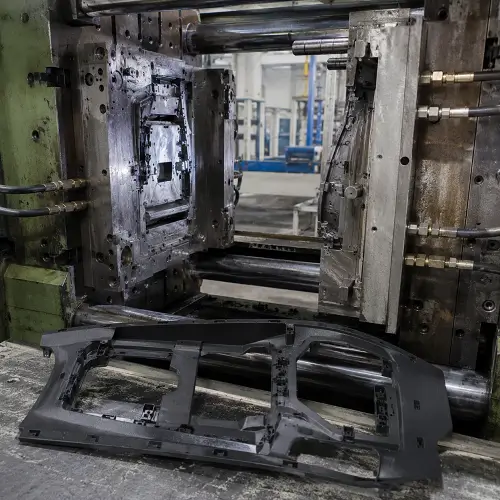
Large automotive parts can also warp. Long trim pieces, panels, covers, and ducts are more sensitive to wall thickness, gate location, cooling, and material shrinkage. Warpage is one of the most common reasons a plastic automotive part fails to assemble cleanly.
Key Design Points for Automotive Plastic Parts
Customers do not need to know every molding parameter, but a few design points can prevent expensive tooling changes.
Wall thickness should stay as even as possible. Sudden thick areas can create sink marks, longer cooling time, and warpage. Very thin areas may be hard to fill. A good part design keeps the wall more balanced so the plastic can flow and cool more evenly.
Ribs and bosses need careful attention. Ribs can make a part stronger, but oversized ribs may leave sink marks on the visible side. Screw bosses need enough strength for assembly, but too much material around the boss can cause shrinkage and stress.
Clips and snap fits should be reviewed early. Automotive parts often rely on snap assembly, but clips can break if the material is not flexible enough or the geometry is too aggressive. A clip that works in one material may fail in another.
Visible surfaces should be clearly marked before tooling. For interior trims, covers, bezels, and decorative parts, the factory needs to know which side the customer will see. This affects gate location, parting line, ejector pin layout, and texture direction.
Tight fit areas should be shown in a 2D drawing if possible. CAD geometry shows the shape, but a drawing shows which dimensions are truly important. This is especially useful for connector housings, clips, mounting holes, mating surfaces, and parts that must fit into a larger assembly.
The best time to catch these issues is before the automotive plastic mold is cut. Changing CAD early is much cheaper than changing steel after a mold trial.
Automotive Plastic Mold Considerations
An automotive plastic mold is more than a tool for making the part shape. The mold affects surface appearance, assembly fit, cycle time, and production repeatability.
Gate location is one of the first mold decisions. A gate mark on a hidden surface may be fine. A gate mark on a visible trim face may cause rejection. Gate location also affects flow direction, weld lines, packing, and warpage.
Ejector pin placement also matters. Ejector marks should not appear on important cosmetic surfaces. Thin ribs, deep bosses, and complex clips can also make ejection harder if the part does not have proper draft.
Slides and lifters may be needed when a part has undercuts, side holes, clip features, or complex geometry. These mold actions can increase the cost of auto parts molds, but they may be necessary to make the part correctly.
Cooling is important for stable production. Poor cooling can cause warpage, long cycle time, and inconsistent part dimensions. Larger automotive molds or automobile mold projects usually need more careful cooling design because the part may have long flow paths or large flat surfaces.
Texture and surface finish should be planned before mold making. A textured part may need more draft. A high-gloss surface may need better polishing. A painted or plated part may need material and surface preparation that supports the secondary process.
This is why automotive molds and automotive moulds should be reviewed around part function, not only part shape.
What Makes a Good Automotive Injection Molding Supplier?
A good automotive injection molding supplier does more than run a molding machine. The supplier should be able to look at the CAD file and identify risks before tooling begins.
For automotive plastic components, early review matters because mold changes can be expensive. A small issue in wall thickness, boss design, clip design, or gate location can become a larger cost after the mold is already built.
A capable supplier should understand visible surfaces. Interior and exterior plastic parts often need clean texture, stable color, and controlled surface quality. The mold design should avoid placing obvious gate marks, ejector marks, weld lines, or parting lines on key cosmetic areas.
Material advice is also important. A customer may know the part is for a vehicle, but may not know whether PP, ABS, PC/ABS, nylon, PBT, or another resin is better. The supplier should help compare material choices based on heat, load, appearance, assembly, and environment.
A good supplier should also understand production repeatability. A first sample may look acceptable, but the process must stay stable during repeated production. Material changes, mold wear, cooling imbalance, and unstable processing can all affect long-term quality.
For customers comparing automotive injection molding suppliers, the lowest mold price is not always the safest choice. A lower-cost tool can become expensive if the part warps, cracks, shows poor surface quality, or fails during assembly.
Cost Factors in Automotive Injection Molding
Automotive injection molding cost depends on more than part size. Material, mold complexity, surface finish, tolerance, quantity, and inspection requirements all affect pricing.
A simple PP cover may be relatively straightforward. A glass-filled nylon bracket with tight mounting points and heat requirements will cost more. A visible interior trim part with texture, color control, and strict cosmetic requirements may also need more tooling and process work.
Material choice can change both part cost and molding difficulty. Engineering resins, glass-filled grades, UV-stabilized materials, and flame-retardant grades usually cost more than general-purpose plastics.
Mold complexity also affects cost. Slides, lifters, inserts, deep ribs, thin walls, undercuts, textured surfaces, large part size, and high production volume can all increase tooling cost. A simple open-and-shut mold is different from a mold with multiple side actions and cosmetic surface requirements.
Surface finish can change the cost as well. A hidden bracket does not need the same finish control as a visible interior trim. If a part needs texture, gloss control, color matching, painting, or plating, the mold and production plan should account for that.
The best quote comes from reviewing the CAD file, drawing, material requirement, visible surfaces, quantity, and assembly conditions together. Without those details, the price can only be a rough estimate.
What to Send for an Automotive Injection Molding Quote
A useful quote needs more than the words “auto part” or “plastic cover.” The supplier needs to understand where the part is used and what the part must do.
For a practical review, send:
- CAD file
- 2D drawing if available
- expected quantity
- target material or performance requirement
- part location in the vehicle
- visible cosmetic surfaces
- surface texture or finish requirement
- color requirement
- critical dimensions
- assembly method
- screw, clip, snap-fit, or insert details
- heat, UV, chemical, or vibration exposure
- inspection or testing requirements
The part location is especially important. Interior trim, exterior cover, under-hood bracket, electrical housing, lighting component, and truck plastic part may all require different material and mold decisions.
If the design is still early, sending the CAD file before tooling can save cost later. A short moldability review can identify wall thickness issues, warpage risks, sink marks, gate location problems, material concerns, and visible surface risks before the mold is built.
JeekMould can review automotive plastic parts, plastic car parts, molded housings, brackets, clips, covers, connectors, and other injection molded plastic auto parts before quoting. This helps customers choose the right material and mold plan before committing to tooling.
Conclusion
Automotive injection molding is used to make plastic car parts that need repeatable shape, stable fit, molded details, and production consistency. It is common for interior trim, exterior covers, clips, brackets, connector housings, lighting parts, ducts, caps, and many other automotive plastic components.
The process is not only about making plastic parts lighter or cheaper. A good automotive molded part needs the right material, part design, surface control, mold structure, and production plan. Interior parts often focus on appearance and fit. Exterior parts need weather resistance. Under-hood parts need heat and strength. Electrical parts need dimensional stability and insulation.
For customers developing automotive plastic components, the most useful step is to review the CAD file before tooling begins. This can help identify material risks, warpage risks, assembly issues, visible surface concerns, and mold cost factors early.
JeekMould can review CAD files, drawings, material requirements, visible surfaces, and expected production quantities for automotive injection molded parts. If the part design is suitable for injection molding, the mold and process can be planned around appearance, function, and repeatable production quality.
Upload your CAD file to request a factory quote for automotive injection molded parts before committing to tooling.