
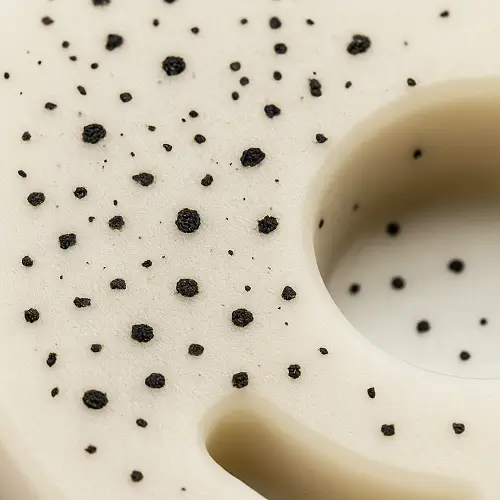
Anyone who has spent time around injection molding equipment has probably seen a part come out of the mold with small black specks embedded on the surface. Sometimes they show up during startup, sometimes after a long stretch of steady production. Whatever timing they choose, these specks usually point toward the same underlying issue: something in the upstream material path or thermal environment is not as clean or as stable as it should be. Many operators refer to them as black dots or black spots, but in molding they fall into a broader category—surface contamination. In injection molding terminology, black specks are considered a contamination-type injection molding defect, often showing up together with other melt-related defects such as burn marks or splay streaking when the thermal or material conditions drift out of range. Once black specks begin recurring in the same cavity, most molders discover they do not go away on their own.
What Are Black Specks in Injection Molding?
How Black Specks Form
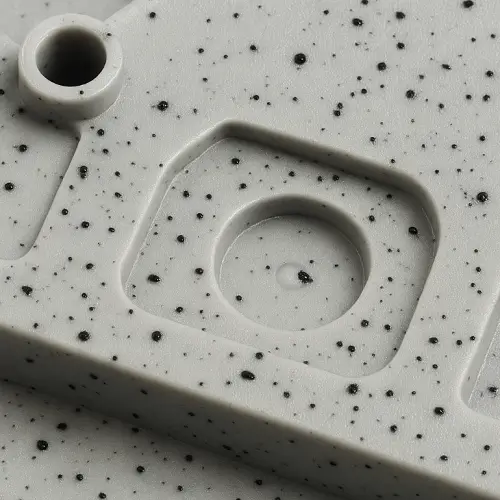
A black speck is essentially a foreign particle—degraded polymer, char from overheated additives, small metal fragments, or airborne dust—that becomes embedded in the melt stream. When a particle looks “baked in,” it usually means it carbonized long before the melt front reached it. High-temperature materials such as PC or PC/ABS blends expose the defect quickly because even a slight thermal spike can carbonize residual resin. If the melt stays in a dead zone or the screw’s rotation does not refresh isolated areas inside the barrel, specks often begin appearing faster than expected. Anyone who has molded heat-sensitive materials has likely seen how a small thermal drift can produce black specks long before the first warning sign appears on the controller.
Why They Are Considered Contamination
In molding practice, contamination refers to anything in the polymer that does not belong there. If you scratch the speck and it smears, the issue often relates to overheated polymer or additive residue. If the particle feels gritty or sharp, metal wear or external debris becomes more likely. That simple difference can help point you toward the right system to inspect. And if both behaviors appear in the same batch, contamination is likely entering from more than one location.
Common Sources of Black Specks in Injection Molding
Material Degradation Inside the Barrel
Many molders have seen a part exit the tool with a burnt flake that seems to have traveled through the entire screw. When material is not purged completely or when the compression zone holds on to degraded residue, carbonized material eventually breaks loose and enters the melt stream. This becomes more noticeable when the screw has worn flights, when the check ring seals inconsistently, or when a machine idles with high rear-zone temperatures. If specks begin to appear immediately after startup or after pauses in production, that’s often the first sign that certain barrel zones are running hotter than intended, even if the setpoints appear normal.
Residual Contamination From Previous Materials
If you switch from a dark resin to a light one and suddenly begin seeing dark specks, leftover material from the previous run is usually the culprit. Even a small amount of dark resin lodged in the check ring or in a low-flow pocket can break loose intermittently. Purging helps, but if residue is physically stuck inside a blind zone, no amount of quick purging will remove it entirely.
Dust, Airborne Debris, and Material Handling Issues
When loaders, hoppers, or dryers stay open—even briefly—airborne dust or fine particles can contaminate the resin. When specks appear randomly across multiple cavities with no consistent pattern, environmental contamination becomes a likely root cause. Transparent materials show this especially clearly, since even tiny foreign particles scatter light and become immediately visible.
Hot-Runner and Gate Region Carbonization
When the same cavity continues producing black specks, the gate region is worth inspecting. A slightly overheated manifold zone, a failing thermocouple, or an improperly tuned heater band can carbonize resin just upstream of the gate. Once carbon forms, it cracks into small flakes that detach intermittently. If you notice specks appearing every few cycles rather than every shot, the gate-area thermal pocket is often the explanation. This type of carbonization can also accompany burn marks, especially when the gate region traps overheated melt just long enough to degrade.
How Black Specks Affect Part Quality
You’ve likely seen how strict cosmetic criteria can be, especially on glossy ABS or PC housings. Even a speck that is barely noticeable in normal light becomes obvious under inspection lighting. Transparent PC or PMMA parts amplify this effect—one speck can disrupt the optical path or create localized haze. On structural components, a contaminant embedded in a thin section can behave as a stress riser, particularly on living hinges, thin-walled clips, or mounting ribs where polymer continuity is critical. In some cases, black specks appear alongside flow lines or splay streaks, especially when unstable melt behavior influences both the flow path and the material quality.
How to Eliminate Black Specks in Injection Molding
Stabilizing the Barrel and Temperature Profile
If black specks appear after the machine idles or during periods of long residence time, the first place to investigate is the temperature profile. A zone that “should” be stable can drift or overshoot by several degrees, especially on older equipment. Logging actual versus setpoint temperatures often reveals drift that is not obvious on the controller. Lowering rear-zone temperatures slightly or rebalancing the heat profile often stabilizes the melt enough to prevent carbonization.
Inspecting the Screw and Check Ring
When purging reduces specks only temporarily, residue may be lodged deep inside the screw flights or around the check ring. Once a carbon layer forms, ordinary purging cannot fully remove it. A screw pull is sometimes necessary, particularly when specks reappear after just one or two clean cycles. If carbon builds up in these regions, it tends to break loose in thin flakes that behave just like the surface specks you see on molded parts.
Cleaning Raw Material Handling Systems
If the specks look granular, mineral-like, or appear across multiple cavities without correlation to machine settings, contamination is likely coming from the material path. Open hoppers, dusty dryers, or unsealed material bags allow airborne particles to enter the system. Dust contamination does not smear and does not respond to barrel adjustments—its behavior makes it relatively easy to differentiate from degraded resin.
Verifying Hot-Runner Balancing and Temperature
When a specific cavity repeatedly produces specks, heat imbalance inside the manifold or gate insert is often the root cause. Resin that overheats in a manifold pocket carbonizes slowly, then flakes away as the melt front cycles. Even a 5–10°C adjustment can shift the thermal balance enough to stop the residue from forming. Uneven heating in these areas can also create weld-line variations, especially when the hot-runner design forces multiple flow fronts to converge under inconsistent temperature profiles.
Purging With the Correct Method
Not all purging is equal. If purging moves material but fails to dislodge residue, a purge compound formulated for high-temperature resins may be required. Back-pressure adjustments often make the largest difference. Purging at low back pressure tends to push material through without lifting residues off metal surfaces. Applying higher back pressure in short bursts typically provides more effective mechanical scrubbing.
When Black Specks Are Difficult to Avoid
Certain materials—flame-retardant ABS, recycled blends, heavily filled compounds, or high-temperature polymers—produce fines or residue more readily. For these resins, even a well-maintained system can show specks during long production cycles. In such cases, the goal shifts from total elimination to reducing frequency by controlling thermal stability, optimizing material refresh rates, and minimizing dwell time in hot zones.
Engineering Recommendations for Reducing Black Specks
If the same cavity continues producing contamination, two questions often identify the source quickly:
Is the material overdrying or sitting in the barrel longer than intended?
Is the gate or manifold pocket running slightly hotter than the surrounding system?
Most persistent speck issues eventually trace back to these two factors. Maintaining a stable thermal window, avoiding excessive residence time, and checking screw and check-ring wear patterns usually provide the most reliable long-term results. Black specks are part of the broader group of injection molding defects, and they frequently appear alongside other thermal-instability symptoms such as burn marks, discoloration, or splay.
Conclusion
Black specks reveal instability somewhere in the molding system—thermal imbalance, material degradation, or contamination introduced during handling. Once you understand where they originate and why they appear under specific conditions, preventing them becomes far more straightforward. Stable temperature control, clean material paths, proper purging, and balanced hot-runner behavior eliminate most contamination sources before they reach the molded part. If the same cavity consistently shows specks after machine idle periods or during long cycles, the true source is often already present—the operating conditions are simply making it visible.
Ready to Eliminate Contamination and Achieve Clean Surfaces?
If black specks keep returning in the same cavity, or if material degradation and residue buildup continue affecting part quality, our team can review the process, identify the thermal or mechanical source, and recommend a stable corrective path. Consistent purge routines, controlled residence time, and clean material handling make a measurable difference in long-run stability—especially for heat-sensitive resins.
If you need support with troubleshooting, purging guidance, or screw and barrel cleaning strategies, our engineering team is available to help you evaluate the tool and the process conditions behind the contamination.
[Click Here to Get a Free Consultation & Quote]