
Choosing between a family mold and a multi-cavity mold looks straightforward until the part geometry, annual demand, and purchasing goals start pulling in different directions. On paper, both options can improve molding efficiency. In production, they solve very different problems. A family mold reduces tooling count by putting several related parts into one mold. A multi-cavity mold increases output by molding the same part several times in one cycle. Those are not small differences. They affect cost, process balance, inventory control, maintenance planning, and the amount of production risk built into the tool before the first shot is even run.
That is why the real question is not whether a family mold is better than a multi-cavity mold in general. The real question is which one fits the part set, the demand pattern, and the business goal behind the project. Some programs benefit from family molds because the parts are used together and the annual volume is still moderate. Other programs should never use a family mold because the parts fill differently, shrink differently, or are not consumed in equal quantities. In those cases, saving tooling cost at the beginning often creates bigger molding and supply problems later.
For customers evaluating tooling strategy, the decision usually comes down to a few practical concerns. How much annual volume is expected? Do the parts really need to be produced in equal quantities? Will the parts fill evenly in one mold? Is the project trying to reduce upfront tooling cost, or is the bigger priority long-term production stability? That is where the comparison actually starts to matter.
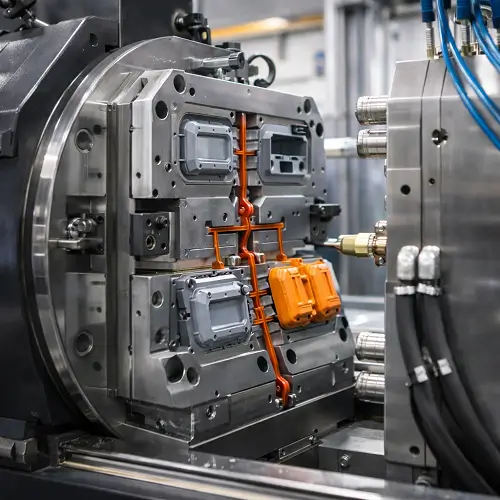
What Is a Family Mold?
A family mold is an injection mold built to produce two or more different parts in the same molding cycle. The parts are usually related to the same product, assembly, or package. A common example would be a housing top and bottom, a lid and base, or several small parts that are always intended to go together.
The attraction is obvious. Instead of paying for separate molds for each part, the project combines them into one tool. That can reduce initial tooling cost, simplify early sampling, and help move a moderate-volume project forward without too much upfront mold investment. In the right situation, that is a practical and defensible strategy.
The problem is that a family mold does not become a balanced production tool just because the parts belong to the same assembly. Different parts often have different wall thicknesses, flow lengths, gate needs, projected areas, and shrink behavior. Once those differences grow too large, the family mold becomes more difficult to run consistently. One part may fill well while another is close to short shot. One may need more hold pressure while another starts to flash. One may hold dimension while another moves around. That is where the savings at the quotation stage can begin to disappear in production.
What Is a Multi-Cavity Mold?
A multi-cavity mold produces multiple copies of the same part in one cycle. If the tool has four cavities, it makes four identical parts per shot. If it has eight cavities, it makes eight identical parts per shot. The purpose is not to combine different geometries. The purpose is to increase output of a single part efficiently.
This is the standard approach when annual demand is high enough to justify a higher-output tool. Multi-cavity molds are common in packaging, closures, consumer components, medical disposables, and many other high-volume injection molding applications. Because every cavity is producing the same geometry, balancing the tool is usually more straightforward than in a family mold. The filling pattern, cooling demand, and packing behavior are easier to control when the part is repeated.
That does not mean a multi-cavity mold is automatically simple. Poor runner balance, unequal cooling, or cavity-to-cavity variation can still cause problems. But the basic molding problem is cleaner. The mold is repeating one known result multiple times, not trying to manage several different molding behaviors in the same cycle.
Family Mold vs Multi-Cavity Mold: Key Differences
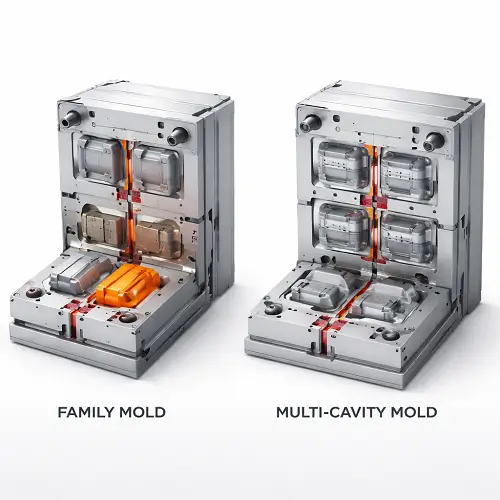
The simplest difference is easy to state, but the production consequences go much further than the definition. A family mold makes different parts in the same shot. A multi-cavity mold makes the same part multiple times in the same shot. That single distinction affects almost everything else.
A family mold is usually selected to reduce tooling count and lower initial mold investment for related parts. A multi-cavity mold is usually selected to increase output and improve long-run efficiency for one part number. One is about tooling consolidation. The other is about production scale.
The cost picture is different too. A family mold often looks more attractive at the beginning because one tool can replace several molds. A multi-cavity mold often costs more up front, but that cost can make much more sense when demand is high and stable. Process behavior is different as well. A family mold usually carries more risk because the parts do not always fill, pack, and cool the same way. A multi-cavity mold is generally easier to balance because every cavity is producing the same geometry.
Inventory behavior is another major difference. A family mold forces a linked quantity relationship between parts. Every cycle produces the whole set, whether or not the real demand still matches that ratio. A multi-cavity mold gives cleaner control because output is tied to one part only.
The best way to summarize the difference is this: a family mold is often useful when related parts truly belong together in moderate production, while a multi-cavity mold is usually the stronger choice when one part needs stable, repeatable, high-volume output.
A Simple Comparison Table
| Factor | Family Mold | Multi-Cavity Mold |
|---|---|---|
| Parts produced per cycle | Different related parts | Same part repeated |
| Main reason to choose it | Lower tooling count | Higher output efficiency |
| Upfront tooling cost | Often lower than separate molds | Often higher than single-cavity tooling |
| Balance risk | Higher if parts mold differently | Usually lower because cavities are identical |
| Inventory flexibility | Lower when part demand changes | Higher for single-part production control |
| Best fit | Related parts, moderate volume | High-volume production of one part |
This table does not replace DFM review, but it helps show why these molds should not be judged by tool price alone.
Cost Comparison: Upfront Tooling Cost vs Long-Term Production Cost
This is where many customers focus first, and for understandable reasons. Tooling cost is visible immediately. A family mold often looks attractive because one mold can replace several separate tools. If the parts are related and the project is still in a lower-volume stage, that can be a real advantage.
But tooling cost is only the first layer of the decision. Once production starts, the mold has to run. If the family mold is difficult to balance, requires a narrow process window, or produces one good part and one marginal part in the same cycle, the early tooling savings can start disappearing. One cavity may be close to short shot while another is already packed hard. One part may hold dimension while another is still drifting. The mold becomes cheaper to buy and more expensive to live with.
This is where customers sometimes get surprised. The quote made sense. The mold technically runs. But one part in the family always seems to need more attention than the others, and the process never feels as stable as expected. That is not unusual. It is one of the most common ways family molds lose value after the initial decision has already been made.
A multi-cavity mold may require more investment at the start, but the long-term cost picture can be much stronger if the part demand is high and stable. Higher output per cycle, more consistent repeatability, and cleaner production planning often justify the higher initial spend.
The better cost question is not which mold is cheaper. The better question is which mold gives the better total cost for the real production plan.
Production Volume and Demand Planning
Volume is one of the clearest decision points between these mold types.
A family mold often makes sense when the parts are genuinely consumed together and the annual volume is still moderate. If each assembly needs one of each molded part, and the volume is not high enough to justify dedicated tools for everything, a family mold can be efficient.
The problem appears when demand ratios stop matching. Many assemblies do not consume replacement parts equally. Some parts become service items. Some are revised earlier than others. Some are forecast at different rates. A family mold cannot react well to that situation because every cycle still produces the whole part family. One carton fills up with excess pieces while another part is still short.
A multi-cavity mold is usually more effective when demand is high, steady, and focused on one part number. It supports cleaner scheduling and stronger long-term volume control because the tool is dedicated to one production stream.
This is one of the most practical reasons multi-cavity molds often win in established production. The output is not tied to a forced quantity relationship between different parts.
Filling Balance and Process Risk
This is where family molds become much more project-sensitive.
When several different parts share one mold, they rarely fill in exactly the same way unless they are very close in size, wall section, and flow behavior. If one cavity contains a long thin part and another contains a compact heavy part, process balance becomes more difficult immediately. Runner design, gate sizing, pressure drop, and packing behavior all have to be managed across different geometries.
In real molding, this is where family mold risk starts to show itself. One part may be dimensionally stable while another stays more variable. One may be well packed while another hovers near short shot. The mold may still run, but the process window becomes tighter and less forgiving.
This often shows up in trial in a very familiar way. The tool comes up and one part already looks good enough to approve. Another part in the same family still needs pressure, gate, or fill adjustments. That is the moment when customers start seeing what a family mold really asks from the process. The mold may be workable, but it is no longer simple.
A multi-cavity mold is usually easier to balance because all cavities are producing the same geometry. If imbalance exists, it is still a real problem, but it is a more familiar and more controllable one. The mold designer is not trying to satisfy different molding behaviors in the same cycle.
That is why family molds work best when the parts are similar, not merely related.
When a Family Mold Makes Sense
A family mold can be a smart option when several molded parts always belong to the same product set, the annual volume is moderate, and the parts are close enough in molding behavior to run together without excessive compromise.
This often works well in early launch stages, lower-volume production, or assemblies where matched output is genuinely useful. It can also make sense when reducing tooling count is more valuable than maximizing output efficiency. A family mold may shorten development timing, simplify early trials, and reduce the number of tools that need to be purchased.
It is also useful when the project needs practical flexibility at moderate volume and the parts have a real assembly relationship. In those situations, the family mold is not just a cheaper tool. It is a deliberate tooling strategy.
But the family mold only stays valuable when the parts are good neighbors in the mold. If they fill, cool, and shrink too differently, the tool becomes harder to justify.
When a Multi-Cavity Mold Is the Better Choice
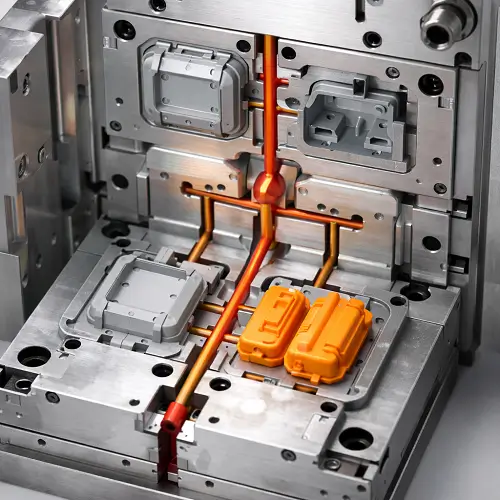
A multi-cavity mold is usually the stronger option when one part is needed in high volume, demand is stable, and production efficiency matters more than tooling consolidation.
This is especially true when the project needs repeatability, scheduling simplicity, and higher output from each machine hour. A dedicated multi-cavity mold is usually easier to validate, easier to monitor, and easier to scale for long production runs than a family mold carrying mixed geometry.
It is also the better choice when the parts in question are not consumed in equal quantities. That alone rules out many family mold ideas that look attractive too early in quotation discussions. If the output ratio does not match the real usage ratio, the mold will keep producing the wrong inventory mix.
A multi-cavity mold also tends to be easier to verify and control over time. When one part is repeated across cavities, cavity-to-cavity comparison becomes cleaner. That makes process monitoring, troubleshooting, and long-run production management more straightforward than in a mixed-geometry family mold.
In other words, a multi-cavity mold is often the better business tool when the program is mature enough to know what demand and production planning really look like.
Where Single-Cavity Molds Still Fit
Single-cavity molds are not the main subject of this comparison, but they still belong in the decision process. A single-cavity mold can be the right answer when the volume is low, the part is still changing, or the project wants the simplest possible tooling route before scaling up.
This matters because some programs jump too quickly into family mold or multi-cavity discussions before the product is even stable. A single-cavity mold may actually be the smarter starting point if design changes are still likely or if the true demand is not known yet. It is often the cleaner way to validate geometry, process behavior, and basic part function before committing to more aggressive tooling.
That does not mean single-cavity tooling is better than family or multi-cavity tooling in general. It means mold strategy should match program maturity. Some parts need scale immediately. Others need flexibility first.
How to Choose the Right Mold Layout for Your Project
The best mold layout usually becomes clear when the project is looked at honestly instead of optimistically.
If the parts belong to the same assembly, are needed in similar quantities, and mold in a reasonably similar way, a family mold can make sense. This is especially true when volume is moderate and reducing tooling count has real value.
If one part has steady high-volume demand, repeatability matters, and inventory control needs to stay clean, a multi-cavity mold is usually the better choice. In that situation, output efficiency and process stability matter more than combining tools.
If the design is still moving, the demand is not proven, or the safest step is to validate one part first, a single-cavity mold may be the smarter starting point. That is not a step backward. In many real programs, it is the most disciplined way to avoid paying for the wrong production tool too early.
If the answer still feels unclear, that usually means the project needs DFM review rather than a quick purchasing shortcut. Related parts are not automatically family mold candidates, and high-volume parts are not automatically ready for any arbitrary cavity count. The right answer depends on part similarity, demand pattern, and actual molding behavior.
Common Mistakes When Choosing Between Them
The first mistake is choosing a family mold only because the initial tool quote is lower. That can be shortsighted if the parts do not process well together or if the demand ratio does not stay matched in real production.
The second mistake is assuming all related parts belong in one mold. Assembly relationship alone is not enough. The parts also need to be compatible in molding behavior.
The third mistake is ignoring future demand flexibility. A family mold ties several parts together. That becomes a problem when one part changes design, one part becomes a service item, or one part is needed in a very different quantity.
The fourth mistake is overestimating process balance in a family mold. Some family molds run well, but they need thoughtful mold design and compatible part geometry. It is risky to assume balance will solve itself later.
The fifth mistake is thinking a multi-cavity mold is always too expensive. In some projects, the higher upfront cost is exactly the right choice because it prevents years of output inefficiency and inventory mismatch.
Which One Is Better for Injection Molding Projects?
There is no universal winner. The better choice depends on what the project is trying to achieve.
If the goal is lower tooling count, moderate-volume production, and matched output for related parts, a family mold may be the right approach. If the goal is stable high-volume production of one part with cleaner balance and better long-term output efficiency, a multi-cavity mold is usually better.
The answer usually becomes clear when the team looks honestly at four things: real annual demand, part similarity, production balance, and inventory flexibility. Those factors matter more than a simple tool price comparison.
This is also where a good DFM and tooling review adds real value. The mold type should not be chosen only by procurement or only by design. It should be chosen by looking at molding behavior and the production plan together.
Conclusion
Family mold vs multi-cavity mold is not really a question of which one is more advanced. It is a question of which one fits the project better.
A family mold can be a practical solution for related parts at moderate volume when the parts mold similarly and are genuinely needed together. A multi-cavity mold is usually the stronger choice for high-volume production of one part where repeatability, output, and long-term planning matter more than tooling consolidation.
The mistake is not choosing one over the other. The mistake is choosing too early, based only on upfront tooling cost, without checking how the parts will actually run and how the production demand will really behave.
JeekMould supports injection mold design review, tooling strategy evaluation, and custom mold manufacturing for plastic parts. If a project is still deciding between a family mold and a multi-cavity mold, you can upload your CAD files to JeekMould to request a quote and get early feedback on balance, cost, and mold feasibility before tooling is released.
FAQs
What is the difference between a family mold and a multi-cavity mold?
A family mold produces different parts in one cycle, while a multi-cavity mold produces multiple copies of the same part in one cycle.
Is a family mold cheaper than a multi-cavity mold?
It can be cheaper in upfront tooling cost, but that does not always mean it is cheaper overall. Long-term production cost depends on balance, scrap, scheduling, and demand planning.
When should a family mold be used?
A family mold is usually a good option when related parts are consumed together, annual volume is moderate, and the parts are similar enough to run well in one mold.
Why is a multi-cavity mold often better for mass production?
A multi-cavity mold is usually better for mass production because it supports higher output, easier balancing, and cleaner scheduling for a single part number.
What is the biggest risk in a family mold?
The biggest risk is process imbalance between different parts. One part may fill or pack differently from another, which makes the tool harder to run consistently.
Can a family mold create inventory problems?
Yes. If the molded parts are not needed in equal quantities, a family mold can produce too many of one part while another part is still short.