
Injection molding cost is rarely as straightforward as buyers expect. Two suppliers can quote the same part with a difference of several thousand dollars, even when material and geometry appear identical. The gap usually has little to do with margin and much more to do with mold design strategy, steel selection, cavity layout, and long-term production assumptions.
In real manufacturing work, injection molding cost is divided into two major categories: tooling investment and unit production cost. The tooling cost is paid upfront and determines how stable the process will be. The production cost accumulates over time and is heavily influenced by cycle time, material efficiency, and process control. Understanding how these two interact is what separates a low initial quote from a stable long-term manufacturing solution.
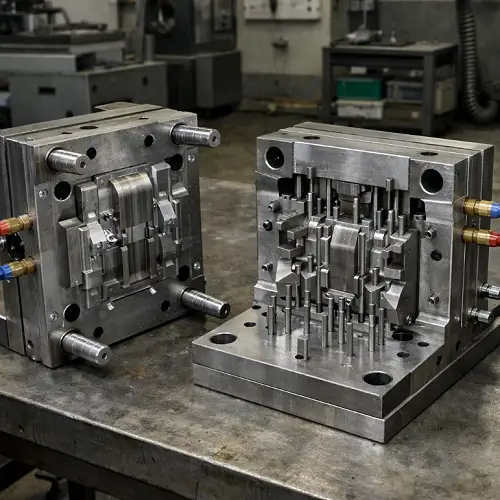
Mold Cost: Where Most of the Budget Goes
In most injection molding programs, tooling defines the financial baseline of the entire project. The mold is not simply a shaped cavity; it is a mechanical system that must withstand injection pressure, thermal cycling, clamp force, and continuous mechanical motion without dimensional instability.
Steel selection alone can shift tooling cost significantly. A pre-hardened P20 mold intended for moderate production runs behaves very differently from a fully hardened H13 tool designed for extended, high-volume manufacturing. The difference is not only in material price, but in machining difficulty, heat treatment requirements, and long-term wear resistance. A mold built for 20,000 shots is engineered differently from one expected to survive 500,000.
Part geometry drives machining intensity inside the toolroom. Deep ribs, side undercuts, threaded features, or high-gloss surfaces increase CNC hours, EDM time, polishing effort, and fitting precision. Slides and lifters introduce additional moving components that must align repeatedly under load. Each mechanism adds labor during mold assembly and future maintenance, even if it appears minor in the CAD model.
Production planning also affects tooling configuration. Choosing a single-cavity layout lowers initial investment but extends production time. Multi-cavity tooling increases mold complexity and base size, yet reduces long-term unit cost when production volume justifies it. That decision is tied to forecast demand as much as to technical feasibility.For example, increasing from a single-cavity tool to a four-cavity configuration may raise tooling investment by 40–70%, yet reduce unit production cost by 20–35% in sustained volume programs. The break-even point depends on projected annual demand and machine utilization rate.
Tolerance strategy further impacts cost. Tight dimensional control requires more precise machining, more careful alignment between core and cavity, and additional inspection time during mold tryout. These elements are embedded in the build process rather than itemized separately, but they shape both tooling price and process stability.
In practice, injection mold cost reflects how the part is expected to perform over its lifecycle. Tooling built for short-term validation is engineered differently from tooling designed for stable, multi-year production.
Material Cost in Plastic Injection Molding
Material cost is often treated as a simple price-per-kilogram calculation, yet it influences far more than raw resin expense. The selected polymer determines processing temperature, shrinkage behavior, cooling time, and long-term dimensional repeatability.
Commodity resins such as PP or ABS typically keep pricing predictable in high-volume programs. Engineering materials shift the equation. Nylon, polycarbonate, POM, or glass-filled grades introduce higher resin cost, increased mold wear, and sometimes longer cooling cycles. A glass-filled nylon part, for example, not only costs more per kilogram but can accelerate cavity wear and demand harder tool steel, indirectly affecting tooling economics.
Material density and wall design also matter. Excessive wall thickness increases shot weight and resin consumption in every cycle. Over tens of thousands of cycles, that additional mass becomes a substantial cost driver. Small geometry adjustments often reduce total material spend more effectively than negotiating resin price.
Scrap and process stability add another layer. Start-up purging, color changeovers, and parameter tuning generate unavoidable waste. Hygroscopic materials such as nylon require consistent drying control. Variations in moisture content lead to splay, brittleness, or rejected parts, raising effective material cost beyond nominal resin pricing.
In injection molding, material cost extends beyond resin price. It is tied directly to design decisions and process discipline across the production lifecycle.
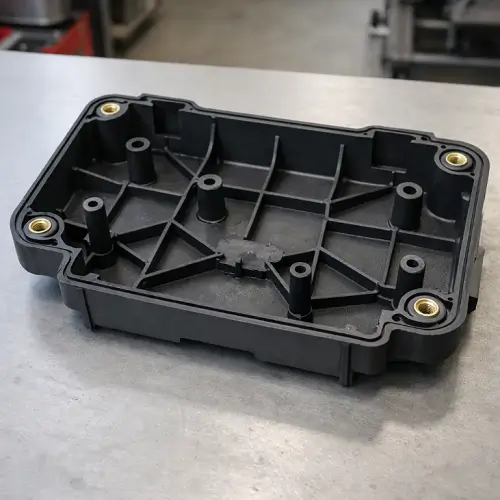
Production Cost Drivers
Once tooling is completed and material selected, unit cost is largely defined by shop-floor performance. Injection molding production cost shifts with cycle time, machine utilization, and operational stability.
Cycle time is the most visible driver. A part stabilized at 22 seconds per cycle carries a very different cost structure from one running at 35 seconds. A difference of 5–8 seconds per cycle may appear minor in isolation. Over a production run of 100,000 parts, however, a 6-second increase translates into roughly 166 additional machine hours. When machine rates range between $40–$80 per hour depending on tonnage, the cumulative cost impact becomes significant.Cooling efficiency often determines that gap. Poor thermal balance inside the mold extends solidification time, consuming additional machine hours across the entire production run.
Machine tonnage selection influences hourly rate. Larger presses require higher energy consumption and capital investment. If a part demands a 450-ton machine due to projected area or clamp safety margin, its economics differ from one molded on a 160-ton press. Optimizing clamp requirements during early design directly affects long-term production cost.
Labor involvement varies by design. Fully automated ejection with robotic handling keeps labor minimal. Manual degating, insert placement, or secondary trimming increases handling time. Small manual steps compound cost in high-volume programs.
Process stability ultimately determines efficiency. Frequent adjustments to control warpage, flash, or dimensional drift interrupt continuous production. Stable tooling and consistent processing reduce downtime and preserve effective machine utilization.
Secondary operations—such as ultrasonic welding, assembly, or surface finishing—introduce additional cost layers when not considered during early planning. In practice, the quoted unit price reflects how smoothly the process can run over sustained production.
Hidden Cost Factors Most Buyers Overlook
Not all injection molding costs appear in the initial quotation. Some surface only after tooling is built and production begins. These hidden variables often determine whether a program remains stable or requires constant correction.
Dimensional instability may emerge after thousands of cycles if cooling balance or alignment was marginal. Corrective work involves tool adjustment, additional sampling, and downtime that was never itemized separately in the original quotation.
Overly aggressive tolerances or uneven wall distribution can increase process sensitivity. Repeated parameter adjustments consume machine time without producing sellable parts.
In well-managed injection molding operations, these fluctuations are typically absorbed within the production system rather than transferred to the customer. Process refinement, minor tool adjustments, and efficiency improvements are internal responsibilities aimed at maintaining consistent output without unexpected cost revisions.
Material-related variation follows a similar pattern. Moisture-sensitive resins require controlled drying. Early process deviations are corrected at the factory level to stabilize quality before affecting customer pricing.
A mature injection molding supplier builds margin structure around risk management. Stable pricing reflects the ability to control process variables quietly in the background rather than renegotiate cost mid-program.
How to Reduce Injection Molding Cost Without Compromising Quality
Reducing injection molding cost rarely starts with negotiation. In most programs, the decisive cost variables are fixed long before the first shot is molded.
Structural drivers are embedded directly in the part geometry. Wall thickness distribution, rib layout, draft angles, gate positioning, and tolerance allocation all shape tooling complexity and long-term production stability. Once the mold base is machined, revisiting those decisions becomes costly.
Wall thickness uniformity remains one of the most controllable factors. Balanced geometry improves cycle consistency and reduces scrap without compromising functional integrity.
Tolerance allocation must align with functional assembly needs. Over-specification narrows the processing window and increases tooling precision requirements unnecessarily.
Cavity configuration should match realistic volume projections. Multi-cavity tooling reduces unit cost only when sustained production volume justifies the higher initial investment.
Material selection influences lifecycle cost as well. Over-engineering resin choice increases raw material expense and mold wear without delivering proportional benefit.
Structured design-for-manufacturing analysis plays a decisive role at this stage. A comprehensive DFM review evaluates draft adequacy, undercut feasibility, gating strategy, cooling efficiency, and ejection reliability before tooling release. Most avoidable injection molding cost originates from geometry decisions made prior to steel cutting.
When design intent is clarified early, cost efficiency emerges from process stability rather than price compression.
If you would like to explore common injection molding defects or material selection considerations, you may also review the related resources for project-specific guidance.
Frequently asked questions
How much does injection molding cost per part?
Injection molding cost per part varies depending on material selection, cycle time, cavity count, and production volume. For high-volume programs using commodity resins, unit pricing may drop significantly once tooling investment is amortized. Low-volume production typically carries higher per-unit cost due to limited cycle accumulation.
What is the average injection mold cost?
Injection mold cost depends on part size, complexity, steel selection, and cavity configuration. Simple prototype molds may begin in the lower thousands of dollars, while hardened multi-cavity production tools for high-volume programs can reach substantially higher investment levels.
Why do injection molding quotes vary so much?
Quotation differences often result from variations in steel grade, mold lifespan expectations, cavity strategy, and process stability assumptions. Lower upfront tooling cost may reflect reduced mold durability or limited production planning.
How can injection molding cost be reduced?
Cost reduction is typically achieved through design optimization, balanced wall thickness, appropriate tolerance allocation, and early DFM review prior to tooling construction. Stable process conditions reduce scrap and improve machine utilization over time.