
Plastic gears are widely used in everyday products such as printers, automotive systems, home appliances, and industrial equipment. Compared to metal gears, plastic gears are lighter, quieter, and more cost-effective for mass production. This makes them a common choice in applications where noise reduction, weight control, and production efficiency are more important than extremely high torque performance.
Injection molding is the most efficient manufacturing method for producing plastic gears in large volumes. It enables consistent quality, high dimensional accuracy, and fast production cycles. However, the performance of a plastic gear is highly dependent on material selection and design. Choosing the wrong material may lead to premature wear, noise issues, deformation, or poor meshing performance during operation.
This guide explains how plastic gear injection molding works, why plastic gears are used instead of metal gears, and how to choose the right material based on real application requirements.
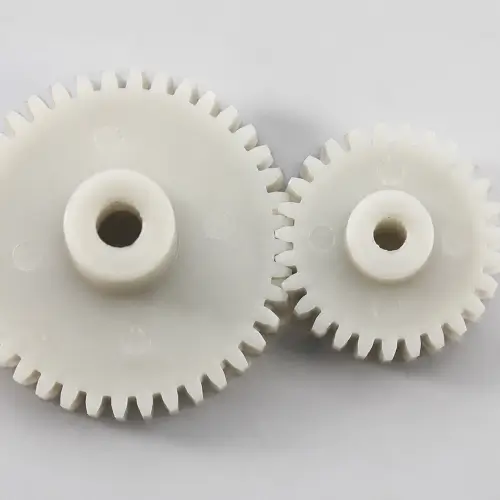
What Is Plastic Gear Injection Molding?
Plastic gear injection molding is a manufacturing process where molten thermoplastic material is injected into a precision gear-shaped mold cavity. After cooling and solidification, the result is a finished plastic gear with consistent geometry and high repeatability.
Unlike machining metal gears individually, injection molding allows mass production of identical parts at low unit cost. Once the mold is created, thousands or even millions of gears can be produced with stable quality and tight dimensional control.
Plastic gears are commonly used in systems where smooth operation, low noise, and cost efficiency are more important than extreme load capacity. They are widely found in printers, small motors, home appliances, automotive components, and consumer electronics.
Why Use Plastic Gears Instead of Metal Gears?
Plastic gears are not simply a cheaper replacement for metal gears. They are used because they offer different functional advantages.
One of the biggest benefits is noise reduction. Plastic materials naturally absorb vibration, which helps gears run more quietly compared to metal systems. This is especially important in household appliances and office equipment.
Plastic gears are also much lighter, which reduces overall product weight and improves energy efficiency in some applications. In addition, many plastic gears do not require lubrication, simplifying assembly and maintenance.
From a manufacturing perspective, injection molded plastic gears allow complex shapes to be produced in large quantities with lower cost compared to machining metal gears individually.
Advantages of Plastic Gear Injection Molding
Plastic gear injection molding offers several key advantages in mass production environments.
It provides high consistency between parts, ensuring stable performance across large production batches. It also allows complex gear geometries to be produced without additional machining steps.
The process is highly efficient, with short cycle times and low unit cost once the mold is ready. This makes it ideal for high-volume applications.
Another advantage is design flexibility. Injection molding allows engineers to integrate multiple features into a single component, reducing assembly complexity and improving production efficiency.
Best Materials for Plastic Gears
Material selection is one of the most important factors in determining how a plastic gear performs in real applications. The right material helps the gear run smoothly, stay quiet, and last longer. The wrong material can lead to fast wear, noise issues, or deformation during use.
Instead of focusing only on technical properties, it is more useful to choose materials based on how the gear will actually be used in the product.
POM
POM is usually the best choice when a gear needs smooth movement, low noise, and long-term stability. It performs very well in continuous rotation systems and can often work without lubrication, which makes it very practical for compact mechanical designs.
Because of its stable performance, POM is widely used in printers, small motors, home appliances, and precision transmission systems.
However, POM is mainly suitable for low to medium load applications. When the working force becomes too high, stronger engineering plastics may be more appropriate.
Nylon (PA6 / PA66)
Nylon is a better choice when the gear needs to handle higher force or occasional impact. It is tougher than standard plastics and performs well in more demanding working conditions.
This makes Nylon suitable for automotive systems, industrial equipment, and power transmission parts where durability is more important than perfect dimensional accuracy.
One thing to consider is that Nylon can absorb moisture from the environment, which may slightly affect its size over time. For this reason, it is not always ideal for very high-precision applications.
PEEK
PEEK is used when standard engineering plastics are not enough. It performs very well in high temperature, high load, and long-term operating environments.
It keeps its strength and stability even under harsh conditions, which makes it suitable for aerospace, medical devices, and high-end industrial systems.
The main limitation is cost. PEEK is significantly more expensive than other materials, so it is usually chosen only when performance requirements cannot be met by other options.
PC / ABS
PC and ABS are mainly used for simple or light-duty gear applications. They are easy to mold and cost-effective, but they are not designed for high-load or long-term wear conditions.
These materials are commonly used in consumer electronics, small appliances, and simple mechanical assemblies where performance requirements are moderate.
Common Problems in Plastic Gear Applications
Plastic gears may experience performance issues if material selection or design is not properly optimized.
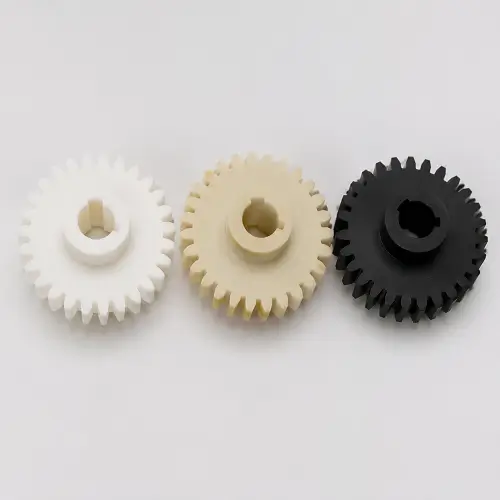
Common problems include wear over time, noise during operation, deformation under load, and poor meshing between gear teeth. These issues are usually caused by incorrect material selection, insufficient design consideration, or inaccurate mold manufacturing.
Proper engineering evaluation during the design stage can significantly reduce these risks and improve long-term performance.
Design Considerations for Plastic Gears
Successful plastic gear performance depends not only on material selection but also on proper design and manufacturing control.
Shrinkage during cooling must be considered during mold design to ensure dimensional accuracy. Tooth geometry must be carefully controlled to ensure smooth meshing and stable transmission.
Mold precision also plays a critical role in determining final gear quality. Even small deviations in mold accuracy can lead to noise, vibration, or reduced efficiency during operation.
For this reason, plastic gear design should always be evaluated together with material selection and injection molding capability before production begins.
Get Custom Plastic Gear Injection Molding
Choosing the right material and manufacturing process is essential for producing reliable plastic gears. Proper evaluation during the design stage can help prevent performance issues and reduce production risks.
If you are developing a new product or need custom plastic gears, our engineering team can review your design, recommend suitable materials, and provide manufacturability feedback before production.
Upload your CAD file to get a quotation and engineering support for your plastic gear project.