
Thin plastic walls are common in injection molded products, but thin walls alone rarely provide enough stiffness for everyday use. This is why plastic ribs are widely used inside electronic housings, medical devices, automotive interior parts, and many other molded products. Instead of making an entire part thicker, ribs reinforce specific areas, improve rigidity, reduce material consumption, and help minimize molding defects when they are properly designed.
Although ribs are hidden inside most finished products, they have a significant influence on manufacturing quality. Poor rib design can lead to sink marks, warpage, filling problems, cosmetic defects, or unnecessary tooling changes. A well-designed rib strengthens the part without adding unnecessary weight or increasing production cost.
This guide explains how plastic ribs improve part performance, why they sometimes create molding problems, and what should be considered before an injection mold is manufactured.
What Is a Plastic Rib?
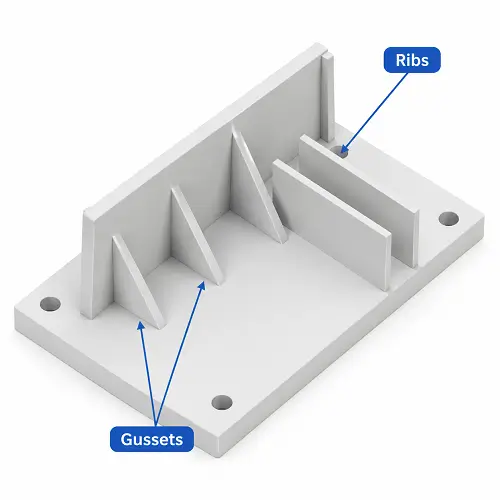
Plastic ribs are thin support features molded into plastic parts to improve stiffness without increasing the overall wall thickness. Instead of making an entire part thicker, ribs reinforce specific areas while helping reduce weight, material usage, cooling time, and the risk of cosmetic defects such as sink marks.
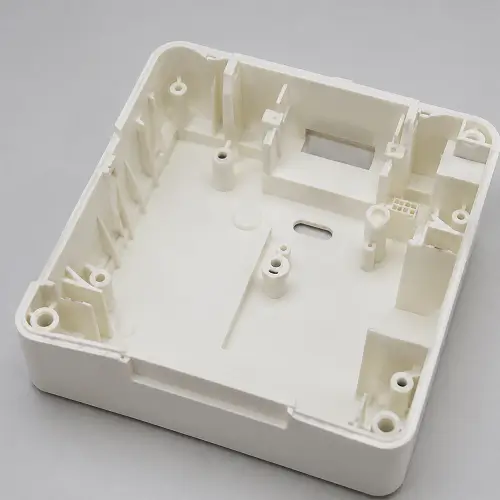
Open almost any plastic housing and the ribs become easy to find. They are commonly placed behind large flat surfaces, around screw bosses, beside snap fits, and underneath areas that require additional support. Although customers rarely see these features after assembly, they play an important role in determining how strong and stable the finished product feels during everyday use.
Ribs do much more than increase part strength. They influence how molten plastic flows through the mold, how evenly the part cools, how much the material shrinks after molding, and whether the housing remains flat after production. Because they affect both product performance and manufacturability, rib design is usually reviewed together with wall thickness, boss design, and material selection during the DFM stage rather than as an independent feature.
Why Plastic Parts Use Ribs Instead of Thicker Walls
When a plastic part feels too flexible, increasing the wall thickness often seems like the simplest solution. Adding more material appears to make the product stronger, but the result is not always what manufacturers expect. Thick plastic sections cool more slowly than thin ones, creating uneven shrinkage that increases the possibility of sink marks, internal stress, and longer molding cycles.
Ribs solve this problem differently. Instead of reinforcing the entire part, they strengthen only the areas that need additional support. This allows the housing to maintain good stiffness while keeping the main wall relatively uniform. The part becomes lighter, uses less material, and usually cools more consistently during molding.
This approach is especially common in electronic housings, appliance covers, automotive interior components, and medical equipment where products need to remain rigid without becoming unnecessarily heavy. A carefully designed rib structure often provides better overall performance than simply increasing wall thickness throughout the entire part.
For manufacturers producing thousands of parts, the difference can be significant. Less material, shorter cooling time, and improved dimensional stability all contribute to a more efficient production process while helping maintain consistent part quality.
How Plastic Ribs Improve Part Strength
A rib does not increase strength simply because more plastic has been added. Its real purpose is to change how loads are distributed throughout the part. When force is applied to a flat plastic surface, the surrounding ribs help transfer that force into a larger area instead of allowing one section to bend excessively.
This is why large plastic housings often contain multiple ribs arranged in different directions rather than one thick solid wall. The rib network increases stiffness while keeping the overall component lightweight. Products such as routers, industrial controllers, battery housings, and medical equipment frequently rely on this design approach to prevent unwanted flexing during normal use.
Support ribs also work together with other structural features. Around screw bosses they help reduce movement during screw assembly. Near snap fits they provide additional support that improves long-term durability. Across large flat surfaces they help minimize deformation after molding and transportation.
Adding more ribs does not automatically create a stronger product. Their thickness, spacing, height, and relationship with nearby features all influence the final result. For this reason, experienced mold designers usually evaluate the complete internal structure instead of reviewing each rib individually.
Why Sink Marks Appear Near Ribs
One of the most common appearance problems in injection molded parts is a sink mark. Customers usually notice it as a small depression on the outside surface of the product, while the actual cause is often hidden inside the housing where the rib is located.
The reason is fairly straightforward. A rib adds extra material beneath the outer wall, so that area cools more slowly than the surrounding plastic. As the thicker section continues to shrink during cooling, it can pull the outer surface inward. The rib itself may look perfectly normal, but the cosmetic surface on the opposite side no longer remains flat.
This problem becomes much more noticeable on products with glossy finishes, painted surfaces, or textured housings where appearance is important. Electronic products, automotive interior trim, and consumer devices often require a clean cosmetic finish, so even a slight sink mark may be considered unacceptable.
Many people assume the solution is simply reducing molding pressure or adjusting machine settings. Processing conditions certainly influence the final result, but they rarely solve the problem completely if the rib geometry itself is not appropriate. In most cases, the structure of the part has a greater influence than the molding parameters.
For this reason, experienced mold designers normally evaluate rib thickness together with the surrounding wall instead of looking at the rib alone. Small design changes made before tooling often eliminate cosmetic defects that would otherwise require repeated mold trials later.
Why Plastic Ribs Warp or Fill Poorly
Not every rib-related problem appears after the part leaves the mold. Some begin while the molten plastic is still flowing through the cavity. If ribs are designed without considering material flow, cooling, and venting, the finished part may show warpage, incomplete filling, or dimensional instability.
Tall, narrow ribs are one example. Although they may appear strong in a CAD model, they are often more difficult to fill completely during injection molding. If the molten plastic loses temperature before reaching the top of the rib, short shots or weak sections may occur, especially when using engineering plastics with higher viscosity.
Rib layout also influences how evenly a part cools. When several large ribs are concentrated in one area while the rest of the housing remains relatively thin, cooling becomes uneven across the component. This imbalance increases the possibility of warpage after ejection, making assembly more difficult even if the molded dimensions initially appear acceptable.
Material selection should also be considered. Glass-filled materials generally shrink differently from unfilled plastics, while some resins flow more easily into thin rib structures than others. Choosing the right material is just as important as choosing the rib geometry itself.
Rather than treating ribs as independent features, successful designs balance rib dimensions, material flow, cooling behavior, and the overall housing structure. Looking at the complete part usually produces more reliable molding results than optimizing a single rib in isolation.
Best Materials for Plastic Rib Design
Plastic ribs can be molded using many different materials, but the best choice depends on how the finished product will be used rather than simply selecting the strongest resin available.
ABS remains one of the most common choices for consumer electronics and general-purpose housings. It offers good rigidity, stable processing characteristics, and a balanced combination of cost and performance. For products that require attractive cosmetic surfaces as well as reliable structural support, ABS is often a practical starting point.
Polypropylene is widely used when flexibility and impact resistance are more important than maximum stiffness. It is commonly found in appliance components, storage products, and living hinge applications where the product may experience repeated movement during normal use.
PC/ABS is frequently selected for products that require greater toughness. Automotive interior components, industrial control equipment, and medical housings often use this material because it combines good impact resistance with stable dimensional performance.
Glass-filled nylon is commonly chosen for applications that carry higher mechanical loads or require increased rigidity. Compared with standard engineering plastics, glass-filled materials provide greater stiffness, although they also require careful consideration during mold and rib design because they behave differently during molding and shrinkage.
Instead of asking which material is strongest, it is usually more useful to ask which material best matches the product’s function, appearance requirements, service environment, and production volume. A well-designed rib molded in the correct material will almost always outperform an unsuitable material selected only for its strength.
For applications requiring higher stiffness, glass-filled plastics may be considered, although they also require careful rib and mold design.
Common Plastic Rib Design Mistakes
Most rib problems are not caused by complex engineering failures. They usually begin with small design decisions that seem reasonable during product development but create unexpected challenges once production starts.
One common mistake is making the rib almost as thick as the surrounding wall. Although this appears to increase strength, it often creates uneven cooling and increases the likelihood of sink marks on the opposite surface. Simply adding more plastic rarely produces the best result.
Another frequent issue is placing too many ribs into a limited space. Closely spaced ribs restrict material flow, complicate cooling, and may increase internal stress within the finished part. A cleaner rib layout often performs better than filling every available space with additional reinforcement.
Support features also need to work together. Ribs, bosses, snap fits, and wall thickness should complement one another instead of competing for the same space inside the housing. When these features are designed independently, assembly problems and mold modifications become much more likely.
Finally, some products simply do not require additional ribs. Small components with naturally rigid shapes may achieve the required strength without adding unnecessary internal structures. Good rib design is not about adding more reinforcement—it is about placing reinforcement where it provides the greatest benefit while maintaining good manufacturability.Can Ribs Replace Thicker Walls?
Many designers assume that increasing wall thickness is the easiest way to make a plastic part stronger. While this may improve stiffness in some situations, it often creates new manufacturing challenges such as sink marks, longer cooling times, and unnecessary material consumption.
Ribs offer a more efficient solution because they reinforce only the areas that require additional support. Instead of making the entire part heavier, ribs increase stiffness while allowing the main wall thickness to remain relatively consistent. This approach not only improves structural performance but also helps maintain better molding quality.
That does not mean ribs should replace thicker walls in every design. Some products carry heavy loads or require additional material for functional reasons. In these cases, the best solution is often a combination of proper wall thickness and well-designed ribs rather than relying entirely on one method.
Choosing between thicker walls and reinforcement ribs depends on the product’s function, material selection, appearance requirements, and manufacturing process. Reviewing these factors together usually leads to a more reliable design than focusing on a single feature.
Plastic Ribs in Custom Housings
Plastic ribs are used in almost every custom housing, even though they are hidden after assembly. They support large flat surfaces, reinforce screw bosses, strengthen snap fits, and help maintain the shape of the housing during production and everyday use.
Because ribs work together with other structural features, changing one part of the design often affects the entire product. Increasing the height of a rib may influence mold filling, while moving a boss may require the surrounding ribs to be redesigned. Looking at the complete housing instead of individual features usually produces better manufacturing results.
For this reason, experienced injection molding suppliers normally review ribs, bosses, wall thickness, snap fits, and material selection as one complete design rather than treating each feature separately.
Before Building the Mold
Many rib-related problems are much easier to solve before tooling begins than after the first molded parts are produced. Once the mold has been machined, even small structural changes may require additional machining, insert modifications, or repeated mold trials.
A proper DFM review evaluates much more than rib dimensions. Material selection, wall thickness, gate location, cooling behavior, screw bosses, snap fits, and overall part geometry all influence how the ribs perform during production. Reviewing these features together helps reduce manufacturing risks before they become expensive production issues.
For products with cosmetic requirements or tight dimensional tolerances, identifying these risks early often saves both development time and tooling cost.
Request a Factory Quote
Well-designed plastic ribs do far more than increase stiffness. They improve product quality, reduce molding defects, support reliable assembly, and help keep manufacturing costs under control. In many cases, a small design adjustment before tooling can prevent expensive mold modifications later.
If you are developing a custom injection molded part, reviewing the internal structure before mold manufacturing is one of the most valuable steps in the entire project. Our engineering team evaluates ribs together with wall thickness, screw bosses, snap fits, material selection, and mold manufacturability to help identify potential issues before production begins.
Upload your 3D CAD file or product drawing to request a factory quote. JeekMould provides DFM feedback, material recommendations, and manufacturing advice for custom plastic parts, helping you move from product design to mass production with greater confidence and fewer design revisions.