
If you’ve ever held a molded housing under a bright light, you know how a perfect surface can turn imperfect with just one angle shift. Dimensions check out, cycle data looks steady, the cavity fills clean — then there it is, a soft dent next to a rib or boss. It rarely shows up on the very first runs. It waits until the process stabilizes, until overpacking fades, until the gate freeze no longer drifts. At that point the part finally tells the truth — how much the core really shrank.A sink mark isn’t cosmetic chance. It’s the thermal footprint of how the part solidified — steel side first, core last — and how the loss of internal volume had nowhere left to go but inward.

What Is a Sink Mark in Injection Molding
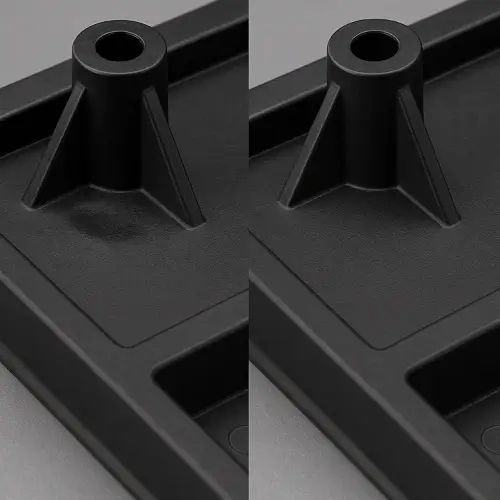
A sink mark is a subtle inward surface collapse created when the skin layer freezes before the core has fully cooled. The outer shell forms quickly against the steel, but the material beneath it contracts more slowly. If packing can’t continue feeding material into that core as it shrinks, the surface is drawn inward.
Although visually small, a sink mark reflects a much larger thermal difference inside the part than the surface suggests. The steel-facing layer locks early while the core is still moving and losing volume. As the core cools and has nowhere to draw material from, it pulls the surface inward instead. If you’ve ever rolled a molded part under a lamp and watched a single spot dip into shadow, that’s the surface surrendering to the core. It looks like a shallow dent, but mechanically it’s a record of uneven heat leaving the part.
Sink marks often appear only after molding conditions stabilize. Early sampling and fluctuating pack pressure can temporarily hide them, but once the cycle repeats consistently — same fill, same freeze, same pressure profile — shrink reappears in the same place shot after shot. It isn’t randomness; it’s behavior repeating because the conditions repeat.
Even a faint sink means the core and the skin cooled on two different clocks. They rarely come from one factor — they come from time, mass, heat, and pressure missing alignment by fractions of a second.
Why Sink Marks Occur in Molded Parts
Sometimes a sink doesn’t appear alone. When two flow fronts meet and solidify at different temperatures, you may see a weld line running through the same region. One defect comes from inner shrink, the other from weak molecular bonding on the surface — but it’s common for both to show up around the same rib or boss.
Thermal timing mismatch drives surface collapse
Inside every molded part there are two cooling clocks. The side touching steel freezes fast and becomes rigid whether the core is ready or not. The core cools slower, especially behind ribs and bosses. When it begins to shrink after the skin has already set, the only direction the surface can move is inward.
Geometry amplifies internal heat retention
Ribs, bosses, intersections, and mass clusters store heat long after the wall is done. A rib twice the wall thickness can remain semi-molten a full moment longer — long enough to collapse once the gate seals. Texture may hide the distortion, but gloss or coating makes it obvious.
A sink mark is not born at the surface. It is the part’s thermal history, written where the eye can read it.
What Causes Sink Marks in Injection Molded Parts
Core shrinkage continues after the surface freezes
If rib thickness outweighs the wall, the core beneath it freezes late. Once the gate seals, packing loses access, and pressure without flow cannot support shrinking volume — collapse follows.
Cooling imbalance and steel mass distribution
Poor coolant reach or heavy steel sections hold heat, leaving molten resin under a rigid shell. Materials react differently: PP and ABS sink broadly, while glass-filled materials collapse narrowly along fiber alignment — almost like a shrink map of flow direction.
Sink doesn’t come from cosmetic error.
It comes from uneven cooling that finally becomes visible.
How to Avoid Sink Marks (Design Principles)
Most sink prevention happens before the tool is built. When ribs sit at 50–70% of wall thickness and bosses are relieved instead of solid blocks, the melt cools together rather than in layers. If the core never outruns the surface thermally, the surface never has reason to fall.
Structural Reference Guidelines
| Parameter | Target | Why it Works |
|---|---|---|
| Rib Thickness / Wall Ratio | 0.50–0.70 | Core solidifies closer to wall timing |
| Boss Outer Wall Ratio | ≤1.5 × Wall | Avoids heat storage inside mass block |
| Radius at Rib/Wall Junction | 0.3–0.8 mm | Smooths heat flow, no freeze-front cliff |
| Hollow Under Boss | Preferred | Removes dead melt volume; cools faster |
Good geometry doesn’t fight shrink.
It removes its reason to exist.
How to Reduce Sink Marks Through Process Control
Processing aims to keep feed time alive — not eliminate shrink
After steel is cut, solving sink becomes a timing exercise. Holding pressure matters only while the gate remains open. Increasing V/P delay or extending pack gives the core something to shrink against — instead of collapsing into empty volume.
Cooling modification reduces collapse severity
A hot rib or boss can be corrected with closer coolant channels, baffles, or high-conductivity inserts. Lower melt shortens shrink duration; cooler steel holds the skin sooner. None of these change geometry — they simply give shrink less time to win.
FAQ
Why do sink marks happen?
Because the core keeps shrinking after the surface is already locked.
Can they be fixed without redesign?
If the gate is still open — yes. More hold time, more stable cooling, lower melt help.
Why do sinks appear at ribs first?
Ribs hold heat longer than the wall and collapse later.
Does pressure alone fix sink?
Only if resin can still move. After freeze, pressure is just a number.
Final Summary
Sink marks happen when steel and resin disagree on timing. They aren’t blemishes — they’re thermal history exposed on the surface. Once you read them as cooling behavior rather than cosmetic flaw, you know where to design differently, where to deepen cooling, and where to give packing time instead of pressure.
Good molding doesn’t hide sink.
Good molding prevents the conditions that make it inevitable.
For a broader look at how different molding behaviors show themselves on finished parts, you can refer to our Injection Molding Defects Guide.
If You Need Support
If a project on your desk is showing early signs of sink — or you want a second set of eyes on rib thickness, gating, or cooling layout — send the model over. A quick review often spots the imbalance before steel is cut, and it’s far cheaper to adjust geometry now than to chase surface collapse later.
You can upload your CAD files, drawings, or photos directly. We’ll review wall structure, rib ratios, freeze window, and cooling paths the same way we analyze our own production tools.
Upload your part → we’ll tell you where sink will appear, and how to prevent it before it costs you time.