
Thermosets and thermoplastics are two major groups of polymer materials, but they respond very differently to heat and molding. A thermoplastic softens when heated and becomes solid again after cooling. A thermoset undergoes a curing reaction that forms permanent chemical cross-links, so it cannot be melted and molded again after curing.
This difference affects more than material chemistry. It changes the molding equipment, mold temperature, runner design, cycle time, scrap handling, part performance, and production cost. Thermoplastics such as PP, ABS, PC, nylon, POM, and PEEK are widely used for injection molded housings, brackets, gears, clips, connectors, covers, and other production parts. Thermosets such as epoxy, phenolic, melamine, silicone, and unsaturated polyester are used when heat resistance, electrical insulation, low creep, or dimensional stability under prolonged load is more important.
Neither material family is automatically better. The right choice depends on the operating temperature, mechanical load, chemical exposure, part geometry, expected quantity, regulatory requirements, and the molding process available for the project.
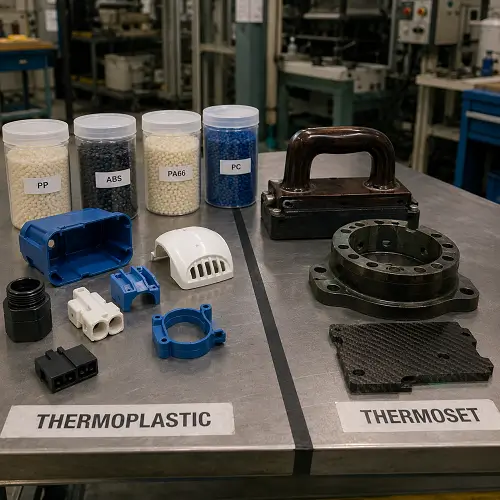
What Is the Difference Between Thermoset and Thermoplastic?
The main difference between thermoset and thermoplastic materials is what happens after they are heated and shaped.
A thermoplastic changes mainly through heating and cooling. When sufficient heat is applied, its polymer chains gain enough mobility for the material to flow. The molten resin fills the mold cavity and becomes solid as it cools. Provided that the material has not degraded or become contaminated, it can often be reheated and processed again.
A thermoset changes through a chemical reaction. During curing, its polymer chains form a three-dimensional cross-linked network. Once this structure has developed, reheating does not return the material to a moldable liquid. Excessive heat eventually causes discoloration, cracking, charring, or decomposition.
In manufacturing terms, thermoplastics are melted and cooled, while thermosets are shaped and permanently cured. This difference explains why thermoplastics and thermosets require different equipment, tooling conditions, cycle controls, and recycling methods.
Thermoset vs Thermoplastic Comparison Chart
| Property | Thermoplastic | Thermoset |
|---|---|---|
| Molecular structure | Linear or branched polymer chains | Permanently cross-linked network |
| Response to heat | Softens or melts when heated | Does not remelt after curing |
| How the part becomes solid | Cooling | Chemical curing |
| Can it be reshaped? | Often possible before degradation | No |
| Common molding methods | Injection molding, extrusion, blow molding, thermoforming | Compression molding, transfer molding, thermoset injection molding, casting |
| Main cycle limitation | Cooling time | Cure time |
| Production scrap | Clean scrap may sometimes be reground | Cured scrap cannot normally be remelted |
| Heat performance | Varies from general-purpose to high-temperature grades | Often retains shape well under prolonged heat |
| Impact behavior | Many tough and flexible grades are available | Often rigid; some grades are relatively brittle |
| Common examples | PP, PE, ABS, PC, PA, POM, PBT, PMMA, PPS, PEEK | Epoxy, phenolic, melamine, polyester, vinyl ester, thermoset polyurethane |
| Typical molded parts | Housings, clips, gears, brackets, containers | Electrical parts, high-heat handles, composite components |
The chart describes the general difference between thermosetting and thermoplastic polymers. Actual performance still depends on the exact resin, reinforcement, filler content, additives, curing conditions, and commercial grade.
What Is a Thermoplastic?
A thermoplastic is a polymer that softens or melts when heated and hardens again when cooled. This behavior allows thermoplastic pellets to be dried, fed into a molding machine, melted inside a heated barrel, injected into a mold, and cooled into the required shape.
Common thermoplastics include PP, PE, ABS, PC, PA6, PA66, POM, PBT, PET, PMMA, PPS, and PEEK. These materials belong to the same broad family but provide very different performance.
PP offers low density and good resistance to many chemicals. ABS is widely used for rigid housings and covers. PC provides strong impact resistance, while POM is commonly selected for gears and low-friction moving components. PPS and PEEK can operate in more demanding thermal and chemical environments.
The wide range of available plastic properties is one reason thermoplastics are used for so many injection molded products. Different grades can provide flexibility, transparency, wear resistance, flame retardancy, electrical insulation, chemical resistance, or elevated-temperature performance.
The ability to remelt a thermoplastic does not mean it can be processed indefinitely. Excessive residence time, repeated heating, moisture, oxidation, or contamination may reduce molecular weight, change color, and weaken the material.
What Is a Thermoset Plastic?
A thermoset begins as a reactive resin, powder, paste, liquid system, or moldable compound. Heat, pressure, a hardener, a catalyst, moisture, ultraviolet light, or a combination of these conditions initiates a curing reaction that permanently hardens the material.
Common thermosets include epoxy, phenolic resin, melamine formaldehyde, urea formaldehyde, unsaturated polyester, vinyl ester, thermoset polyurethane, and some silicone materials. Sheet molding compound and bulk molding compound also use thermosetting resin systems combined with reinforcement and fillers.
Before curing, the material must remain capable of filling the mold cavity. After curing, the cross-linked structure restricts molecular movement and prevents the material from flowing again. This behavior can provide good heat resistance, electrical insulation, dimensional stability, and resistance to creep under continuous load.
Thermosets are commonly found in electrical components, heat-resistant handles, encapsulated parts, reinforced composite panels, adhesives, coatings, and products exposed to prolonged heat.
Processing control is critical. Material that begins curing too early may block the barrel, nozzle, runner, or feed equipment. A part removed before sufficient curing may have poor strength, dimensional instability, or an incomplete surface.
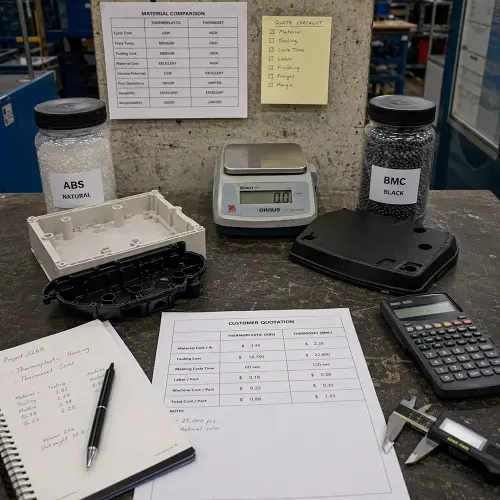
What Are Examples of Thermoplastics and Thermosets?
The same product category may use either material family depending on its operating conditions.
| Application | Thermoplastic Options | Thermoset Options |
|---|---|---|
| Electrical connector | PA66, PBT, PPS, PC | Phenolic, epoxy molding compound |
| Equipment housing | ABS, PC, PC/ABS | Polyester composite, thermoset polyurethane |
| Heat-resistant handle | PA66-GF, PPS, PEEK | Phenolic |
| Automotive bracket | PP-GF, PA6-GF, PBT-GF | SMC or BMC polyester |
| Transparent cover | PC, PMMA | Selected clear thermoset resins |
| Gear or sliding component | POM, PA, PEEK | Limited thermoset use |
| Electrical encapsulation | Selected thermoplastics | Epoxy |
| Structural composite panel | Long-fiber thermoplastic | Polyester, vinyl ester, epoxy |
Among the main types of plastic, thermoplastics account for a large proportion of everyday molded products because they support automatic feeding, complex geometry, relatively short cycles, and repeatable production.
Thermosets remain important where the cured network provides heat resistance, electrical performance, or structural stability that a general-purpose thermoplastic cannot provide.
How Do Thermoset and Thermoplastic Properties Compare?
Thermoplastic and thermoset are broad material categories rather than individual performance grades. PP, ABS, PC, PPS, and PEEK are all thermoplastics, yet their stiffness, impact resistance, chemical resistance, and working temperatures differ greatly. Similar differences exist among epoxy, phenolic, silicone, and polyester thermosets.
Thermoplastics generally provide more options for impact-resistant parts, flexible sections, snap fits, living hinges, and components exposed to repeated movement. Thermosets often retain their shape well under prolonged heat and constant load, although some cured grades are relatively brittle.
The final comparison must use the exact resin grade, filler or reinforcement, operating temperature, load direction, and part geometry. Strength, heat resistance, creep, chemical resistance, and dimensional stability cannot be predicted from the material family alone.
Thermoset vs Thermoplastic Heat Resistance
Thermosets are often associated with better heat resistance because they do not melt after curing. This can be useful when a component must retain its shape under prolonged heat, but it does not mean every thermoset performs better than every thermoplastic.
General-purpose thermoplastics such as PE, PP, and ABS may soften or lose stiffness at moderate temperatures. High-performance thermoplastics such as PPS, PEI, PEEK, and heat-resistant polyamides can operate in much more demanding environments.
A cured thermoset may maintain its shape at a temperature where an ordinary thermoplastic begins to soften. Thermosets still have thermal limits. Excessive temperature or prolonged exposure can cause oxidation, surface damage, cracking, loss of mechanical strength, charring, or decomposition.
A useful heat comparison should consider glass transition temperature, heat deflection temperature, continuous operating temperature, short-term peak temperature, thermal expansion, flammability, and the mechanical load applied at temperature.
For semi-crystalline thermoplastics, the plastic melting point is also relevant. A cured thermoset does not have a conventional remelting point because it degrades instead of returning to a processable melt.
Do Thermoplastics and Thermosets Melt?
Thermoplastics can soften or melt, but amorphous and semi-crystalline materials do not behave in exactly the same way.
Semi-crystalline thermoplastics such as PP, PE, POM, PA, PBT, PPS, and PEEK have a recognizable melting range. Their ordered crystalline regions break down as the resin reaches its melting temperature.
Amorphous thermoplastics such as ABS, PC, PMMA, and PS do not have the same sharp melting point. They gradually soften above their glass transition temperature and become easier to process as temperature increases.
A fully cured thermoset does not melt. Its cross-linked molecular structure prevents the chains from flowing independently. Heating beyond the material’s limit causes degradation rather than useful remelting, so a cured thermoset part cannot normally be placed back into a molding machine and reshaped.
Thermoset vs Thermoplastic Strength
There is no universal answer to whether a thermoset or thermoplastic is stronger because strength can describe tensile, flexural, impact, compressive, or fatigue performance.
Thermosets often perform well in stiffness, compression, creep resistance, and shape retention under heat. Thermoplastics frequently offer better impact resistance, elongation, fatigue behavior, and flexibility. These are different forms of mechanical performance, so one group cannot be described as stronger in every application.
Reinforcement can change the comparison substantially. Glass-filled nylon, PBT, PPS, and PEEK can provide high tensile and flexural strength. Glass- or carbon-fiber thermoset composites may provide greater structural stiffness, particularly when fiber direction is controlled.
The part geometry also affects performance. Thin sections, sharp corners, weld lines, inserts, ribs, bosses, and fiber orientation may determine where a molded part fails. Material data should therefore be reviewed together with the actual load direction and component design.
Thermoset vs Thermoplastic Creep and Dimensional Stability
Creep is the gradual deformation of a material under continuous load. Thermoplastics are more likely to creep when stress increases, operating temperature rises, or the part works close to the material’s softening range.
The cross-linked structure of a thermoset restricts molecular movement, which often improves creep resistance. This can benefit electrical parts, structural supports, equipment components, and assemblies that must retain clamping force over time.
Engineering thermoplastics can also provide stable dimensions when the correct grade and part design are used. POM, PBT, PPS, filled nylon, and other reinforced materials are frequently selected for precision molded components.
Their final dimensions may still be affected by molding shrinkage, moisture absorption, fiber orientation, mold temperature, and uneven wall thickness.
Thermosets have their own dimensional concerns. Cure shrinkage, uneven curing, reinforcement distribution, mold temperature, and post-curing conditions can all affect the finished part.
Thermoset vs Thermoplastic Chemical Resistance
Both thermoplastics and thermosets include chemically resistant options, so chemical compatibility should be checked against the exact grade rather than the broad material category.
PP and PE resist many water-based chemicals and are widely used for containers, laboratory products, and fluid-handling parts. PPS, PEEK, PVDF, and fluoropolymers are used for more demanding chemical environments. ABS, PC, and PMMA can be vulnerable to certain solvents, fuels, cleaners, or stress-cracking agents.
Epoxy, vinyl ester, polyester, and phenolic thermosets are used in chemical-resistant coatings, tanks, electrical systems, and reinforced composites. Their resistance depends partly on the resin system and whether curing has been completed correctly.
Chemical concentration, temperature, exposure time, moisture, and mechanical stress can all change the result. A material that tolerates brief contact at room temperature may still fail during long-term immersion or continuous exposure at elevated temperature.
Can Thermoplastics Be Injection Molded?
Most products described as injection molded plastic parts are made from thermoplastics. Their melt-and-cool behavior allows the process to repeat automatically across thousands or millions of production cycles.
During molding, pellets are fed into a heated barrel, melted by heat and screw rotation, and injected into a closed mold. Holding pressure compensates for resin contraction, while the cooling system removes heat until the part becomes rigid enough for ejection.
Common thermoplastic injection molding materials include ABS, PP, PE, PC, PC/ABS, PA6, PA66, POM, PBT, PMMA, TPU, PPS, and PEEK.
These materials are used for housings, clips, gears, brackets, connectors, covers, fluid-handling components, automotive parts, electronic products, and medical-device components.
Changing the resin can also change drying requirements, melt temperature, mold temperature, injection pressure, shrinkage, gate design, cooling time, venting, and mold-steel requirements. The exact commercial grade should therefore be confirmed before tooling dimensions are finalized.
Can Thermosets Be Injection Molded?
Some thermoset materials can be injection molded, but they usually require different equipment and process control from ordinary thermoplastic injection molding.
Phenolic molding compounds, epoxy molding compounds, bulk molding compound, selected polyester systems, and liquid silicone rubber may be processed through specialized injection methods. Instead of cooling the material until it solidifies, the heated mold initiates and completes the curing reaction.
Liquid silicone rubber commonly requires metering and mixing equipment that combines two liquid components before injection. Phenolic and BMC materials may require specialized screws, barrels, runners, temperature control, and cleaning procedures.
The presence of an injection molding machine does not automatically mean a factory can process thermosets. The material system, equipment, tooling design, curing conditions, and production experience must all be confirmed before manufacturing begins.
Thermoplastic vs Thermoset Injection Molding
Thermoplastic and thermoset injection molding both use pressure to fill a mold, but their temperature control and solidification mechanisms are almost opposite.
| Molding Factor | Thermoplastic Injection Molding | Thermoset Injection Molding |
|---|---|---|
| Feed material | Pellets or granules | Compound, powder, paste, or liquid system |
| Barrel condition | Heats and melts the resin | Transports material without premature curing |
| Mold condition | Removes heat from the melt | Adds heat to promote curing |
| How the part solidifies | Cooling | Chemical reaction |
| Main cycle control | Cooling time | Cure time |
| Runner handling | Clean runners may sometimes be reground | Cured runners cannot normally be remelted |
| Production interruption | Material can often be purged | Cured material may block equipment |
| Equipment | Standard thermoplastic machines for many materials | Specialized machines may be required |
Thermoplastic injection molding is the more common route for complex consumer, industrial, automotive, electronic, and medical components. Thermoset injection molding is selected when the cured material provides a specific performance advantage that justifies the specialized process.
Thermoset vs Thermoplastic Cost
The cost difference between thermoset and thermoplastic parts cannot be determined from resin price alone. Tool construction, cavity count, molding cycle, equipment requirements, scrap, labor, energy use, secondary operations, and annual quantity all contribute to the finished-part price.
Thermoplastic injection molding is often economical for high-volume parts because automatic feeding, multicavity tooling, repeatable ejection, and relatively short cycles can reduce the cost per component. Clean runners and rejected parts may sometimes be reground, although appearance, traceability, mechanical requirements, and customer specifications can limit reuse.
Thermosets may require longer curing cycles and more specialized processing equipment. Cured runners and rejected parts cannot normally be fed directly back into the molding machine. Cleaning and production interruptions may also be more difficult if the material cures inside an unintended area.
A thermoset can still reduce the total product cost when its heat resistance, electrical insulation, creep performance, or structural stability eliminates a metal component, coating, heat shield, or separate assembly. The comparison should therefore be based on the finished component rather than the raw-material price per kilogram.
Are Thermoplastics or Thermosets Recyclable?
Thermoplastics are generally easier to recycle because they can be softened by heat and processed again. Clean runners, sprues, and rejected parts may sometimes be ground and blended with virgin resin.
The amount of regrind that can be used depends on the polymer, processing history, contamination, color, appearance requirements, mechanical specifications, and customer approval. Medical, food-contact, optical, electrical, and safety-related products may have stricter restrictions.
Cured thermosets cannot be melted and remolded. Some waste can be ground and used as filler, while reinforced composite waste may undergo mechanical separation, thermal treatment, or specialized chemical recycling. These methods are generally more difficult than remelting clean thermoplastic production scrap.
Recyclability also depends on the finished product. Metal inserts, coatings, adhesives, mixed materials, pigments, and fiber reinforcement can make either material difficult to recover in practice.
How to Choose Between Thermoset and Thermoplastic for a Molded Part
The choice should begin with the operating environment, geometry, and expected production quantity of the finished component rather than the material category alone.
A thermoplastic is usually the more practical option for parts with complex injection molded geometry, snap fits, flexible sections, living hinges, or impact requirements. Thermoplastics also support relatively short production cycles, broad color and texture options, and automated high-volume manufacturing.
A thermoset may be more suitable when the part must retain its shape under prolonged heat, resist creep under constant load, provide electrical insulation, or remain dimensionally stable at elevated temperatures. Reinforced thermoset compounds can also support structural applications, although curing time, brittle behavior, and scrap handling must be considered.
The final decision also depends on tolerances, draft angles, undercuts, surface finish, inserts, assembly method, chemical exposure, regulatory requirements, and annual volume.
Changing from a thermoplastic to a thermoset is not simply a resin substitution. The molding equipment, mold-temperature control, runner layout, cycle time, shrinkage allowance, ejection method, and inspection requirements may all need to change.
For a part intended for conventional injection molding, comparing common injection molding materials is normally the most direct starting point.
Conclusion
Thermoplastics soften or melt when heated and become solid again after cooling. Thermosets develop permanent chemical cross-links during curing and cannot return to a moldable liquid. This difference affects heat resistance, impact behavior, creep, mold temperature, cycle control, runner handling, and the equipment used to produce the component.
For most housings, brackets, clips, gears, connectors, covers, and other standard injection molded parts, thermoplastics provide a broader range of material choices and are generally more practical for repeatable production. Thermosets are considered when prolonged heat resistance, electrical insulation, low creep, or dimensional stability under load justifies a specialized curing process.
JeekMould focuses on thermoplastic injection molding projects, including material review, DFM analysis, mold manufacturing, mold trials, and production molding. Upload your CAD model or 2D drawing together with the expected quantity and operating requirements to review the material and mold solution for your plastic parts.