
The density of plastic varies with the polymer, resin grade, reinforcement, additives, crystallinity, and material condition. Polypropylene and polyethylene are among the lightest common plastics, while POM, rigid PVC, filled PPS, and mineral-reinforced compounds can be considerably heavier.
Plastic density is normally expressed in g/cm³ or kg/m³. Designers and manufacturers use it to calculate part weight, compare materials with the same geometry, estimate resin consumption, and understand how glass fiber or mineral fillers may affect a molded component.
For injection molding, density is more than a number on a material datasheet. It affects the weight of every shot, the amount of resin used per production cycle, runner consumption, machine-capacity calculations, packaging weight, and material cost.
However, density alone does not indicate whether a plastic is strong, heat resistant, chemically resistant, or easy to mold. Those decisions require a broader comparison of material performance and part requirements.
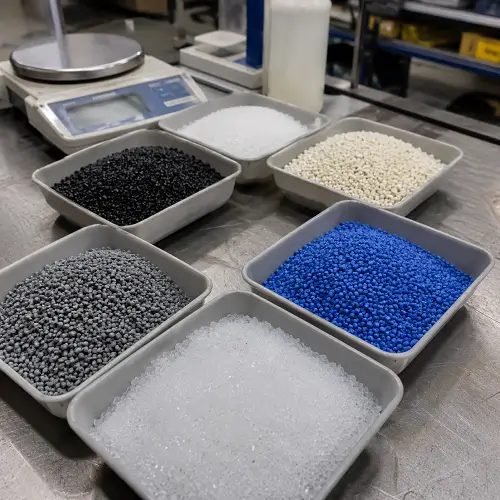
What Is the Density of Plastic?
Plastic density is the mass of a material divided by its volume. A plastic with a density of 1.20 g/cm³ weighs approximately 1.20 grams for every cubic centimeter of solid material.
The basic formula is:
Density = Mass ÷ Volume
There is no universal density for plastic. Unfilled polypropylene is commonly close to 0.90 g/cm³, HDPE is usually around 0.95 g/cm³, ABS is approximately 1.04 g/cm³, and polycarbonate is near 1.20 g/cm³.
The relationship can also be rearranged to estimate molded-part weight:
Part weight = CAD volume × Material density
This calculation is useful before tooling begins because it allows the weight and resin consumption of different material options to be compared using the same part geometry.
Plastic Density Chart for Common Materials
The following plastic density chart shows typical values for common unfilled materials. Reinforced, flame-retardant, mineral-filled, impact-modified, or recycled grades may fall outside these ranges.
| Plastic Material | Abbreviation | Typical Density g/cm³ | Typical Density kg/m³ | Float or Sink in Water |
|---|---|---|---|---|
| Polypropylene | PP | 0.89–0.91 | 890–910 | Usually floats |
| Low-Density Polyethylene | LDPE | 0.91–0.93 | 910–930 | Usually floats |
| High-Density Polyethylene | HDPE | 0.94–0.97 | 940–970 | Usually floats |
| Polystyrene | PS | 1.04–1.06 | 1,040–1,060 | Usually sinks |
| ABS | ABS | 1.03–1.07 | 1,030–1,070 | Usually sinks |
| Polyamide 6 | PA6 | 1.12–1.15 | 1,120–1,150 | Sinks |
| Polyamide 66 | PA66 | 1.13–1.16 | 1,130–1,160 | Sinks |
| Acrylic | PMMA | 1.17–1.20 | 1,170–1,200 | Sinks |
| Polycarbonate | PC | 1.19–1.22 | 1,190–1,220 | Sinks |
| PEEK | PEEK | 1.29–1.32 | 1,290–1,320 | Sinks |
| PBT | PBT | 1.29–1.32 | 1,290–1,320 | Sinks |
| PET | PET | 1.33–1.40 | 1,330–1,400 | Sinks |
| PPS | PPS | 1.34–1.36 | 1,340–1,360 | Sinks |
| Rigid PVC | PVC | 1.35–1.45 | 1,350–1,450 | Sinks |
| POM / Acetal | POM | 1.39–1.43 | 1,390–1,430 | Sinks |
These values are suitable for preliminary comparisons. Final weight, tooling, and production calculations should use the density listed on the datasheet for the selected resin grade.
What Units Are Used for Plastic Density?
Plastic density is commonly reported in:
- g/cm³
- kg/m³
- g/mL
- specific gravity
The main metric conversion is:
1 g/cm³ = 1,000 kg/m³
A material with a density of 1.20 g/cm³ therefore has a density of 1,200 kg/m³.
Specific gravity compares the density of a material with the density of a reference substance, normally water under defined test conditions. A plastic with a specific gravity of 1.20 is often treated as having a density close to 1.20 g/cm³ for preliminary calculations, although the test conditions should still be checked.
ISO 1183-1 and ASTM D792 are commonly used to determine the density or relative density of non-cellular plastics. The methods normally rely on immersion, displacement, pycnometer testing, or another controlled comparison of sample mass and volume.
How to Calculate Plastic Part Weight
When the CAD volume and material density are known, the theoretical weight of an injection molded part can be calculated before the mold is manufactured.
The formula is:
Part weight in grams = Part volume in cm³ × Density in g/cm³
Consider a plastic housing with a CAD volume of 75 cm³.
| Material | Density | Estimated Net Part Weight |
|---|---|---|
| PP | 0.90 g/cm³ | 67.5 g |
| ABS | 1.04 g/cm³ | 78 g |
| PC | 1.20 g/cm³ | 90 g |
| POM | 1.41 g/cm³ | 105.75 g |
The geometry remains unchanged, but the POM version weighs more than 50% more than the PP version.
This difference may affect handheld-product balance, shipping weight, material consumption, support structures, and the loads placed on surrounding components.
The CAD model must represent a closed solid without unintended overlaps, gaps, or duplicate bodies. The result above is also the net part weight. It does not include runners, sprues, cold slugs, startup scrap, rejected parts, or material left inside the barrel and hot-runner system.
How Does Plastic Density Affect Material Cost?
Plastic raw material is purchased and consumed by weight. A higher-density material requires more kilograms of resin to fill the same cavity volume.
A simplified calculation is:
Net material cost = Part weight × Resin price per kilogram
Production quotations also need to consider:
- runner and sprue weight;
- number of mold cavities;
- startup and color-change waste;
- expected rejection rate;
- permitted regrind percentage;
- cold-runner or hot-runner design;
- resin price;
- and annual production quantity.
A higher-density material is not automatically the most expensive option. Resin price, cycle time, scrap rate, processing temperature, machine requirements, tooling wear, and product performance can have a greater effect on total cost.
A filled material may be heavier but stiff enough to support a thinner section. An engineering plastic may cost more per kilogram but replace a metal component, improve service life, or reduce assembly work.
Density is therefore one part of the cost comparison rather than the complete decision.
Does Higher Plastic Density Mean Higher Strength?
Higher plastic density does not automatically mean greater strength, stiffness, toughness, or heat resistance. Density only describes how much mass is contained within a given volume.
POM is denser than unfilled PEEK, but this does not mean POM offers better high-temperature performance. Mineral-filled PP may be denser and stiffer than unfilled PP, but its impact strength, surface appearance, flow behavior, and weld-line performance can also change.
A material should therefore be evaluated using the complete plastic properties required by the product, including tensile strength, flexural modulus, impact resistance, creep, heat resistance, chemical resistance, shrinkage, moisture absorption, and fatigue performance.
How Does Density Affect Injection Molding?
Plastic density affects the amount of resin required for each production cycle. A denser resin produces a heavier shot when cavity and runner volume remain unchanged.
Shot Size and Machine Capacity
Injection molding machine capacity is often published using a reference resin, commonly as a polystyrene-equivalent shot weight. The usable shot weight changes when a resin has a different density and melt behavior.
The cavity, runner, and sprue volume should be converted to the actual material weight before the machine is selected. The required shot should also remain within a stable operating range rather than using the machine at its absolute maximum capacity.
Density is only one part of this calculation. Screw diameter, usable injection stroke, melt viscosity, injection pressure, residence time, processing temperature, and the supplier’s recommended shot utilization also matter.
A simple density ratio can support preliminary comparison, but it does not confirm that a machine is suitable for production.
Runner and Sprue Weight
A cold-runner mold produces the finished parts together with a runner and sprue.
Higher material density increases the weight of both the part and the runner. This becomes commercially important for large runners, multicavity molds, expensive engineering plastics, and materials with limited regrind allowance.
A hot-runner system may reduce runner waste, although tooling cost, maintenance, color changes, residence time, and heat sensitivity must also be considered.
Resin Consumption
For the same molded volume, a higher-density material consumes more kilograms of resin per cycle.
The effect becomes more noticeable in:
- large plastic parts;
- thick components;
- multicavity molds;
- high annual production;
- and expensive engineering materials.
Accurate density data allow the manufacturer to calculate net part weight, total shot weight, annual resin demand, and material cost more reliably.
Product and Shipping Weight
Density affects the final product weight even when the external dimensions remain unchanged.
A lightweight material may be important for handheld products, vehicle components, portable equipment, packaging, and moving assemblies. In other applications, a heavier material may improve perceived solidity or product balance.
The right choice depends on the function of the part rather than a general preference for lower or higher density.
Quality Control
Density testing can help compare incoming resin batches, check filler concentration, detect mixed material, and investigate unexpected changes in molded-part weight.
It should not be used as the only method of material identification. Melt-flow testing, moisture measurement, ash-content testing, spectroscopy, supplier certificates, and mechanical testing may also be required.
For routine production, monitoring part and runner weight is often more practical than testing density for every batch. Changes in weight may reveal unstable packing, feeding problems, material variation, cushion changes, or inconsistent processing.
Cooling and Cycle Time
Density alone does not determine injection molding cycle time.
The cooling stage is more directly affected by wall thickness, thermal conductivity, specific heat, crystallization behavior, melt temperature, mold temperature, part geometry, and cooling-channel design.
A filled material may be denser and cool differently, but the result comes from the entire formulation rather than density by itself.
Injection Molding Weight and Cost Example
Consider a four-cavity mold producing a part with a net CAD volume of 50 cm³ per cavity. The complete cold runner has a volume of 40 cm³.
The total plastic volume per cycle is:
4 × 50 cm³ + 40 cm³ = 240 cm³
Using PP at 0.90 g/cm³:
240 × 0.90 = 216 g per cycle
Using ABS at 1.04 g/cm³:
240 × 1.04 = 249.6 g per cycle
Using POM at 1.41 g/cm³:
240 × 1.41 = 338.4 g per cycle
The mold volume has not changed, but the POM version uses more than 120 additional grams per cycle compared with PP.
At 100,000 production cycles, the difference between PP and POM would exceed 12,000 kilograms of resin before considering startup waste or rejected parts.
This does not mean PP should replace POM. The two materials offer different wear resistance, friction, stiffness, fatigue performance, shrinkage, and dimensional behavior.
The example shows why the CAD model, exact material grade, cavity count, runner design, and expected production quantity are all needed for an accurate injection molding quotation.
What Is High-Density Plastic?
The phrase high-density plastic is often used informally to refer to HDPE, but HDPE is not the highest-density plastic material.
HDPE means high-density polyethylene. It is called high density because its molecular structure allows closer chain packing and greater crystallinity than LDPE.
Typical values are:
- LDPE: approximately 0.91–0.93 g/cm³
- HDPE: approximately 0.94–0.97 g/cm³
Despite its name, HDPE remains lighter than water and lighter than ABS, PC, PA, POM, PBT, PPS, and many other engineering plastics.
HDPE is therefore high density within the polyethylene family, not among all plastic materials.
When a product drawing or inquiry specifies “high-density plastic,” the intended polymer should be clarified. The phrase may refer to HDPE, a heavily filled compound, a rigid engineering plastic, or simply a material that feels heavier.
LDPE vs HDPE Density
LDPE and HDPE are both polyethylene materials, but their molecular structures are different.
LDPE contains more chain branching. These branches prevent the polymer chains from packing closely, resulting in lower crystallinity and lower density.
HDPE contains less branching, allowing the chains to pack more closely and form a greater proportion of crystalline regions.
The numerical density difference is relatively small, but the structural difference also affects:
- stiffness;
- flexibility;
- shrinkage;
- chemical resistance;
- environmental stress-crack behavior;
- and molding performance.
Material selection should not be based only on the small density difference between the two polymers.
What Is the Density of ABS Plastic?
The density of ABS plastic is commonly around 1.03–1.07 g/cm³, with many general-purpose injection molding grades close to 1.04 g/cm³.
A solid ABS component normally sinks in water because the base material is slightly denser than water. A hollow ABS product may still float because its internal air reduces the average density of the complete assembly.
ABS density can change when the formulation contains flame retardants, mineral fillers, glass fiber, impact modifiers, plating additives, pigments, or recycled resin.
Filled and flame-retardant ABS grades may therefore produce a noticeably heavier part than standard unfilled ABS, even when both materials are referred to simply as ABS.
What Is the Density of Polypropylene?
Unfilled polypropylene is one of the lightest common thermoplastics, with many grades close to 0.90 g/cm³.
Its low density supports lightweight containers, living hinges, automotive trim, battery components, household products, and large molded parts where minimum weight is important.
Filled polypropylene can be much heavier. Talc, calcium carbonate, glass fiber, and other reinforcements increase compound density.
A part made from 30% mineral-filled PP should not be calculated using the same density as an unfilled PP part. The filled material may offer greater stiffness and lower shrinkage, but it can also change flow, surface appearance, impact behavior, warpage, and tool wear.
What Is the Density of Polycarbonate?
Unfilled polycarbonate normally has a density close to 1.20 g/cm³.
A PC component with the same solid volume as a PP component can therefore weigh approximately one-third more.
The higher weight may be acceptable when the application requires PC’s impact performance, transparency, dimensional behavior, or heat resistance.
Glass fiber, mineral filler, flame retardants, and other additives can increase PC density. PC/ABS blends also have their own grade-specific density and should not be calculated using the value of pure PC or ABS.
What Is the Density of Nylon?
Nylon density depends on the polyamide family, filler content, and moisture condition.
Typical unfilled values include:
- PA6: approximately 1.12–1.15 g/cm³
- PA66: approximately 1.13–1.16 g/cm³
- PA12: generally lower than PA6 and PA66
- glass-filled nylon: higher than the unfilled polymer
For example, unfilled PA6 may have a density around 1.13 g/cm³, while a 30% glass-filled PA6 grade may be close to 1.36 g/cm³.
This difference affects part weight, shot weight, shrinkage, stiffness, and mold wear.
Moisture absorption also matters. Nylon can absorb water after molding, increasing part mass and changing dimensions and mechanical behavior. Weight comparisons should therefore specify whether the sample is dry-as-molded or conditioned.
What Is the Density of POM Plastic?
POM, also called acetal, commonly has a density around 1.39–1.43 g/cm³.
At the same solid volume, a POM part is noticeably heavier than a PP, ABS, PC, or unfilled nylon part.
POM is often selected for gears, sliding components, latches, bearings, and precision moving parts because of its low friction, wear resistance, fatigue performance, and dimensional behavior rather than its weight.
Impact-modified, low-friction, glass-filled, conductive, and metal-detectable POM grades may have different densities from standard unfilled acetal.
What Is the Density of PBT, PPS, and PEEK?
PBT and unfilled PEEK are commonly near 1.30 g/cm³, while unfilled PPS is usually close to 1.35 g/cm³.
These engineering plastics are frequently supplied with glass fiber, carbon fiber, mineral filler, flame-retardant systems, or wear additives. Reinforced density can therefore be considerably higher than the unfilled value.
Heavily filled PPS compounds, for example, may exceed 2.0 g/cm³.
A change in filler content affects more than part weight. It may also change:
- melt flow;
- injection pressure;
- fiber orientation;
- shrinkage;
- dimensional stability;
- surface appearance;
- abrasion;
- and mold-steel requirements.
Which Plastics Float in Water?
Water has a density close to 1.0 g/cm³ under ordinary room conditions. A solid, non-foamed plastic with a density below water generally floats, while a material with a density above water generally sinks.
Plastics that usually float include PP, LDPE, and HDPE.
ABS, PS, PA, PMMA, PC, PET, PBT, PPS, PEEK, POM, and rigid PVC usually sink.
Float testing is only a basic identification method. It cannot reliably identify a polymer because fillers, foaming, internal cavities, bubbles, contamination, and product geometry can change the result.
A hollow PC housing may float because it traps air, even though solid PC is denser than water. A mineral-filled PP component may sink even though unfilled PP normally floats.
Plastic Density vs Bulk Density
Material density and pellet bulk density are not the same measurement.
Material density describes the mass of the solid polymer or compound divided by its solid volume.
Bulk density describes the mass of loose pellets, powder, or regrind divided by the total container volume, including the empty spaces between particles.
Plastic pellets do not pack without gaps, so pellet bulk density is normally lower than the density of the solid molded material.
Bulk density is useful when sizing hoppers, dryers, silos, conveying equipment, packaging, and volumetric dosing systems.
Solid material density should be used when calculating molded-part weight.
Why Do Plastics Have Different Densities?
Plastic density depends on polymer chemistry, molecular arrangement, crystallinity, filler content, and the physical structure of the material.
Polymer Molecular Structure
Different plastics contain different atoms, chemical groups, and molecular arrangements.
Materials built mainly from lightweight hydrocarbon chains do not have the same density as polymers containing heavier atoms, oxygen-rich groups, or rigid aromatic structures.
This is one reason PP and PE are lighter than PVC, POM, and many engineering compounds.
Crystallinity
Semi-crystalline plastics contain ordered regions where molecular chains pack more closely.
Higher crystallinity can increase density within the same polymer family. The difference between LDPE and HDPE is a familiar example.
Glass Fiber and Mineral Fillers
Glass fiber, talc, calcium carbonate, barium sulfate, and metal-containing fillers are generally denser than the base polymer.
Adding them increases the density of the final compound. The same change may also increase stiffness, reduce shrinkage, alter warpage, affect surface quality, and increase abrasion inside the mold.
Flame Retardants and Functional Additives
Flame-retardant systems, conductive fillers, metal-detectable additives, and thermally conductive fillers can increase material density substantially.
A flame-retardant grade should not be assumed to have the same part weight as a standard grade from the same polymer family.
Plasticizers and Impact Modifiers
Plasticizers and elastomeric modifiers may increase or decrease density depending on their composition and loading level.
Flexible PVC can cover a broad density range because its formulation may contain different plasticizers, stabilizers, pigments, and fillers.
Recycled Content and Contamination
A controlled recycled grade may have density close to the equivalent virgin material.
Mixed or contaminated recycled material may show greater variation. Density testing can help reveal changes in filler concentration, contamination, composition, or internal structure.
Foaming and Internal Voids
Foamed plastic contains gas cells that reduce apparent density.
Structural foam injection molding can produce a component with lower average density than a solid part made from the same base polymer.
Unintended voids also reduce measured part density, although they usually represent a molding defect rather than a planned material property.
How Do Glass Fiber and Fillers Change Plastic Density?
Reinforcement percentage can create a substantial weight difference.
Typical PA6 values illustrate the trend:
- unfilled PA6: approximately 1.13 g/cm³;
- PA6-GF15: approximately 1.23 g/cm³;
- PA6-GF30: approximately 1.36 g/cm³.
The higher density is only one result of reinforcement.
Glass-filled materials may also provide greater stiffness, reduced shrinkage in the flow direction, improved heat-deflection performance, greater abrasion, and more directional warpage.
The mold design may need changes to gate size, gate location, cavity shrinkage allowance, venting, ejector placement, steel selection, surface treatment, and cosmetic expectations.
The base polymer name alone is not enough to calculate the final part or design the mold. Filler type and percentage must also be identified.
How Is Plastic Density Measured?
Plastic density is commonly measured by weighing a sample and determining its displaced liquid volume.
ASTM D792 and ISO 1183-1 provide standardized methods for the density and relative density of non-cellular plastics.
A representative sample should not contain unintended bubbles, internal voids, contamination, or attached metal components.
A useful test report should identify:
- test method;
- sample condition;
- test temperature;
- reinforcement level;
- whether the sample is dry or conditioned;
- and whether the reported result is solid density or apparent density.
In production, part-weight monitoring is often more practical than regular laboratory density testing. Stable part and runner weight can help identify changes in packing, cushion, feeding, material supply, or process consistency.
Can Density Identify a Type of Plastic?
Density can narrow the possible material family, but it cannot identify a plastic reliably by itself.
PP and PE are normally below 1.0 g/cm³, while many engineering plastics are above 1.0 g/cm³. However, several materials overlap.
ABS and PS may both be close to 1.04 g/cm³. PBT and PEEK may both be near 1.30 g/cm³. PA6 and PA66 also have similar unfilled densities.
Filled PP may overlap with an unfilled engineering plastic, while flame-retardant or mineral-filled grades may be much denser than standard material.
Accurate identification may require supplier records, FTIR spectroscopy, melting analysis, ash-content testing, or other laboratory methods.
Unknown resin should not be approved for production only because its density appears close to the required material.
How to Choose Plastic Based on Density
Density becomes important when product weight, buoyancy, resin consumption, or transportation cost is a major design requirement.
Low-density PP or PE may be suitable when the product needs to float, remain lightweight, resist moisture, or reduce material weight.
Higher-density engineering plastics may still be preferred when the part requires wear resistance, stiffness, dimensional stability, heat resistance, chemical resistance, electrical performance, or low friction.
The lightest material is not automatically the best choice. The heaviest material is not automatically the strongest.
Material selection should also consider:
- mechanical loads;
- operating temperature;
- chemicals and moisture;
- dimensional tolerances;
- surface and color requirements;
- molding shrinkage;
- reinforcement;
- regulatory requirements;
- annual quantity;
- and total molded-part cost.
When several common injection molding materials can meet the application requirements, density helps compare final part weight, shot weight, and annual resin consumption.
What Density Information Is Needed for an Injection Molding Quote?
When the resin has already been selected, provide the supplier name and complete grade code. The injection molding manufacturer can then review its density, shrinkage, drying requirements, processing window, and reinforcement level.
When the material has not been finalized, useful project information includes:
- 3D CAD model or part volume;
- 2D drawing and critical tolerances;
- preferred polymer family;
- target product weight;
- glass-fiber or mineral-filler percentage;
- virgin or recycled-content requirement;
- mechanical and thermal requirements;
- whether the product must float;
- surface finish and color;
- expected annual quantity;
- and permitted material alternatives.
A requirement such as “high-density plastic” is not specific enough for quotation or mold design. It should be clarified whether the product requires HDPE, a mineral-filled material, a rigid engineering plastic, or a minimum numerical density.
Conclusion
Plastic density helps estimate part weight, resin consumption, runner weight, shot size, shipping weight, and material cost before injection molding begins.
Common unfilled plastics range from approximately 0.90 g/cm³ for polypropylene to around 1.41 g/cm³ for POM. Glass fiber, mineral fillers, flame retardants, and other additives can increase density considerably.
The value used for a real project should come from the exact resin grade. Density alone cannot determine strength, heat resistance, shrinkage, flow, or long-term durability.
JeekMould can review the CAD model, material requirements, part weight, wall thickness, expected quantity, and mold structure before manufacturing begins. Upload your 3D model or 2D drawing together with the selected resin grade to receive an injection molding DFM review and quotation.