
Types of plastic vary widely in strength, flexibility, heat resistance, transparency, chemical resistance, and manufacturing performance. Plastic is not a single material but a large family of polymers designed for different products and operating conditions.
Common plastics include PET, HDPE, PVC, LDPE, PP, PS, ABS, polycarbonate, nylon, acrylic, POM, PBT, PPS, and PEEK. Some are identified on packaging through Resin Identification Codes, while others are mainly used in engineering, medical, automotive, electrical, and industrial components.
Plastics can also be classified according to how they respond to heat, their performance level, and their polymer structure. Understanding the different types of plastic, their properties, and their uses helps product designers compare materials for packaging, consumer products, electrical components, medical equipment, automotive parts, and injection molded products.
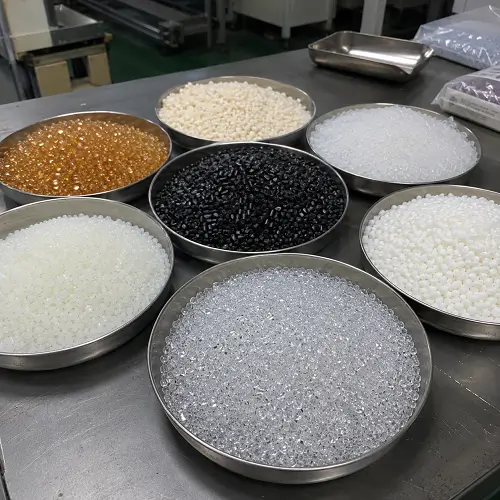
What Are the Common Types of Plastic?
PET, HDPE, PVC, LDPE, PP, PS, and materials grouped under Other are commonly identified through Resin Identification Codes 1 through 7.
| Plastic Number | Plastic | Full Name | Common Uses |
|---|---|---|---|
| 1 | PET | Polyethylene Terephthalate | Bottles, food trays, packaging, fibers |
| 2 | HDPE | High-Density Polyethylene | Containers, pipes, caps, crates |
| 3 | PVC | Polyvinyl Chloride | Pipes, cables, flooring, flexible tubing |
| 4 | LDPE | Low-Density Polyethylene | Bags, films, squeeze bottles, liners |
| 5 | PP | Polypropylene | Caps, containers, living hinges, automotive parts |
| 6 | PS | Polystyrene | Trays, housings, disposable products, foam packaging |
| 7 | Other | Other resin chemistries | Engineering plastics, blends, and specialty parts |
These numbers identify the primary resin family used in a manufactured plastic article. They do not rank plastics according to strength, quality, safety, or recyclability.
The Resin Identification Code system is only one way to classify plastics. Product designers and manufacturers also distinguish between thermoplastics, thermosets, elastomers, commodity plastics, engineering plastics, amorphous plastics, and semi-crystalline plastics.
1. PET — Polyethylene Terephthalate
Polyethylene terephthalate, commonly abbreviated as PET or PETE, is identified by resin code 1.
PET is a polyester thermoplastic known for its good strength-to-weight ratio, moisture resistance, and ability to produce clear packaging. Amorphous PET is widely used for transparent bottles and containers, while semi-crystalline and reinforced PET grades are available for engineering applications.
PET is commonly found in water bottles, soft-drink bottles, food trays, cooking-oil containers, cosmetic packaging, plastic strapping, and polyester fibers. Engineering PET grades may also be used for electrical, automotive, and mechanical components that require greater stiffness, dimensional stability, or heat resistance.
PET bottles are normally manufactured by injection molding a preform and then stretch blow molding it into the final bottle shape. PET sheet can be thermoformed into trays, while suitable resin grades can also be processed through injection molding and extrusion.
The final performance of PET depends on the selected grade, crystallinity, moisture control, wall thickness, processing conditions, and intended use.
2. HDPE — High-Density Polyethylene
High-density polyethylene, or HDPE, is identified by resin code 2.
HDPE has polymer chains that can pack relatively closely together, giving it greater density and stiffness than LDPE. It is generally tough, lightweight, moisture resistant, and resistant to many chemicals.
Common HDPE products include milk bottles, detergent containers, shampoo bottles, buckets, storage bins, crates, toys, caps, industrial containers, and water or gas pipes.
Blow molding is widely used for hollow HDPE bottles and containers. Injection molding is common for caps, crates, bins, household products, toys, and industrial components, while extrusion is used for pipes, films, sheets, and profiles.
HDPE is normally opaque or translucent rather than completely clear. Its toughness and chemical resistance make it suitable for packaging and industrial applications, although shrinkage, dimensional stability, environmental stress cracking, and operating temperature still need to be reviewed.
3. PVC — Polyvinyl Chloride
Polyvinyl chloride, or PVC, is identified by resin code 3.
PVC can be produced as either a rigid or flexible plastic. Rigid PVC is widely used for pipes, construction profiles, panels, fittings, and electrical products. Flexible PVC contains plasticizers and is used for cable insulation, medical tubing, hoses, flooring, seals, and flexible profiles.
The properties of PVC depend heavily on its formulation. Plasticizers can increase flexibility, while stabilizers, fillers, impact modifiers, and flame-retardant additives can change durability, processing behavior, and end-use performance.
Extrusion is one of the main manufacturing processes for PVC pipes, profiles, cable coatings, and sheets. PVC can also be injection molded into fittings, connectors, handles, electrical housings, and other shaped components.
Because rigid and flexible PVC behave differently, the exact grade and additive package should be confirmed before the material is selected.
4. LDPE — Low-Density Polyethylene
Low-density polyethylene, or LDPE, is identified by resin code 4.
LDPE has a more highly branched molecular structure than HDPE. This prevents the polymer chains from packing as closely together, producing a material that is generally softer, more flexible, and lower in density.
LDPE is widely used for plastic bags, packaging films, cling wrap, squeeze bottles, flexible lids, cable coatings, agricultural films, protective liners, and flexible laboratory products.
Film extrusion is the most common process for LDPE bags, wraps, and flexible packaging. Blow molding can be used for squeeze bottles, while injection molding is suitable for some flexible lids, caps, containers, and small plastic parts.
LDPE performs well where flexibility, moisture resistance, and easy processing are more important than structural stiffness. It is less suitable for products that require high rigidity, high-temperature performance, or tight dimensional control.
5. PP — Polypropylene
Polypropylene, or PP, is identified by resin code 5 and is one of the most widely used thermoplastics.
PP has low density, good chemical resistance, and useful fatigue resistance. Certain grades can flex repeatedly without cracking, which makes polypropylene a common material for living hinges in bottle caps, packaging boxes, and reusable containers.
Polypropylene is widely used for food containers, bottle caps, storage boxes, automotive trim, battery cases, syringe components, medical containers, appliance parts, plastic housings, textile fibers, and household products.
Injection molding is commonly used for PP caps, containers, automotive components, clips, housings, and consumer products. Polypropylene is also processed through extrusion, thermoforming, blow molding, and fiber production.
PP is available as homopolymer, random copolymer, impact copolymer, mineral-filled, glass-filled, and flame-retardant grades. The suitable grade depends on the required stiffness, impact strength, surface appearance, dimensional stability, and operating temperature.
6. PS — Polystyrene
Polystyrene, or PS, is identified by resin code 6.
General-purpose polystyrene is normally rigid, easy to process, and naturally transparent, but it can be brittle. High-impact polystyrene, commonly called HIPS, contains impact-modifying material that improves toughness but reduces transparency.
Polystyrene is also available as expanded polystyrene, or EPS, which has a lightweight cellular structure.
Rigid PS and HIPS are commonly used for disposable packaging, laboratory products, appliance liners, cosmetic containers, trays, and low-cost plastic housings. EPS is widely used for protective packaging, insulation panels, chilled-food boxes, and helmet liners.
Injection molding is used for rigid PS and HIPS components. Thermoforming is common for trays and packaging, while specialized foaming processes are used to manufacture EPS products.
Standard PS is suitable for low-cost rigid products and transparent parts that do not require high impact resistance. HIPS is selected when additional toughness is needed, while EPS is mainly used for insulation, cushioning, and lightweight packaging.
7. Other Plastics
Resin code 7 is labeled Other.
It is not one specific plastic. The category includes polymer chemistries that are not included in resin codes 1 through 6.
Other plastics may include ABS, polycarbonate, nylon, acrylic, acetal, PLA, PBT, PPS, PEEK, PEI, PPSU, plastic blends, multilayer materials, and other specialty polymers.
The properties of these materials vary greatly. ABS is commonly used for impact-resistant housings and consumer products. Polycarbonate can provide transparency and impact strength. Nylon is used for gears, clips, brackets, and mechanical components. POM provides low friction and dimensional stability, while PPS and PEEK are used in more demanding heat, chemical, and mechanical environments.
A resin code 7 marking alone does not provide enough information for product design. The exact resin name, grade, reinforcement, additives, regulatory approval, and supplier datasheet should be reviewed.
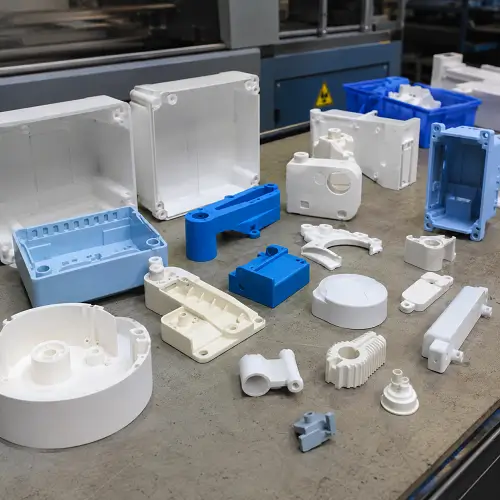
Comparison of Common Plastic Types
| Plastic Number | Plastic Name | Typical Properties | Common Uses | Common Manufacturing Processes |
|---|---|---|---|---|
| 1 | PET | Strong, lightweight, moisture resistant, often clear | Bottles, trays, fibers, packaging | Injection molding, blow molding, thermoforming, extrusion |
| 2 | HDPE | Tough, chemical resistant, relatively stiff | Bottles, crates, bins, pipes, caps | Blow molding, injection molding, extrusion |
| 3 | PVC | Can be rigid or flexible, durable, versatile | Pipes, profiles, cable insulation, flooring | Extrusion, injection molding, calendaring |
| 4 | LDPE | Soft, flexible, moisture resistant | Bags, films, squeeze bottles, coatings | Film extrusion, blow molding, injection molding |
| 5 | PP | Lightweight, chemical resistant, fatigue resistant | Caps, hinges, containers, automotive parts | Injection molding, extrusion, thermoforming, blow molding |
| 6 | PS | Rigid and clear, impact modified, or foamed | Packaging, trays, housings, insulation | Injection molding, thermoforming, foaming |
| 7 | Other | Properties depend on the exact resin | Engineering parts, housings, medical and specialty products | Injection molding and other processes |
This plastic comparison provides a general overview rather than a final material specification.
The properties of a plastic can change significantly between different grades. Glass fiber can increase stiffness, impact modifiers can improve toughness, and plasticizers can increase flexibility. Flame retardants, UV stabilizers, mineral fillers, colorants, and recycled content can also affect processing, appearance, shrinkage, and mechanical performance.
What Do Plastic Numbers 1 to 7 Mean?
Plastic numbers 1 through 7 are Resin Identification Codes used to identify the main polymer in a manufactured plastic article.
Numbers 1 to 6 represent PET, HDPE, PVC, LDPE, PP, and PS. Number 7 covers other polymer chemistries that do not belong to the first six groups.
These codes are often called plastic recycling numbers because they commonly appear inside a triangular symbol. However, the number identifies the resin type and does not guarantee that the finished product can be recycled.
Actual recyclability depends on local collection systems, product shape, contamination, color, labels, additives, multilayer construction, and the recycling equipment available in a particular region.
Plastic numbers also do not confirm whether a product is suitable for food contact, medical use, electrical insulation, or high-temperature applications. These requirements depend on the exact resin grade, formulation, additives, intended use, and applicable certifications.
How Are Plastics Classified?
The Resin Identification Code system is only one method of classifying plastic materials.
Product designers, material suppliers, and manufacturers also classify plastics according to how they respond to heat, their elastic behavior, their performance level, and the arrangement of their polymer chains.
| Classification Method | Main Plastic Categories |
|---|---|
| Resin identification | PET, HDPE, PVC, LDPE, PP, PS, Other |
| Response to heat | Thermoplastics and thermosets |
| Elastic behavior | Elastomers and thermoplastic elastomers |
| Performance level | Commodity, engineering, and high-performance plastics |
| Polymer structure | Amorphous and semi-crystalline plastics |
These classification methods describe different characteristics of the same material.
For example, polypropylene is identified by resin code 5, but it is also a thermoplastic, a semi-crystalline polymer, and usually a commodity plastic. Polycarbonate is normally placed under resin code 7, while also being an amorphous engineering thermoplastic.
This is why the question “how many types of plastic are there?” does not have one universal answer. Manufacturers work with many polymer families, reinforced compounds, blends, and specialized grades.
Thermoplastics vs Thermosets vs Elastomers
Thermoplastics, thermosets, and elastomers are separated according to how the polymer responds to heat and deformation.
Thermoplastics
Thermoplastics soften or melt when heated and harden again when cooled. This behavior allows them to be shaped through injection molding, extrusion, blow molding, thermoforming, and other melt-processing methods.
PE, PP, PVC, PET, PS, ABS, PC, PA, POM, PMMA, PBT, PPS, and PEEK are all thermoplastics.
Most materials included in the Resin Identification Code system are thermoplastics. Their ability to soften again also makes mechanical reprocessing possible, although repeated heating, contamination, mixed materials, and polymer degradation can reduce final material quality.
Thermosetting Plastics
Thermosetting plastics, also called thermosets, undergo an irreversible curing reaction. After curing, they do not simply melt and return to their original processing state when reheated.
Epoxy, phenolic resin, melamine formaldehyde, unsaturated polyester, certain polyurethane systems, and silicone thermosets are common examples.
Thermosets are used for electrical insulation, adhesives, coatings, composite structures, heat-resistant handles, and products that require dimensional stability after curing.
Their manufacturing processes differ from conventional thermoplastic injection molding because the material cures inside the mold rather than only cooling and solidifying.
Elastomers and Thermoplastic Elastomers
Elastomers can deform under load and recover toward their original shape after the force is removed.
Traditional rubber materials normally require vulcanization or curing. Thermoplastic elastomers combine rubber-like flexibility with the processing behavior of thermoplastics.
TPE, TPU, TPV, and TPR are widely used for soft grips, seals, protective covers, cable components, flexible housings, and overmolded parts. Silicone rubber, EPDM, and natural rubber are also common elastomer materials, although their molding and curing methods differ.
Commodity Plastics vs Engineering Plastics
Plastic materials can also be grouped according to their typical performance, availability, production volume, and application requirements.
Commodity Plastics
Commodity plastics are widely produced materials used in packaging, consumer products, construction, agriculture, and other high-volume applications.
PE, PP, PVC, PS, and PET are commonly described as commodity plastics. These materials are available in many grades and are often selected when cost, availability, easy processing, and production volume are important.
The term commodity plastic does not mean that the material is low quality. Reinforced, impact-modified, flame-retardant, and specially formulated grades can be used in automotive, electrical, medical, and industrial products.
Engineering Plastics
Engineering plastics are normally selected when a part requires better strength, heat resistance, dimensional stability, wear resistance, impact performance, or electrical properties.
ABS, PC, PA, POM, PBT, PMMA, modified PPO, and PC/ABS are common engineering plastics. They are widely used for gears, bearings, electrical connectors, automotive components, appliance parts, equipment housings, and precision injection molded products.
The boundary between commodity plastics and engineering plastics is not absolute. A reinforced polypropylene grade, for example, may replace an engineering plastic in some automotive or industrial applications.
The exact resin grade and product requirements are more important than the category name.
High-Performance Plastics
High-performance plastics are used when a component must operate under demanding temperatures, chemicals, loads, wear, sterilization, or electrical conditions.
PEEK, PPS, PEI, PPSU, PSU, LCP, PAI, PTFE, and other fluoropolymers are commonly included in this category.
These plastics normally cost more and may require higher processing temperatures, controlled drying, specialized molding equipment, and more demanding mold design.
A high-performance material should only be selected when its properties are required by the actual application.
Amorphous vs Semi-Crystalline Plastics
Thermoplastics can also be classified according to how their polymer chains are arranged after cooling.
Amorphous Plastics
Amorphous plastics have polymer chains arranged without long-range crystalline order.
ABS, PC, PMMA, PS, SAN, PEI, PSU, PPSU, and many PVC formulations are commonly described as amorphous plastics.
These materials generally soften over a temperature range associated with their glass-transition behavior rather than having one sharply defined crystalline melting point.
Many amorphous plastics provide relatively low molding shrinkage, good dimensional consistency, and predictable surface appearance. Some amorphous materials, including PMMA and PC, can also produce transparent plastic parts.
Transparency still depends on the material grade, fillers, colorants, surface texture, wall thickness, mold polish, and processing conditions.
Semi-Crystalline Plastics
Semi-crystalline plastics contain both ordered crystalline regions and amorphous regions.
PE, PP, PA, POM, PET, PBT, PPS, and PEEK are common semi-crystalline plastics.
These materials normally have a more defined melting range and can provide good chemical resistance, fatigue strength, wear resistance, or low-friction performance.
Semi-crystalline plastics often have higher molding shrinkage than amorphous plastics. Cooling rate, mold temperature, wall thickness, crystallization, and fiber orientation can all affect final dimensions and warpage.
The terms amorphous and semi-crystalline describe polymer structure rather than overall quality. Both categories contain plastics used for everyday consumer products and demanding engineering components.
Which Types of Plastic Are Used for Injection Molding?
Most injection molded plastic parts are manufactured from thermoplastics.
| Plastic | Typical Injection Molded Products |
|---|---|
| PP | Caps, living hinges, containers, automotive trim |
| ABS | Electronic housings, appliance parts, consumer products |
| PC | Transparent covers, protective housings, medical components |
| PC/ABS | Automotive interiors, equipment housings, electronic parts |
| PA | Gears, clips, brackets, mechanical parts |
| POM | Bushings, gears, latches, low-friction components |
| PE | Caps, containers, household and industrial parts |
| PMMA | Lenses, light covers, transparent cosmetic parts |
| PBT | Electrical connectors, sensor housings, automotive parts |
| PPS | Heat-resistant electrical and industrial components |
| PEEK | Medical, aerospace, semiconductor, and demanding mechanical parts |
Material selection should not be based only on the polymer name.
An ABS grade developed for plating may behave differently from a flame-retardant ABS. Glass-filled nylon has different stiffness, flow, shrinkage, warpage, and surface appearance from an unfilled nylon grade. A high-flow PC grade may fill a thin housing more easily than a standard structural grade.
The exact resin grade can change the required injection pressure, mold temperature, drying conditions, practical wall thickness, shrinkage, surface finish, cooling time, and mechanical performance.
These differences can be significant even within the same polymer family. The supplier datasheet, product environment, molding requirements, and complete part design should therefore be reviewed before mold manufacturing.
Thermoset molding is also possible, but it uses different materials and processing controls because the resin cures inside the mold rather than simply cooling and solidifying.
How to Choose the Right Type of Plastic
The right type of plastic depends on how the product will be used, how it will be manufactured, and what performance the final part must provide.
Mechanical and Environmental Requirements
The first step is to identify the main loads and operating environment.
A plastic part may need to resist impact, bending, compression, screw installation, repeated movement, friction, or long-term creep. A material with high short-term strength can still deform if it remains under a constant load for a long period.
Operating temperature must also be considered. The material should remain stable during normal use and temporary exposure to higher temperatures. Glass-transition behavior, melting range, heat-deflection temperature, thermal expansion, and long-term aging can all affect performance.
Oils, fuels, cleaners, acids, alkalis, moisture, UV light, and outdoor weather may also change the appearance and strength of a plastic. Chemical resistance should be checked against the actual substance, concentration, temperature, and exposure time.
Flexibility, Appearance, and Dimensional Stability
The required flexibility or rigidity should be based on product function.
LDPE, TPE, and TPU may suit flexible products, seals, grips, or protective features. ABS, PC, impact-modified PP, and reinforced engineering plastics may be considered for rigid components that require greater impact resistance.
Transparent parts commonly use PET, PMMA, PC, or suitable grades of PS. ABS and PC/ABS are frequently selected for textured, painted, or decorative housings. Reinforced plastics may show visible fibers or flow patterns and may not be suitable for every cosmetic surface.
Dimensional stability is especially important for gears, connectors, housings, assembly features, and tight-tolerance parts. Material shrinkage, moisture absorption, crystallinity, fiber orientation, wall thickness, gate position, and cooling conditions can all affect final dimensions.
Regulations and Manufacturing Process
Medical, food-contact, electrical, automotive, and flame-retardant applications may require approved resin grades and supporting documentation.
A plastic number or polymer family does not prove compliance. The exact grade, color, additives, intended use, and applicable certification must be confirmed.
The manufacturing process should also be considered. Some plastics are more suitable for film extrusion, blow molding, thermoforming, rotational molding, compression molding, or injection molding.
Product geometry, annual quantity, wall thickness, tolerances, surface appearance, tooling budget, and production volume must be reviewed together with the material properties.
Material Cost and Total Production Cost
The lowest-priced plastic does not always produce the lowest-cost part.
A material with poor flow may require thicker walls, a larger gate, or a larger injection molding machine. A slow-cooling material can increase cycle time, while an unstable material may create more scrap, warpage, or dimensional variation.
Material cost should therefore be evaluated together with mold complexity, molding cycle, processing temperature, drying requirements, scrap rate, quality control, and expected service life.
The most suitable plastic is the material that meets the product requirements without adding unnecessary cost or performance.
Conclusion
Common plastic types include PET, HDPE, PVC, LDPE, PP, PS, and many engineering or specialty polymers grouped under the Other resin identification category.
Plastics can also be divided into thermoplastics and thermosets, commodity and engineering plastics, or amorphous and semi-crystalline polymers. Each classification explains a different part of material behavior.
PET is widely used for bottles, packaging, and fibers. HDPE is common in containers, crates, and pipes. PVC can be rigid or flexible. LDPE is used for films and flexible products. PP is widely used for caps, containers, housings, and living hinges. PS is available as rigid, impact-modified, or foamed material. Other plastics include many engineering, high-performance, and specialty polymers.
No single plastic is suitable for every product. The final material should be selected according to mechanical load, temperature, chemical exposure, surface appearance, dimensional requirements, manufacturing process, regulatory needs, production quantity, and total cost.
JeekMould supports plastic material selection, injection molding DFM, mold manufacturing, trial molding, and plastic part production. Upload your 3D CAD model and material requirements to receive an injection molding review and quotation.