
Many plastic parts work well at room temperature but begin to soften, deform, or lose strength when exposed to heat for a long time. This becomes a serious problem for automotive components, electrical connectors, medical devices, industrial equipment, and products used near engines, heating elements, or sterilization environments.
Choosing the right heat resistant plastic is not only about selecting the material with the highest temperature rating. Cost, strength, dimensional stability, chemical resistance, moldability, and the actual working environment all affect the final choice. In many projects, PEEK may offer excellent heat resistance, but PPS, PEI, PPSU, LCP, PA46, or PBT may be more practical depending on the part function and production budget.
This guide explains the best heat resistant plastics for injection molding, their advantages, limitations, typical cost level, and the types of parts they are commonly used for.
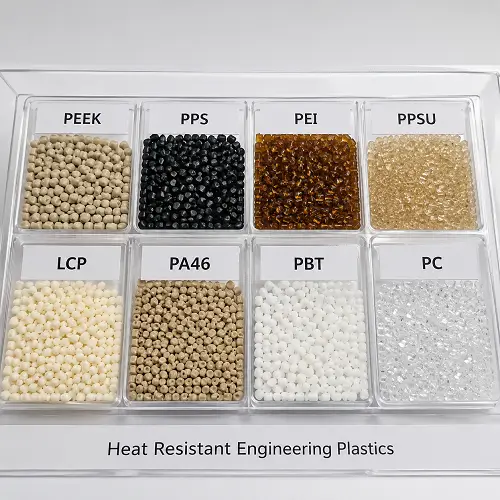
What Are Heat Resistant Plastics?
Heat resistant plastics are materials that can keep their shape, strength, and function when exposed to elevated temperatures. For injection molded parts, this usually means more than surviving a short heat spike. The material should also remain stable during long-term use, repeated heating cycles, or exposure to hot environments.
A material with a high melting point is not always the best choice. Some plastics may resist heat but become difficult to mold, too expensive for the project, or unsuitable for the product’s mechanical requirements. A good material choice should match the working temperature, load, chemical exposure, part size, and expected service life.
For example, a medical part that needs repeated steam sterilization may require PPSU or PEEK, while an electrical connector may be better suited to LCP, PPS, or PBT. An automotive part near the engine area may need PPS, PA46, or glass-filled PBT instead of a standard plastic such as ABS or PP.
Best Heat Resistant Plastics for Injection Molding
PEEK
PEEK is one of the highest-performance heat resistant plastics used in injection molding. It can handle high temperature, mechanical load, chemical exposure, and long-term service conditions better than most standard engineering plastics. It is often selected when failure is not acceptable.
The main advantage of PEEK is its strong balance of heat resistance, strength, wear resistance, and chemical stability. It is commonly used for aerospace components, medical device parts, high-end industrial components, pump parts, valve parts, and demanding electrical applications.
The main limitation is cost. PEEK is much more expensive than PPS, PBT, PA46, or PC, so it is usually not the first choice for ordinary heat-resistant parts. If the part only needs moderate heat resistance, another material may provide better value.
PEEK is best for high-temperature, high-strength, and high-reliability parts where the material cost is justified by the application.
PPS
PPS is a strong option when a part needs good heat resistance, chemical resistance, and dimensional stability at a lower cost than PEEK. It is widely used in automotive, electrical, industrial, and pump-related applications.
Compared with PEEK, PPS is usually more cost-effective while still performing well in high-temperature environments. It is often used for electrical connectors, sensor housings, pump components, automotive under-hood parts, and industrial plastic parts that need stable dimensions.
PPS is not as tough as some other engineering plastics, so impact requirements should be reviewed carefully. Glass-filled PPS is often used when the part needs better stiffness and dimensional stability.
PPS is a good choice when the product needs reliable heat resistance but does not require the extreme performance level of PEEK.
PEI
PEI is a high-temperature plastic known for heat resistance, strength, flame resistance, and good dimensional stability. Some PEI grades also offer transparency, which makes it useful for applications where both heat resistance and visual inspection are important.
PEI is commonly used in electrical housings, medical components, lighting parts, aerospace interiors, and high-temperature structural parts. It is also used when the product needs a more rigid and stable material than PC.
The cost of PEI is relatively high, but usually lower than PEEK. It can be a good middle-ground option when standard materials are not enough, but PEEK is too expensive for the project.
PEI is best for parts that need heat resistance, rigidity, flame resistance, and stable performance, especially in electrical and industrial applications.
PPSU
PPSU is especially valuable in medical and food-contact applications because it can withstand repeated sterilization better than many other plastics. It offers good toughness, heat resistance, and hydrolysis resistance, making it suitable for parts exposed to steam, hot water, or repeated cleaning cycles.
Common applications include medical device housings, sterilization trays, surgical instrument components, dental products, food processing parts, and fluid handling components.
PPSU is more expensive than standard engineering plastics, but its performance in repeated sterilization environments makes it worth considering for medical and high-cleanliness applications.
PPSU is best when the part must survive repeated steam sterilization, hot water exposure, or demanding cleaning conditions.
LCP
LCP is a high-performance plastic used mainly for small, thin-wall, precision components. It flows very well during injection molding, which makes it suitable for tiny connectors, electronic parts, and components with very thin sections.
Its heat resistance and dimensional stability are excellent, especially in electrical and electronic applications. LCP is often used for connectors, sockets, coil bobbins, sensors, and precision electronic components.
The limitation is that LCP is not usually selected for large structural parts. It is strongest when used for small, precise, thin-wall parts where stable dimensions and high-temperature performance matter.
LCP is best for high-temperature electronic connectors and precision thin-wall parts.
PA46
PA46 is a high-temperature nylon used for automotive and mechanical applications where standard PA6 or PA66 may not provide enough heat resistance. It has good strength, wear resistance, and performance under elevated temperatures.
It is commonly used in automotive engine-area components, gears, clips, electrical parts, and mechanical components that need better heat resistance than standard nylon.
Like other nylon materials, moisture absorption should be considered. Dimensional changes may occur depending on humidity and working conditions, so the part design and tolerance requirements should be reviewed carefully.
PA46 is best for automotive and mechanical parts that need higher temperature resistance than regular nylon.
PC
PC is not a true high-temperature engineering plastic like PEEK, PPS, or PEI, but it offers better heat resistance than many common plastics such as ABS or PP. It also has excellent impact strength, making it useful for housings, covers, protective parts, and electrical components.
PC is often used when the part needs impact resistance, a clean appearance, and moderate heat resistance. It is common in electrical housings, transparent covers, protective enclosures, and consumer products.
The limitation is that PC may not be suitable for long-term high-temperature use compared with PPS, PEI, PPSU, or PEEK. If the part will be exposed to continuous high heat, a higher-performance material should be considered.
PC is best for moderate heat resistance and strong impact performance at a more practical cost.
PBT
PBT is a widely used engineering plastic for electrical and automotive applications. It offers good dimensional stability, electrical insulation, and moderate-to-good heat resistance, especially when reinforced with glass fiber.
PBT is commonly used for electrical connectors, sensor housings, automotive small parts, switches, and industrial components. It is often selected when the part needs stable dimensions, good moldability, and cost control.
Compared with PPS or PEEK, PBT has lower heat resistance, but it is much more cost-effective for many applications. Glass-filled PBT can improve stiffness and heat performance.
PBT is best for electrical connectors, automotive small parts, and molded components that need balanced performance and reasonable cost.
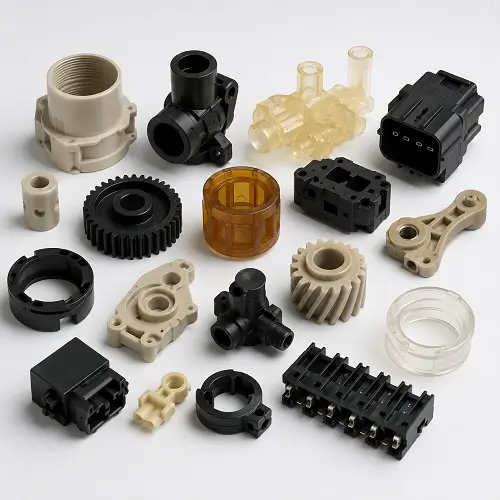
Heat Resistant Plastic Comparison
Choosing a heat resistant plastic is often a balance between performance and cost. The material with the highest temperature resistance is not always the best option for every project.
The comparison below provides a general overview of commonly used heat resistant plastics for injection molding.
| Material | Typical Continuous Use Temp. | Approximate Material Cost* | Typical Applications |
|---|---|---|---|
| PBT | 120–140°C | $2–5/kg | Electrical connectors, sensors, switches |
| PC | 120–130°C | $3–6/kg | Housings, covers, lighting parts |
| PA46 | 150–170°C | $15–30/kg | Automotive engine-area parts, gears |
| PPS | 200–220°C | $20–50/kg | Automotive, electrical connectors, pumps |
| PEI | 170–200°C | $40–80/kg | Medical devices, electrical housings |
| PPSU | 180–200°C | $40–90/kg | Sterilizable medical and food-contact parts |
| LCP | 220–240°C | $30–80/kg | Thin-wall electronic connectors |
| PEEK | 250–260°C | $80–180/kg | Aerospace, medical, high-end industrial parts |
Material prices are approximate and may vary depending on grade, supplier, order quantity, and market conditions.
How to Choose the Right Heat Resistant Plastic
The best heat resistant plastic is not necessarily the material with the highest temperature rating. A successful material choice depends on how the plastic part will actually be used, including its operating temperature, mechanical load, production volume, and budget.
For most injection molding projects, selecting a material that meets the application requirements is far more important than choosing the most expensive engineering plastic.
Automotive Parts
Plastic parts used around the engine compartment are continuously exposed to heat, oil, vibration, and automotive fluids. Materials such as ABS or PP are often unsuitable because they can gradually lose strength or dimensional stability in these conditions.
For many automotive applications, PPS provides an excellent balance of heat resistance, chemical resistance, and production cost. It is widely used for sensor housings, electrical connectors, thermostat components, and pump parts.
When higher mechanical strength and wear resistance are required, PA46 is commonly selected for gears, clips, cable guides, and structural components operating near the engine.
Only in extremely demanding applications—such as high-performance vehicles or aerospace systems—is PEEK typically justified, as its material cost is significantly higher than most engineering plastics.
Medical Devices
Medical components often face repeated steam sterilization instead of continuous high operating temperatures.
For reusable medical products, PPSU is one of the most widely used materials because it maintains its toughness and dimensional stability after repeated autoclave sterilization cycles. It is commonly found in sterilization trays, medical instrument handles, fluid management components, and equipment housings.
If the application also requires exceptional chemical resistance, wear resistance, or long-term mechanical performance, PEEK becomes an excellent choice despite its higher price.
For many medical products, selecting the right material is not about achieving the highest heat resistance—it is about maintaining reliable performance after thousands of sterilization cycles.
Electrical and Electronic Components
Modern electronic products continue to become smaller while generating more heat during operation. This places greater demands on both heat resistance and dimensional accuracy.
Materials such as LCP, PPS, and PBT are widely used because they can maintain tight tolerances while performing reliably at elevated temperatures.
LCP is especially suitable for precision connectors and thin-wall electronic components because of its excellent flowability and dimensional stability during injection molding. PPS is commonly used for electrical connectors and sensor housings, while PBT remains a cost-effective choice for many switches, relays, and electrical enclosures.
Industrial Equipment
Industrial plastic parts are often exposed to continuous heat, mechanical loads, lubricants, and aggressive chemicals throughout their service life.
Depending on the operating environment, PPS, PEI, and PEEK are frequently selected because they maintain stable mechanical properties under demanding conditions.
For general industrial equipment, however, choosing the highest-performance material is not always necessary. If the operating temperature is moderate, a more economical engineering plastic may deliver comparable performance while reducing overall manufacturing costs.
Common Mistakes When Choosing Heat Resistant Plastics
Material selection is about finding the right balance between performance, manufacturability, and cost. The following mistakes are common during product development.
Choosing PEEK Simply Because It Has the Highest Heat Resistance
Many engineers assume the safest solution is to choose the material with the highest temperature rating.
In reality, this often increases production costs without improving product performance.
For example, if a plastic component operates at around 120–150°C, materials such as PPS, PA46, or glass-filled PBT may provide more than enough heat resistance while costing significantly less than PEEK.
The best material is not the one with the highest specification—it is the one that matches the actual application.
Focusing Only on Temperature
Heat resistance is only one part of the material selection process.
Some applications also require resistance to chemicals, moisture, steam sterilization, friction, or long-term mechanical loading. A material that performs well in one environment may not be suitable in another.
For example, PPSU performs exceptionally well in repeated steam sterilization, while LCP is often a better choice for miniature electronic connectors where dimensional stability is critical.
Understanding the complete operating environment usually leads to a better material choice than comparing temperature ratings alone.
Ignoring Manufacturing Cost
High-performance plastics generally require higher molding temperatures, specialized processing equipment, and tighter process control during injection molding.
These requirements increase not only material cost but also manufacturing cost.
Before selecting a premium engineering plastic, it is worth evaluating whether a more economical material can meet the same performance requirements.
Get Help Choosing the Right Heat Resistant Plastic
Every injection molded part has different performance requirements, so there is rarely a single material that is suitable for every project.
Selecting the right engineering plastic involves balancing heat resistance, mechanical performance, manufacturability, and overall production cost.
If you’re unsure whether PPS, PEEK, PEI, PPSU, or another engineering plastic is the right choice, our engineering team can review your part design and recommend materials based on the operating environment, industry requirements, and expected production volume.
Whether you’re developing automotive components, electrical connectors, industrial equipment, or medical devices, we can support your project from material selection and DFM review through mold manufacturing and injection molded part production.