
Polypropylene is usually the better choice for lightweight rigid injection molded parts, living hinges, thin-wall components, and products exposed to moderately higher temperatures. Polyethylene is generally more suitable when flexibility, low-temperature toughness, or impact resistance matters more, although the result depends heavily on whether the material is LDPE or HDPE.
PP, LDPE, and HDPE can all be injection molded successfully. There is no single material that is better for every product. A rigid cap, flexible closure, chemical container, automotive trim component, and living-hinge box place very different demands on the plastic.
The correct polypropylene vs polyethylene comparison must therefore consider stiffness, flexibility, impact performance, temperature, chemical exposure, shrinkage, part geometry, tolerances, and production quantity. The exact resin grade should be selected before the mold shrinkage allowance, gate design, and processing conditions are finalized. PP’s crystallization and cooling behavior can have a direct effect on molded-part shrinkage and dimensional stability.
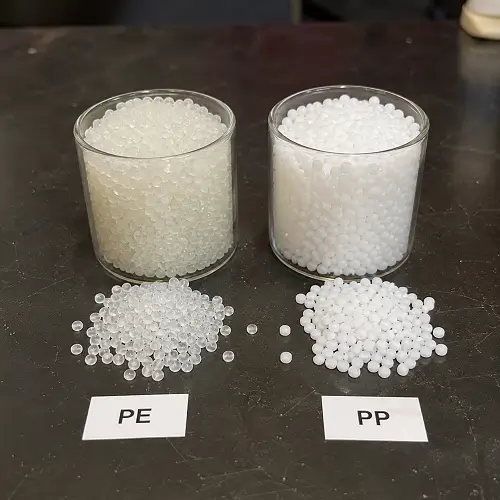
Polypropylene vs Polyethylene Comparison Chart
| Property | Polypropylene | LDPE | HDPE |
|---|---|---|---|
| Abbreviation | PP | LDPE | HDPE |
| Relative stiffness | Usually highest | Lowest | Moderate to high |
| Flexibility | Moderate and grade-dependent | High | Lower than LDPE |
| Low-temperature toughness | More limited in many standard grades | Good | Generally good |
| Typical density | 0.89–0.91 g/cm³ | 0.91–0.93 g/cm³ | 0.94–0.97 g/cm³ |
| Heat resistance | Generally highest | Generally lowest | Between LDPE and PP |
| Living-hinge performance | Excellent with a suitable grade | Not normally the first choice | Less common than PP |
| Chemical resistance | Good against many chemicals | Good against many chemicals | Good against many chemicals |
| Moisture absorption | Very low | Very low | Very low |
| Appearance | Usually opaque or translucent; clarified grades exist | Can be relatively translucent | Usually opaque or translucent |
| Molding shrinkage | Moderate to high | Generally high | Generally high |
| Typical molded parts | Hinges, caps, housings, automotive parts | Soft lids, flexible caps, squeeze parts | Rigid containers, bins, caps, fittings |
These are broad tendencies rather than fixed specifications. PP homopolymer, impact-copolymer PP, random-copolymer PP, LDPE, LLDPE, and different HDPE grades can behave differently even when they share the same general material name.
Which Is Better for Injection Molding: Polypropylene or Polyethylene?
Polypropylene is generally the more practical starting point for a molded component that needs a lightweight but relatively rigid structure. It is commonly used for thin-wall containers, caps, closures, housings, clips, appliance parts, automotive trim, storage products, and living hinges.
Many PP grades flow well through thin sections and multicavity molds. Suitable grades also provide strong fatigue performance, allowing a deliberately thin hinge section to bend repeatedly without separating from the main body.
Polyethylene is often more suitable when the part needs flexibility, low-temperature toughness, or the ability to deform without cracking. LDPE is commonly considered for soft lids, flexible closures, squeeze components, and protective parts. HDPE is more suitable when the product needs a rigid polyethylene structure, as found in durable containers, caps, bins, fittings, and fluid-handling parts.
From a molding perspective, PP is not automatically easier to process. PP, LDPE, and HDPE are all semi-crystalline materials and can show noticeable shrinkage. Mold temperature, gate location, packing, cooling balance, and wall-thickness distribution affect the final dimensions of all three.
The practical choice is:
Choose PP for stiffness, low weight, living hinges, thin walls, and better elevated-temperature performance. Choose LDPE for softness and flexibility. Choose HDPE for tough, rigid polyethylene components and fluid-handling parts.
Polypropylene vs Polyethylene: Which Is Stronger?
Neither PP nor PE is universally stronger because “strength” may refer to stiffness, tensile strength, impact resistance, fatigue life, or resistance to long-term deformation.
Polypropylene is generally stiffer than LDPE. A PP housing or cap is more likely to retain its shape under a moderate load, while an LDPE component can deform much more easily. This does not make LDPE inferior when flexibility is an intentional product requirement.
HDPE is considerably stiffer than LDPE and provides a closer comparison with PP. It is frequently selected for rigid containers, industrial bins, caps, closures, and fittings where toughness is more important than achieving the highest possible stiffness.
Polyethylene often retains impact toughness better at low temperatures. A standard PP grade may become more brittle in a cold environment, while a suitable PE grade can continue to deform and absorb impact.
The exact grade can change these general results. Impact-copolymer PP, glass-filled PP, mineral-filled PP, UV-stabilized HDPE, and specialty polyethylene compounds should be compared using their actual datasheets and the load conditions of the molded part.
Is Polypropylene or Polyethylene More Flexible?
Polyethylene is usually more flexible, especially when PP is compared with LDPE.
LDPE has a branched molecular structure that prevents its chains from packing as closely as those in HDPE. This produces a softer plastic that can bend, squeeze, and deform more easily. It is useful for flexible caps, soft lids, squeeze features, protective parts, and components that must change shape during use.
HDPE has a more closely packed structure and is noticeably stiffer than LDPE. It is still generally tougher and less rigid than many engineering plastics, but it can produce stable containers, caps, and functional molded parts.
Polypropylene normally feels more rigid than LDPE. However, PP’s living-hinge performance should not be confused with overall softness. A PP box can have rigid walls and a very thin hinge section that repeatedly bends. The hinge works because of the material’s fatigue behavior and the geometry of the molded feature, not because the complete part is flexible.
For a product that must remain soft throughout its body, LDPE is usually the better starting point. For a rigid part containing one repeatedly flexing hinge, PP is normally more suitable.
Polypropylene vs Polyethylene Density and Part Weight
PP, LDPE, and HDPE are all lightweight plastics, but polypropylene generally has the lowest density.
Typical unfilled values are approximately:
- PP: 0.89–0.91 g/cm³
- LDPE: 0.91–0.93 g/cm³
- HDPE: 0.94–0.97 g/cm³
For the same solid CAD volume, a PP component will normally weigh slightly less than an LDPE component and less than an HDPE component. The difference may be small for one cap, but it becomes more important for large parts or hundreds of thousands of production cycles.
Density also affects resin consumption. When the cavity and runner volume remain unchanged, a denser material requires more kilograms per molding cycle. Part weight can be estimated by multiplying CAD volume by the value in a plastic density chart.
Fillers can reverse the expected comparison. Talc-filled, calcium-carbonate-filled, or glass-filled PP may be denser than unfilled HDPE. The exact compound density should therefore be used for weight and quotation calculations rather than assuming every PP grade is lighter than every PE grade. JeekMould’s density chart lists typical ranges while noting that fillers and grade formulation can change them.
Polypropylene vs Polyethylene Heat Resistance
Polypropylene generally provides better elevated-temperature performance than LDPE and HDPE. It usually has a higher melting range and retains useful stiffness at temperatures where polyethylene begins to soften more noticeably.
This makes PP a common starting point for hot-fill containers, appliance components, laboratory products, automotive interior parts, and molded products that experience moderately elevated temperatures.
Polyethylene often has an advantage in cold conditions. Many PE grades retain flexibility and impact toughness better than standard PP at low temperatures. This can matter for outdoor products, refrigerated applications, cold-storage components, and parts used during winter.
LDPE normally provides the lowest heat resistance of the three. HDPE performs better than LDPE, but PP is generally preferred when the product must retain greater stiffness at higher temperatures.
The melting point should not be treated as the maximum safe operating temperature. A molded part can creep, soften, or distort under load long before the polymer reaches its melting range. Heat-deflection data, continuous-use temperature, mechanical stress, and exposure time must also be considered.
Polypropylene vs Polyethylene Chemical and Moisture Resistance
PP and PE both absorb very little moisture and resist many acids, alkalis, salts, detergents, and water-based chemicals. These properties support their use in containers, caps, laboratory products, household goods, and industrial fluid-handling components.
Chemical resistance is not identical across all PP, LDPE, and HDPE grades. Oils, fuels, solvents, oxidizing chemicals, cleaning agents, temperature, concentration, and exposure time can change the result.
Mechanical stress must also be considered. A material sample may tolerate a chemical when it is unloaded but develop environmental stress cracking when the molded part is under continuous strain.
For a tank or chemical container, HDPE is frequently considered because of its toughness and chemical resistance. PP may be more suitable when greater temperature resistance or rigidity is required. Size, wall thickness, UV exposure, fittings, welding, permeation, and the exact fluid all affect the final decision.
Neither polypropylene nor polyethylene is automatically approved for food-contact or medical use. Compliance depends on the complete resin grade, additives, colorants, processing conditions, and the regulations applied to the finished component.
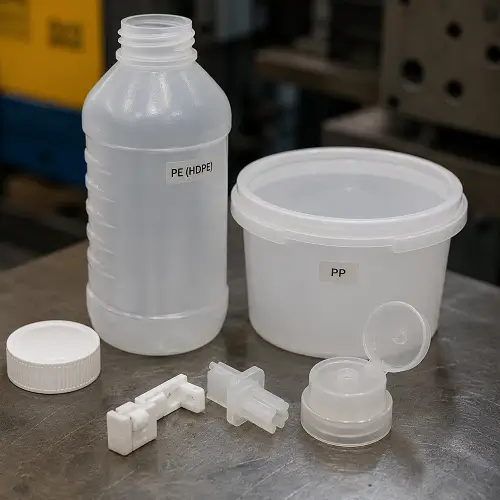
PP vs LDPE vs HDPE
A generic “PP vs PE” comparison can be misleading because LDPE and HDPE are used for different types of parts.
LDPE is usually selected when softness and easy deformation are central requirements. It suits flexible lids, squeeze components, soft caps, protective features, and other parts that should bend throughout their body. Its branched molecular structure explains much of this production behavior.
HDPE provides greater rigidity than LDPE while retaining strong toughness, low moisture absorption, and chemical resistance. It is a more realistic competitor to PP for rigid containers, caps, closures, fittings, bins, and industrial components.
PP is normally the lightest and most heat resistant of the three. Its living-hinge performance also gives it an advantage for caps, reusable boxes, dispensing products, and molded products containing a repeated flexing feature.
The choice can be summarized as follows:
| Part Requirement | Typical Starting Point |
|---|---|
| Living hinge | PP |
| Lightweight rigid housing | PP |
| Thin-wall molded component | PP |
| Flexible squeeze part | LDPE |
| Soft lid or closure | LDPE |
| Rigid chemical container | HDPE or PP |
| Durable bin or crate | HDPE |
| Low-temperature toughness | PE |
| Rigid cap or fitting | PP or HDPE |
| Higher elevated-temperature stiffness | PP |
Polypropylene vs Polyethylene for Injection Molding
PP and PE are both semi-crystalline plastics. Ordered crystalline regions develop while the melt cools, creating additional contraction beyond ordinary thermal cooling. This is one reason their molding shrinkage is generally higher than that of amorphous materials such as ABS and PC.
PP flows well in many thin-wall and multicavity applications. It is commonly molded into caps, closures, containers, clips, housings, automotive trim, and living-hinge products. Different grades can provide higher stiffness, improved impact toughness, better clarity, faster flow, UV resistance, or reduced shrinkage.
HDPE is commonly injection molded into caps, bins, crates, fittings, household products, industrial containers, and durable functional parts. LDPE can be molded into flexible lids, soft closures, fitments, and deformable components.
PP and PE normally do not require the same routine drying as hygroscopic plastics such as nylon or PET because their moisture absorption is very low. However, condensation, wet surface contamination, poor storage, or a supplier-specific requirement can still create processing problems.
Both material families also have relatively low surface energy. Painting, printing, adhesive bonding, and overmolding may require surface treatment, a compatible primer, mechanical retention, or a specially formulated resin grade.
Which Has Lower Injection Molding Shrinkage?
PP and PE both show noticeable molding shrinkage, and it is not accurate to state that one always shrinks less than the other.
Unfilled PP reference ranges commonly overlap with those of HDPE and LDPE. The actual result depends on the exact grade, melt-flow rate, nucleating package, filler content, mold temperature, packing pressure, gate freeze, cooling time, and part geometry.
A high-flow impact-copolymer PP should not use the same shrinkage allowance as a mineral-filled PP grade. The same principle applies to different HDPE and LDPE formulations.
Packing can compensate for some contraction while the gate remains open. Once the gate freezes, further material cannot enter the cavity, and the part continues to cool and contract.
Uneven wall thickness can create different cooling and shrinkage rates across the part. Thick sections, ribs, bosses, and areas far from cooling channels may remain hot longer and produce sink marks, distortion, or warpage.
Glass fiber and mineral filler normally reduce average shrinkage, but reinforcement may introduce directional behavior. A filled PP part can shrink less along the main flow direction and more across it, producing twisting or flatness problems.
Use the exact grade’s injection molding shrinkage data when designing the cavity. The existing JeekMould shrinkage article also explains why a stable final dimension is more useful than simply achieving the smallest measurement immediately after molding.
Polypropylene vs Polyethylene Cost
PP, LDPE, and HDPE are all commonly considered economical thermoplastics for high-volume production. There is no permanent rule that polypropylene is always cheaper than polyethylene or that HDPE always costs more than LDPE.
Resin pricing changes with region, supply, order volume, grade, melt-flow requirement, color, additives, recycled content, and regulatory documentation. Impact-modified, UV-stabilized, clarified, reinforced, or specialty grades can cost more than standard natural resin.
The finished molded-part cost also depends on part weight, runner design, cavity count, machine size, cycle time, scrap, expected production quantity, and quality requirements.
PP’s lower density may reduce the part weight for the same cavity volume. However, material price per kilogram and part weight alone do not determine the complete production cost.
A lower-cost resin may require thicker walls, longer cooling, larger tolerances, or additional assembly work. Material and mold cost should therefore be evaluated together with the required product performance.
Can Polyethylene Be Replaced with Polypropylene?
A PE part cannot automatically be changed to PP simply because both materials are polyolefins and both can fill an injection mold.
Changing from LDPE to PP will usually increase stiffness and reduce flexibility. A squeeze feature may become difficult to operate, while a soft sealing section may no longer conform to the mating component.
Changing from HDPE to PP may reduce part weight and improve heat resistance, but low-temperature toughness, environmental stress cracking, surface feel, ejection behavior, and shrinkage may change.
The original mold also needs to be checked. If the cavity was manufactured using the shrinkage allowance of a specific PE grade, changing to PP may alter the final dimensions even when the new resin fills the cavity successfully.
Successful filling does not prove that the molded part will meet its tolerances. Hole positions, snap-fit engagement, flatness, sealing surfaces, assembly clearance, and overall dimensions may all change.
Some molds can produce acceptable parts after a material trial and process adjustment. Other projects may require gate changes, cavity correction, altered packing conditions, or a different resin grade.
How to Choose Between Polypropylene and Polyethylene
Choose polypropylene when the molded part needs a relatively rigid and lightweight structure, a thin wall, better elevated-temperature performance, or a durable living hinge. PP is commonly considered for caps, clips, housings, containers, automotive trim, reusable boxes, and dispensing products.
Choose LDPE when softness, flexibility, and easy deformation are central to the design. Flexible closures, squeeze components, soft lids, and protective molded parts are typical examples.
Choose HDPE when the product needs greater rigidity than LDPE while retaining strong toughness, low moisture absorption, and chemical resistance. Rigid containers, industrial bins, fittings, caps, and fluid-handling components often begin with HDPE.
The decision should use the exact commercial grade rather than only the broad polymer name. PP homopolymer, impact-copolymer PP, random-copolymer PP, LDPE, LLDPE, and HDPE have different flow, stiffness, shrinkage, clarity, impact, and temperature performance.
Part geometry remains equally important. Wall thickness, tolerances, snap fits, hinge dimensions, chemical exposure, working temperature, surface requirements, annual volume, and expected product life should all be reviewed before the mold is manufactured.
Conclusion
Polypropylene is generally the better choice for lightweight rigid injection molded parts, living hinges, thin-wall components, and products requiring greater elevated-temperature stiffness. Polyethylene is usually more suitable when flexibility, low-temperature toughness, or impact resistance is more important.
LDPE should be considered for soft and easily deformed parts. HDPE is more appropriate for tough, rigid containers, caps, bins, fittings, and fluid-handling components.
PP, LDPE, and HDPE can all be injection molded successfully, but they do not use identical shrinkage allowances or produce the same mechanical behavior. The exact material grade should be selected before the cavity dimensions, gate design, cooling layout, and production parameters are finalized.
JeekMould can review the PP or PE grade, part geometry, wall thickness, shrinkage, gate location, tolerances, and expected production quantity before tooling begins. Upload your CAD model or 2D drawing to compare material options and receive an injection molding DFM review.