
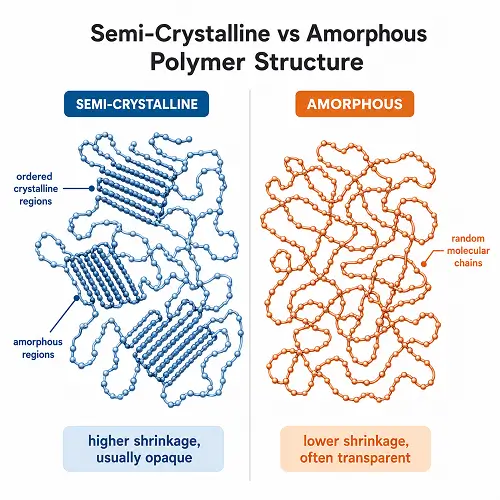
Amorphous and crystalline polymers differ mainly in how their molecular chains are arranged. Amorphous polymers have a largely random structure, while semi-crystalline polymers contain both ordered crystalline regions and disordered amorphous regions. In plastic manufacturing, the term “crystalline polymer” usually refers to a semi-crystalline polymer because ordinary molded plastics are not completely crystalline.
This structural difference affects how a plastic softens or melts, whether it can be transparent, how much it shrinks after molding, and how easily its final dimensions can be controlled. ABS, PC, PMMA, and PS are common amorphous plastics. PP, PE, PA, POM, PBT, PPS, and PEEK are generally classified as semi-crystalline plastics.
Both groups can be injection molded, but their processing behavior is different. Amorphous plastics usually have lower and more uniform molding shrinkage. Semi-crystalline plastics are more sensitive to mold temperature, cooling rate, wall thickness, gate location, and fiber orientation. The right choice depends on the appearance, tolerances, chemical exposure, wear requirements, operating temperature, and production conditions of the finished part.
What Are Amorphous Polymers?
Amorphous polymers have molecular chains arranged in a random and disordered structure. The chains do not form large, regularly packed crystalline regions as the material cools.
Because there is no major crystalline structure to break down, an amorphous polymer does not have the same defined melting point as a semi-crystalline polymer. Instead, it gradually softens as the temperature rises above its glass transition temperature.
Below the glass transition temperature, an amorphous plastic is generally rigid and glass-like. As temperature increases, molecular movement becomes easier, causing the material to lose stiffness and become more rubbery before reaching a suitable processing range.
This gradual softening behavior is important during injection molding. The melt changes viscosity across a broad temperature range, and the molded part becomes rigid as it cools below its glass transition region.
Amorphous plastics are frequently selected for transparent components, cosmetic housings, dimensional assemblies, and products where relatively predictable molding shrinkage is important.
What Are Examples of Amorphous Polymers?
Common amorphous polymers include ABS, polycarbonate, acrylic, polystyrene, SAN, PEI, and many PVC grades.
ABS is widely used for equipment housings, automotive interior components, consumer products, and electronic covers. It provides a useful balance of stiffness, impact resistance, surface appearance, and processing cost.
Polycarbonate is commonly selected for impact-resistant covers, transparent housings, lighting components, and structural parts. It can provide transparency while offering considerably greater toughness than standard acrylic or polystyrene.
PMMA, also called acrylic, is used when optical clarity, gloss, weather resistance, and surface quality are important. It provides excellent transparency but is generally less impact resistant than polycarbonate.
Polystyrene can produce clear, rigid parts at relatively low material cost, although its brittleness limits its use in impact-loaded products. High-impact polystyrene improves toughness by adding rubber components, but this modification normally reduces transparency.
These materials are all classified as amorphous, yet they do not provide identical plastic properties. Impact resistance, chemical compatibility, heat performance, stiffness, flammability, and long-term loading must still be evaluated for the exact grade.
What Are Semi-Crystalline Polymers?
Semi-crystalline polymers contain two structural regions after cooling. Some molecular chains arrange themselves into ordered crystalline regions, while the remaining chains stay in a disordered amorphous state.
The proportion of ordered structure is described as crystallinity. It is affected by polymer chemistry, cooling rate, mold temperature, wall thickness, additives, reinforcement, and processing history.
A semi-crystalline polymer has both a glass transition temperature and a melting range. The amorphous regions gain mobility around the glass transition temperature, while the crystalline regions remain intact until the material approaches its melting point.
This allows many semi-crystalline plastics to retain useful mechanical properties above their glass transition temperature because the crystalline regions continue to support the structure.
During injection molding, crystallization develops as the material cools. The chains pack more closely as crystalline regions form, causing additional volume contraction. This is why semi-crystalline plastics often have higher molding shrinkage and greater sensitivity to cooling conditions.
What Are Examples of Semi-Crystalline Polymers?
Common semi-crystalline polymers include polypropylene, polyethylene, nylon, POM, PBT, PET, PPS, and PEEK.
PP is a low-density material used for containers, living hinges, automotive components, household products, and chemically resistant parts. Its crystallization behavior contributes to greater molding shrinkage than many amorphous materials.
PE includes LDPE and HDPE. These materials are used for containers, caps, fluid-handling components, packaging, and flexible products. Both are semi-crystalline, although their branching, density, stiffness, and crystallinity differ.
Nylon materials such as PA6 and PA66 are used for gears, brackets, clips, connectors, and reinforced mechanical parts. Their semi-crystalline structure supports strength and wear resistance, but moisture absorption can change dimensions and mechanical performance after molding.
POM is commonly selected for gears, latches, bearings, sliding components, and precision mechanisms. It offers low friction and good fatigue performance, although its relatively high shrinkage requires careful mold and process control.
PBT, PPS, and PEEK are used in applications that require greater heat resistance, chemical resistance, electrical performance, or dimensional control. These materials are often reinforced with glass fiber, which reduces shrinkage in the fiber direction but can create directional warpage.
PET is an example of a polymer whose final structure depends strongly on processing. Rapid cooling can restrict crystallization and produce a largely amorphous, transparent structure. Slower cooling or higher mold temperatures allow more crystalline regions to form, normally making the material more opaque.
These are only some of the main types of plastic used for molded parts. The exact commercial grade remains more important than the polymer name alone.
Amorphous vs Semi-Crystalline Polymers Comparison Chart
| Property | Amorphous Polymers | Semi-Crystalline Polymers |
|---|---|---|
| Molecular arrangement | Mostly random and disordered | Ordered crystalline regions mixed with amorphous regions |
| Thermal transition | Gradually softens above Tg | Has Tg and a recognizable melting range |
| Transparency | Often transparent when unfilled | Usually opaque or translucent |
| Molding shrinkage | Generally lower and more uniform | Generally higher and more process-sensitive |
| Warpage risk | Often easier to control | More sensitive to cooling and molecular orientation |
| Chemical resistance | Depends on the polymer | Often better in suitable chemical environments |
| Wear and friction | Material-dependent | Many grades provide good wear and fatigue performance |
| Dimensional control | Often more predictable | Requires closer control of crystallization and cooling |
| Common examples | ABS, PC, PMMA, PS, SAN, PEI | PP, PE, PA, POM, PBT, PET, PPS, PEEK |
| Typical parts | Clear covers, housings, lenses, cosmetic components | Gears, clips, bearings, connectors, fluid-handling parts |
These are general trends rather than fixed rules. Fillers, glass fiber, additives, moisture, mold temperature, and resin grade can substantially change the behavior of either group.
Can Amorphous Polymers Be Injection Molded?
Amorphous polymers are widely used in injection molding. ABS, PC, PMMA, PS, SAN, and PEI can all be processed into complex molded parts.
During molding, the material is heated until it flows, injected into the cavity, packed, and cooled until the part becomes rigid enough for ejection. Because amorphous plastics soften gradually rather than passing through a defined crystalline melting point, many provide a relatively broad processing range.
Their molding shrinkage is usually lower than that of semi-crystalline plastics. This can make cavity dimensions and part tolerances easier to predict, particularly for housings, covers, frames, and components that must fit together after molding.
Amorphous plastics are also common in transparent or high-gloss products. Optical parts require close control of mold polishing, gate design, flow marks, weld lines, contamination, ejection, and residual stress.
Lower shrinkage does not eliminate molding problems. Amorphous materials can retain internal stress when they cool unevenly or are packed under excessive pressure. These stresses may later cause warpage, cracking, or chemical stress failure.
Drying is also important for moisture-sensitive materials such as PC and PEI. Moisture in the resin can cause degradation, surface defects, or reduced mechanical performance during molding.
Can Semi-Crystalline Polymers Be Injection Molded?
Semi-crystalline polymers are also widely injection molded. PP, PE, nylon, POM, PBT, PET, PPS, and PEEK are used for products ranging from low-cost household parts to precision gears and high-temperature industrial components.
The main processing challenge is controlling crystallization. Mold temperature and cooling rate affect how much ordered structure develops and how evenly it forms across the part.
A cold mold may freeze the surface quickly while the core remains hot. The difference in cooling rate can produce different levels of crystallinity and shrinkage through the section. A suitable and stable mold temperature promotes more consistent crystallization, although it may also increase initial molding shrinkage and cycle time.
Some high-performance materials require much hotter molds than ordinary PP or PE. PPS, PEEK, and similar polymers need suitable barrel temperatures, mold heaters, insulation, mold steel, and process control.
Drying is particularly important for hygroscopic materials such as nylon, PBT, and PET. PPS and PEEK absorb less moisture, but pre-drying may still be required according to the resin grade, storage conditions, and supplier processing instructions.
Semi-crystalline plastics can produce accurate, durable parts, but cavity shrinkage, gate position, cooling layout, and conditioning requirements must be considered before tooling dimensions are finalized.
Are Polymers Amorphous or Crystalline?
Polymers may be amorphous or semi-crystalline depending on how easily their molecular chains can arrange themselves into an ordered structure.
Chain symmetry, branching, side groups, molecular regularity, and intermolecular attraction all affect crystallization. An irregular molecular structure makes close packing difficult and generally favors an amorphous material.
More regular polymer chains can align and form crystalline regions as the material cools. Complete crystallization is difficult because long polymer chains become entangled and molecular movement becomes restricted during solidification.
For this reason, PP, PE, nylon, POM, and similar plastics are more accurately described as semi-crystalline rather than completely crystalline.
Processing also affects the final structure. The same polymer may develop different levels of crystallinity when molded with different mold temperatures, cooling rates, part thicknesses, or annealing conditions.
How Are Amorphous and Semi-Crystalline Polymer Structures Different?
An amorphous polymer resembles a randomly tangled group of molecular chains. It does not have a repeating long-range arrangement across large areas of the material.
A semi-crystalline polymer contains small ordered regions surrounded by amorphous material. These ordered regions, often called crystallites, form as portions of the chains fold, align, and pack together while the material cools.
The crystalline regions can improve chemical resistance, stiffness, wear behavior, and mechanical-property retention above the glass transition temperature. They also increase molding shrinkage because the chains occupy less volume after packing into an ordered structure.
This relationship explains why molecular structure affects both part performance and mold design. The same crystallinity that improves chemical or wear resistance may make shrinkage and warpage more difficult to control.
Glass Transition Temperature vs Melting Point
Glass transition temperature and melting point describe different changes within a polymer.
The glass transition temperature, or Tg, relates to molecular movement in the amorphous regions. Below Tg, movement is limited and the material is generally harder and more rigid. Above Tg, the amorphous regions become more mobile and the plastic begins to soften.
Both amorphous and semi-crystalline polymers contain amorphous regions, so both have a glass transition temperature.
A melting range applies to the crystalline regions of a semi-crystalline polymer. As the material reaches this range, the ordered structure breaks down and the polymer becomes a processable melt.
Amorphous plastics do not have a true crystalline melting point. ABS, PC, PMMA, and PS gradually soften across a temperature range instead of changing sharply from a crystalline solid into a liquid.
This distinction is important when interpreting plastic melting point data. Processing temperature, glass transition temperature, heat deflection temperature, and continuous operating temperature describe different aspects of material behavior.
Are Amorphous or Semi-Crystalline Plastics Transparent?
Amorphous plastics are more likely to be transparent because their random molecular structure allows light to pass through with less internal scattering.
PC, PMMA, PS, and SAN can all be produced as transparent materials. Final optical quality still depends on the grade, colorant, surface finish, mold polish, flow marks, weld lines, internal stress, contamination, and part thickness.
Semi-crystalline plastics are usually opaque or translucent because light is scattered at the boundaries between crystalline and amorphous regions.
This does not mean every semi-crystalline material must be completely opaque. Thin sections, low crystallinity, rapid cooling, and specialized formulations can produce translucent or relatively clear parts.
PET is a familiar example. Rapid cooling can restrict crystallization and maintain transparency. Slower cooling or heat treatment allows more crystalline regions to form, making the material increasingly opaque.
For a clear injection molded cover or lens, amorphous materials are generally the more direct starting point. Optical performance must still be balanced against impact resistance, scratch resistance, chemical exposure, temperature, and cost.
Amorphous vs Crystalline Polymer Shrinkage
Amorphous polymers generally have lower molding shrinkage because they contract mainly as the melt cools and molecular movement decreases.
Semi-crystalline polymers experience thermal contraction together with additional contraction caused by crystallization. As the chains pack into ordered regions, the material occupies less volume.
This is why PP, PE, PA, POM, and other semi-crystalline materials normally require greater mold shrinkage allowances than ABS, PC, PMMA, or PS.
Actual shrinkage depends on more than polymer structure. The exact grade, filler content, melt temperature, mold temperature, packing pressure, gate size, gate location, cooling time, and part geometry all affect the result.
Glass fiber can reduce shrinkage along the direction of fiber alignment. Shrinkage across the fiber direction remains higher, creating directional contraction rather than uniform shrinkage.
Changing a molded part from ABS to POM, or from PC to glass-filled nylon, should therefore not be treated as a simple resin substitution. Cavity dimensions, gate arrangement, cooling, draft, and expected warpage may all need to be reviewed.
Which Polymer Structure Has Better Dimensional Stability?
Amorphous plastics are often easier to control dimensionally during molding because their shrinkage is usually lower and less dependent on crystallization.
PC, ABS, and similar materials are commonly used for housings, covers, and mating assemblies where predictable molded dimensions are important. Their dimensions can still be affected by residual stress, mold temperature, packing pressure, moisture, and service temperature.
Semi-crystalline materials can also produce precision components, but different mechanisms must be considered. POM is widely used for accurate gears and moving mechanisms despite its higher shrinkage because it provides low friction, wear resistance, and good fatigue performance.
Nylon introduces an additional dimensional change after molding. A dry nylon part can absorb moisture from the surrounding environment, increasing its dimensions and changing stiffness, toughness, and weight.
Filled PBT, PPS, and nylon grades may show low shrinkage along the main flow direction but higher shrinkage across it. A dimension parallel to fiber flow can therefore behave differently from a transverse dimension or a feature near a weld line.
Dimensional stability depends on polymer structure, reinforcement, moisture, processing conditions, operating temperature, and the location of the tolerance on the part.
Amorphous vs Semi-Crystalline Chemical Resistance
Semi-crystalline polymers often provide good chemical resistance because their closely packed crystalline regions make it more difficult for chemicals to penetrate the material.
PE, PP, POM, PPS, and PEEK are commonly used for fluid-handling components, laboratory products, chemical equipment, and industrial parts exposed to oils, fuels, cleaners, or aggressive environments.
Amorphous plastics can also provide useful chemical resistance, but some are more vulnerable to solvents and environmental stress cracking. PC, ABS, PMMA, and PS may crack when exposed to an incompatible chemical while the part is under mechanical stress.
The broad material category cannot replace a grade-specific compatibility review. Chemical concentration, temperature, exposure time, mechanical load, UV exposure, and additives all affect performance.
A material that survives brief contact at room temperature may still fail during long-term immersion or repeated cleaning at elevated temperatures.
Amorphous vs Crystalline Polymer Strength and Impact Resistance
Neither molecular structure is universally stronger.
Amorphous thermoplastics such as PC and ABS can provide excellent impact resistance. Their disordered structure allows molecular movement and energy absorption before fracture.
Semi-crystalline plastics often provide good fatigue performance, wear resistance, chemical resistance, and mechanical-property retention across a broad temperature range. POM and nylon are commonly used for gears, bearings, clips, latches, and moving components.
Crystalline regions can improve stiffness and strength, but greater crystallinity may also reduce impact toughness. The final result depends on the polymer, molecular weight, reinforcement, temperature, moisture, and loading speed.
Glass-filled semi-crystalline plastics can provide high tensile and flexural strength, although their properties become more directional. Strength near a weld line may be lower because the fibers do not continue across the joint in the same way as the surrounding material.
Part design remains as important as resin data. Sharp corners, abrupt thickness changes, weak weld-line positions, and unsupported bosses can cause failure even when the selected material has strong datasheet values.
How Polymer Structure Affects Mold Temperature and Cooling
Mold temperature affects more than the time required before ejection. It influences surface quality, residual stress, crystallization, shrinkage, weld-line strength, and final dimensions.
For an amorphous plastic, the mold removes heat until the component becomes rigid enough to retain its shape. A mold that is too cold can cause poor surface replication, flow marks, weak weld lines, or high residual stress. A warmer mold may improve appearance and reduce stress but extend the cooling cycle.
For a semi-crystalline plastic, mold temperature also controls crystal development. A stable mold temperature allows more consistent crystallization across the cavity. This may improve performance and dimensional stability in service, although greater crystallization can increase initial molding shrinkage.
Cooling should be balanced across the mold. Uneven cooling channels, thick mold-steel sections, deep cores, and uneven wall thickness can cause different areas to cool and contract at different rates.
The best mold temperature is not simply the lowest temperature that produces an acceptable surface. It must support the required appearance, dimensions, mechanical performance, and cycle time for the selected material grade.
Why Do Semi-Crystalline Plastics Warp More Easily?
Semi-crystalline plastics often show greater warpage because crystallization, molecular orientation, and cooling do not occur uniformly across the part.
Thin sections near the mold surface cool first. Thick sections, ribs, bosses, deep cores, and areas far from cooling channels remain hot longer. These temperature differences create different shrinkage rates across the component.
Flow direction also affects the result. Polymer chains and reinforcing fibers become oriented as the melt travels through the cavity. Shrinkage along the flow direction can differ from shrinkage across it.
Gate location determines the main flow pattern. Moving the gate can change fiber orientation, weld-line position, packing efficiency, and the direction in which the part bends after molding.
Packing pressure can reduce shrinkage while the gate remains open, but it cannot correct every warpage problem. After the gate freezes, the part continues cooling and contracting without additional material entering the cavity.
Controlling warpage requires suitable gate placement, balanced wall thickness, effective cooling, realistic tolerances, and shrinkage data for the exact resin grade.
Which Polymer Structure Is Better for Precision Molded Parts?
Amorphous plastics are often preferred when low and predictable molding shrinkage is the main requirement. PC, ABS, and similar materials are widely used for dimensional housings, frames, covers, and mating components.
Semi-crystalline materials may be better when the part requires wear resistance, low friction, fatigue strength, chemical resistance, or mechanical performance at elevated temperature. POM, PBT, PPS, and reinforced nylon are common examples.
The material that is easier to mold dimensionally is not always the material that performs best in use. A PC gear may be easier to mold close to its initial dimensions, while POM may provide much better friction and wear performance during operation.
Precision also depends on the feature being measured. A tight hole diameter, flat sealing surface, long straight wall, bearing seat, and gear tooth profile do not respond to shrinkage and warpage in the same way.
Material selection should therefore be combined with DFM review, gate location, mold-flow direction, cooling design, measurement method, conditioning state, and the expected operating environment.
How to Choose Between Amorphous and Semi-Crystalline Plastics
An amorphous plastic is often the more practical choice when the part requires transparency, a high-gloss appearance, relatively low molding shrinkage, or predictable mating dimensions. ABS, PC, and PMMA are common starting points for housings, covers, lenses, displays, and cosmetic products.
A semi-crystalline material may be preferred when chemical resistance, wear behavior, low friction, fatigue performance, or strength retention at elevated temperature is more important. PP, nylon, POM, PBT, PPS, and PEEK cover a broad range of costs and performance levels.
The decision should also consider moisture absorption, operating temperature, impact loading, flame rating, regulatory requirements, surface texture, assembly method, annual quantity, and expected product life.
When several common injection molding materials appear suitable, the final comparison should use the exact grade rather than only the polymer family. Glass fiber, impact modifiers, flame retardants, lubricants, and mineral fillers can change flow, shrinkage, density, surface quality, and mechanical performance.
Changing from an amorphous material to a semi-crystalline material after the mold has been designed may require changes to cavity dimensions, gate size, gate location, cooling, venting, processing temperature, and cycle time. The existing mold should be reviewed before making the substitution.
Conclusion
Amorphous polymers have a largely random molecular structure and gradually soften above their glass transition temperature. Semi-crystalline polymers contain both ordered crystalline regions and amorphous regions, giving them a glass transition temperature and a recognizable melting range.
Amorphous plastics generally provide better transparency, lower molding shrinkage, and more predictable dimensional control. Semi-crystalline plastics often provide better wear behavior, chemical resistance, fatigue performance, and strength retention across a wider temperature range, but they are more sensitive to crystallization, cooling, and warpage.
Both material groups can produce high-quality injection molded parts. The correct choice depends on the geometry, tolerances, surface requirements, operating environment, mechanical loads, and expected production quantity.
JeekMould can review the material grade, molding shrinkage, wall thickness, gate location, cooling requirements, tolerances, and production quantity before tooling begins. Upload your 3D model or 2D drawing to compare suitable materials and receive an injection molding DFM review.
Get an Injection Molding Quote