
Plastic properties vary widely because plastic is not one uniform material. Polypropylene, ABS, polycarbonate, nylon, POM, PBT, PPS, PEEK, and TPU have different molecular structures, and each material family contains grades with different flow characteristics, additives, fillers, and reinforcements.
Important plastic material properties include strength, stiffness, toughness, impact resistance, hardness, density, heat resistance, chemical resistance, moisture absorption, molding shrinkage, electrical insulation, and optical clarity. These properties determine how a finished plastic component performs, but they also affect how the resin fills the cavity, how much the part shrinks, where warpage may occur, what mold temperature is required, and whether the selected gate and wall thickness can support stable production.
A material with high tensile strength is not automatically suitable for every structural component. It may be too brittle for a snap fit, absorb too much moisture for a precision assembly, or require processing conditions that are unsuitable for the mold and part geometry. Plastic selection should therefore consider the complete property profile rather than one impressive value from a material datasheet.
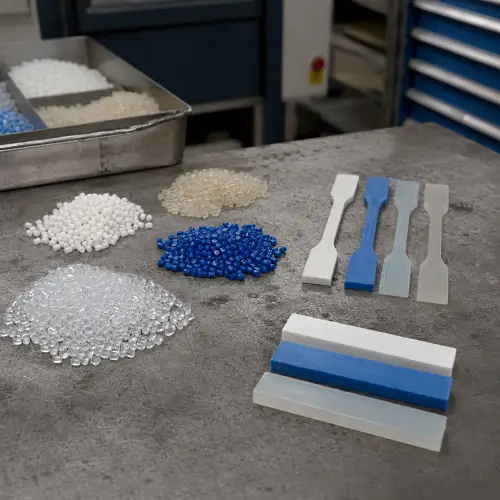
What Are the Properties of Plastic?
The properties of plastic describe how a material responds to force, temperature, chemicals, moisture, electricity, light, time, and manufacturing conditions. They are commonly grouped into mechanical, physical, thermal, chemical, electrical, optical, and processing properties.
Different types of plastic provide very different combinations of these characteristics. PP offers low density and good fatigue resistance, PC is known for impact performance and transparency, POM provides low friction and dimensional performance, while PPS and PEEK support more demanding thermal and chemical environments.
Properties also vary within the same polymer family. High-flow ABS, impact-modified ABS, flame-retardant ABS, and heat-resistant ABS do not have identical strength, shrinkage, appearance, or molding requirements. PA66-GF30 behaves differently from unfilled PA66 because glass fiber changes stiffness, flow direction, tool wear, surface appearance, and dimensional shrinkage.
Material datasheet values must also be read with care. Test specimen thickness, conditioning, temperature, humidity, loading speed, and test method can all affect the result. Two values should not be compared directly unless they were measured under reasonably similar conditions.
Plastic Properties Chart for Common Materials
The following plastic properties chart gives a general comparison of frequently used injection molding materials. It describes typical material behavior rather than the exact performance of every commercial grade.
| Plastic | Main Mechanical Profile | Thermal Performance | Moisture Behavior | Main Advantage | Injection Molding Consideration |
|---|---|---|---|---|---|
| PP | Flexible to moderately stiff with good fatigue resistance | Moderate | Very low absorption | Low weight, chemical resistance and living hinges | Relatively high shrinkage and possible warpage |
| HDPE | Tough with moderate stiffness | Moderate to low | Very low absorption | Durability and moisture resistance | High shrinkage and early gate freezing can affect dimensions |
| ABS | Balanced stiffness, toughness and impact resistance | Moderate | Low | Good appearance and general-purpose performance | Requires suitable venting and temperature control for cosmetic parts |
| PC | Rigid with high impact resistance | Good | Drying required before molding | Impact strength and transparency | Moisture, residual stress and long residence time must be controlled |
| PMMA | Rigid with excellent optical clarity | Moderate | Drying commonly required | Transparency, gloss and weatherability | Mold polish, gate position and flow marks are important |
| PA6/PA66 | Strong, wear resistant and often reinforced | Good | Relatively high absorption | Strength, toughness and wear resistance | Drying, directional shrinkage and warpage need attention |
| POM | Stiff, fatigue resistant and low friction | Good | Low | Gears, bearings and precision moving parts | Relatively high shrinkage and limited thermal residence time |
| PBT | Stiff and dimensionally stable, often glass-filled | Good | Drying required before molding | Electrical and automotive components | Reinforced grades may be abrasive and directionally shrink |
| PPS | High stiffness, chemical resistance and thermal stability | High | Very low | High-temperature electrical and chemical applications | Requires higher mold temperature and wear-resistant tooling |
| PEEK | Strong, stiff and highly resistant to demanding environments | Very high | Low | High-performance medical, industrial and mechanical parts | Specialized equipment, mold heating and strict temperature control |
| TPU | Flexible, tough and abrasion resistant | Grade-dependent | Drying often required | Flexible parts, grips, seals and protective components | Cooling, ejection and moisture control vary by hardness and grade |
These descriptions support early material comparison, but the final mold should be designed around the exact resin grade. Reinforcement level, flow grade, impact modification, flame-retardant additives, color, and recycled content can substantially change molding behavior.
How Do Plastic Properties Affect Injection Molding?
Plastic properties influence every stage of injection molding, from filling and packing to cooling, ejection, dimensional inspection, and long-term product performance.
Melt flow affects whether the resin can pass through the runner and gate and reach thin walls, ribs, bosses, and distant features before freezing. Molding shrinkage affects the size of the mold cavity and the final dimensions of the part. Stiffness and toughness influence wall design, ribs, snap fits, screw bosses, and expected impact performance.
Moisture-sensitive materials require controlled drying before processing. Glass fibers can produce directional shrinkage and visible fiber orientation. Heat-resistant plastics may require higher barrel temperatures, heated molds, specialized hot runners, and more demanding startup and shutdown procedures.
The published properties of a resin are therefore not separate from mold design. They help determine:
- whether the part can be filled reliably;
- how much shrinkage allowance the cavity requires;
- where the gate should be located;
- whether warpage is likely;
- how the part should be cooled and ejected;
- what tool steel or surface treatment may be needed;
- and whether the final component can meet its dimensional and functional requirements.
Which Plastic Properties Affect Mold and Part Design?
Some material properties have a particularly direct effect on DFM decisions.
| Plastic Property | Effect During Injection Molding | Mold or Part Design Decision |
|---|---|---|
| Melt flow | Controls filling pressure, flow length and weld-line formation | Wall thickness, runner size, gate size and gate location |
| Molding shrinkage | Changes final dimensions and warpage | Cavity allowance, packing, cooling and dimensional tolerances |
| Stiffness and toughness | Affect deformation, cracking and impact performance | Ribs, snap fits, bosses, radii and load paths |
| Moisture absorption | Can cause degradation, streaks and dimensional changes | Resin drying, sealed handling and material selection |
| Heat resistance and Tg | Affect stiffness under heat and mold-release behavior | Mold temperature, cooling and product operating limits |
| Glass-fiber content | Creates directional shrinkage, abrasion and fiber marks | Gate orientation, tool steel, venting and cosmetic expectations |
| Chemical resistance | Determines compatibility with cleaners, oils and fluids | Resin grade, residual-stress control and application testing |
| Thermal expansion | Causes dimensional movement as temperature changes | Insert design, seals, press fits and mixed-material assemblies |
These relationships explain why selecting a material after the mold has already been designed can create expensive changes. A new resin may require different cavity dimensions, gates, vents, cooling circuits, mold temperatures, or steel specifications.
What Are the Mechanical Properties of Plastic?
Mechanical properties describe how plastic responds when it is pulled, compressed, bent, struck, scratched, or held under load. Several values usually need to be considered together because a plastic that performs well under one type of force may perform poorly under another.
Tensile Strength of Plastic
Plastic tensile strength describes the stress a material can withstand when it is pulled. Tensile testing may also report tensile modulus, yield strength, elongation at yield, and elongation at break.
Tensile strength can help compare materials for brackets, links, handles, housings, and other parts exposed to pulling forces. It does not independently predict the performance of an injection molded component because the final geometry contains corners, holes, bosses, ribs, weld lines, and thickness changes that are not present in a simple test specimen.
A molded part may also have lower strength around a weld line or in a reinforced region where the fiber direction is unfavorable. Gate location, flow pattern, corner radii, and local wall thickness can therefore be as important as the published tensile value.
Elongation should also be considered. A material with moderate tensile strength and high elongation may deform before breaking, while a stronger but less ductile grade may fracture more suddenly.
Tensile Strength vs Flexural Strength
Tensile strength describes resistance to pulling, while flexural strength describes the material’s behavior under bending. A loaded plastic beam experiences tension on one side and compression on the other, making flexural properties relevant to covers, clips, brackets, handles, levers, and support structures.
A resin can have good tensile strength but still bend too easily if its modulus is low. Part geometry can increase rigidity without making every wall thicker. Ribs, curved surfaces, boxed sections, and well-planned load paths can provide stiffness while reducing material use and cooling time.
For injection molded parts, the direction of flow also matters. Reinforced materials may show different flexural behavior along and across the fiber direction, particularly near gates and weld lines.
Plastic Stiffness vs Toughness
Stiffness is the resistance to elastic deformation, while toughness is the ability to absorb energy before fracture. These properties should not be treated as the same thing.
A stiff plastic part maintains its shape under load, but a highly stiff material may have limited strain before failure. A tough plastic can deform during an impact without immediately cracking, although it may not provide the same dimensional rigidity.
Glass fiber generally increases stiffness, but a reinforced grade is not automatically suitable for a clip or snap fit that must flex repeatedly. An impact-modified unfilled grade may perform better in a component exposed to drops, vibration, or assembly strain.
The correct balance depends on the part. A support bracket may prioritize stiffness, while a protective cover, latch, or snap connection may need more toughness and elongation.
Impact Strength of Plastic
Impact strength describes how a plastic responds to sudden loading rather than a slowly applied force. It is important for housings, protective covers, clips, handles, automotive trim, and products that may be dropped or struck.
Published impact values are influenced by specimen thickness, temperature, moisture, notch geometry, and material orientation. A part with good resin data can still crack at a sharp screw boss, a weak weld line, or a region containing excessive residual stress.
Poor material drying can also reduce impact performance. In transparent PC or nylon parts, moisture-related degradation may not always be obvious from appearance alone, but it can reduce molecular weight and make the component more brittle.
Generous radii, controlled packing, suitable gate placement, and balanced wall thickness are important when impact performance matters.
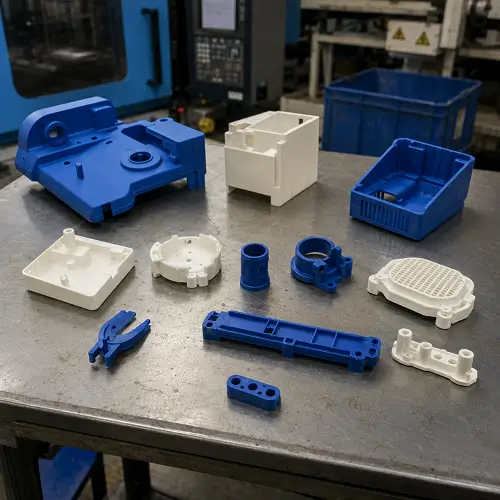
Plastic Hardness
Plastic hardness describes resistance to localized indentation or surface deformation. Softer elastomers are commonly compared using Shore hardness, while rigid plastics may be evaluated with other indentation scales.
Hardness does not directly equal tensile strength, stiffness, wear resistance, or scratch resistance. A hard plastic can still be brittle, while a softer elastomer may provide better abrasion performance in a wheel, seal, or protective grip.
For molded parts, hardness also affects ejection and assembly. A soft TPU component may grip the mold surface and require additional draft, a suitable texture, careful ejector placement, or a longer cooling time.
Creep and Fatigue in Plastic
Creep is the gradual deformation of plastic under continuous load. A bracket can pass a short-term strength test and still bend after supporting a load for several months, particularly at elevated temperature.
Fatigue develops under repeated loading. Living hinges, clips, gears, pump components, springs, and vibration-exposed parts may fail after many cycles even when each individual load is below the short-term strength of the material.
Creep and fatigue are especially important for plastic because time and temperature strongly influence molecular movement. A material that appears stiff at room temperature may deform more quickly when used near its heat limit.
Wall thickness, rib layout, stress concentration, preload, assembly method, and operating temperature should therefore be considered together with short-term mechanical data.
What Are the Physical Properties of Plastic?
Physical properties include density, shrinkage, moisture absorption, dimensional stability, and surface behavior. These characteristics often have a direct effect on part weight, tool dimensions, cooling, and assembly.
Plastic Density and Part Weight
Plastic density determines the weight of a part for a given volume. PP and PE are among the lighter common plastics, while mineral-filled, glass-filled, and high-performance materials are usually denser.
Part weight can be estimated from the CAD volume and material density. This helps compare lightweight options, calculate resin consumption, and estimate the material contribution to unit cost.
A material that costs more per kilogram does not always create a proportionally more expensive part. Density, runner volume, cycle time, scrap rate, and processing requirements also influence total cost.
Fillers and reinforcements increase density. A glass-filled grade may provide higher stiffness, but the finished part can be heavier than the same geometry molded in unfilled resin.
Plastic Shrinkage and Dimensional Stability
Plastic shrinkage occurs as hot resin cools and solidifies. The amount depends on polymer structure, crystallinity, reinforcement, packing pressure, gate freeze, melt temperature, mold temperature, cooling rate, and part geometry.
Semi-crystalline plastics such as PP, PE, PA, and POM often require greater shrinkage allowance than many amorphous materials. Glass fiber can reduce shrinkage in the flow direction while creating a different value across the flow direction.
This directional behavior can produce warpage even when the average shrinkage appears lower. A long glass-filled housing may bend or twist because the fibers and cooling pattern are not balanced.
Uniform wall thickness helps reduce uneven cooling and shrinkage. Large thickness changes can create sink marks, voids, differential shrinkage, and dimensional movement even when the correct material shrinkage range is used.
Final cavity dimensions should therefore be based on the exact resin grade and supported by molding trials rather than a generic value for “PP,” “nylon,” or “POM.”
Water and Moisture Absorption
Some plastics absorb very little moisture, while hygroscopic materials take moisture from the surrounding air. Nylon is particularly important because absorbed water can change dimensions, stiffness, toughness, and long-term part behavior.
Moisture before molding creates a separate problem. PC, PA, PET, PBT, TPU, and several high-performance polymers may degrade when processed wet. Possible results include silver streaks, bubbles, unstable viscosity, brittle parts, poor surfaces, and reduced mechanical performance.
A material datasheet may report different properties for dry-as-molded and conditioned specimens. These values can be noticeably different, particularly for polyamides.
Drying temperature, time, airflow, dew point, storage, and the period between drying and molding all influence the actual material condition.
Surface Appearance and Texture
The visible surface of a molded part depends on the resin formulation and the molding process.
Unfilled ABS can provide a smoother cosmetic surface than many glass-filled engineering plastics. Reinforcement may become visible near the gate, weld line, or high-shear area. Mineral-filled grades may produce a more uniform but less glossy surface.
Mold polish and texture also interact with material flow. A highly polished cavity cannot create a glossy part when the resin contains visible fibers or the flow front freezes before fully reproducing the mold surface.
Color, masterbatch ratio, melt temperature, mold temperature, injection speed, venting, and gate position can all affect gloss, flow lines, weld-line visibility, and texture reproduction.
What Are the Thermal Properties of Plastic?
Thermal properties describe how a plastic softens, melts, expands, transfers heat, and maintains strength as temperature changes.
Plastic Melting Point and Glass Transition Temperature
Semi-crystalline plastics have a measurable melting range because their ordered crystalline regions melt. Amorphous plastics such as ABS, PC, PMMA, and PS soften over a broader temperature range and are generally described using glass-transition and processing temperatures rather than one sharply defined melting point.
The relationship between Tm, Tg, processing temperature, and mold temperature is explained in more detail in plastic melting point. These temperatures should not be used interchangeably.
For injection molding, the material normally needs to be processed above its melting or softening transition so it can develop enough flow to fill the cavity. The mold temperature remains much lower than the melt temperature but still affects flow, cooling, crystallinity, shrinkage, and surface quality.
Heat Deflection Temperature
Heat deflection temperature, or HDT, indicates when a standardized plastic specimen reaches a defined amount of bending under load as its temperature rises.
HDT is more useful than melting point alone when comparing loaded parts, but it is still a short-term test value. It does not directly represent the continuous operating temperature of a finished product.
Glass-fiber reinforcement can increase HDT because it helps the polymer retain stiffness under load. The same reinforcement may also increase density, abrasion, directional shrinkage, and surface visibility.
A high HDT value therefore needs to be considered together with part geometry, loading time, stress level, and molding behavior.
Continuous Operating Temperature
Continuous operating temperature relates to longer-term exposure rather than a short thermal test. The actual allowable temperature depends on how much strength, stiffness, electrical performance, color, or dimensional accuracy the product must retain.
A plastic can remain solid while gradually creeping, oxidizing, discoloring, or losing modulus. An electrical connector may maintain its general shape but lose dimensional accuracy after long-term heat exposure.
The expected load, exposure time, environment, wall thickness, and safety factor should be defined before the material is approved.
Plastic Thermal Expansion
Plastics generally expand and contract more than metals when temperature changes. Thermal expansion is especially important for tight assemblies, long components, sealed housings, press fits, optical parts, and products containing metal inserts.
When plastic is molded around metal, the two materials may expand at different rates. Repeated temperature changes can place stress on insert-molded areas, screw joints, seals, and bonded surfaces.
Glass or carbon reinforcement can reduce expansion, but fiber orientation makes the behavior directional. The material may expand differently along the melt-flow direction than across it.
Gate position and flow orientation can therefore influence both room-temperature warpage and dimensional movement during product use.
Plastic Thermal Conductivity
Most unfilled plastics conduct heat more slowly than metals. This makes them useful as thermal insulators, but it can also increase cooling time in thick molded sections.
Thermally conductive fillers can be added for lighting, electronic housings, battery components, and heat-management parts. These fillers usually increase density and melt viscosity and may affect impact strength, surface quality, tool wear, and injection pressure.
A thermally conductive plastic should be evaluated as a complete molding grade rather than as ordinary resin with one improved property.
What Are the Chemical Properties of Plastic?
Chemical properties describe how a plastic responds to water, fuels, oils, acids, alkalis, cleaning agents, solvents, disinfectants, and other substances.
Plastic does not rust like steel, but it can swell, soften, discolor, crack, lose mass, or suffer reduced mechanical strength. A material that resists one chemical may perform poorly against another.
Temperature, concentration, exposure time, mechanical stress, and surface condition all affect chemical resistance. A mild cleaning fluid at room temperature may become more aggressive when heated or left in contact for a long period.
Environmental stress cracking is particularly important for injection molded parts. A housing under residual molding stress or assembly stress may crack after chemical contact even when an unstressed sample appears resistant.
Gate position, packing pressure, weld lines, sharp corners, and uneven cooling can all contribute to residual stress. Chemical compatibility should therefore be tested using representative molded parts whenever the application is demanding.
What Are the Electrical Properties of Plastic?
Many plastics provide electrical insulation and are widely used for connectors, switches, sensor housings, coil formers, covers, and electrical equipment.
Important electrical properties include dielectric strength, volume resistivity, surface resistivity, dielectric constant, tracking resistance, and flame performance.
The required property depends on the application. A low-voltage cosmetic cover does not need the same material performance as a connector exposed to heat, moisture, contamination, and electrical tracking.
Carbon black, carbon fiber, metal fibers, or conductive additives can be used to create antistatic or conductive plastic. These additives can change density, flow, shrinkage, strength, and surface appearance.
Electrical performance therefore needs to be specified together with the molding and mechanical requirements. A conductive grade may require different gate dimensions or processing conditions from an unfilled insulating grade.
What Are the Optical Properties of Plastic?
Optical plastic properties include light transmission, transparency, haze, gloss, color, opacity, and refractive behavior.
PMMA and PC are commonly considered for transparent injection molded parts, but their overall property balance is different. PC generally offers better impact resistance, while PMMA is often selected for optical clarity, gloss, and outdoor appearance.
A transparent resin does not automatically produce a clear molded part. Moisture, contamination, excessive residence time, mold polish, weld lines, flow marks, trapped gas, internal stress, and uneven cooling can all reduce optical quality.
Gate location should keep visible weld lines away from critical viewing areas. Smooth flow transitions help reduce hesitation and stress marks, while suitable drying and clean material handling help prevent streaks and bubbles.
Transparent parts often require tighter control of the resin, mold, machine, and handling environment than opaque housings.
How Do Fillers and Glass Fibers Change Plastic Properties?
Fillers and reinforcements can change nearly every property of a plastic material.
Glass fiber commonly increases stiffness, tensile strength, heat-deflection performance, and creep resistance. Mineral fillers may adjust stiffness, density, shrinkage, surface appearance, or material cost.
These changes are not always uniform in every direction. Fibers align as the melt moves through the cavity, creating directional strength, shrinkage, and thermal expansion.
A 30% glass-filled material is therefore not simply the unfilled polymer with higher strength. Gate position and flow direction can determine where the part is stiff, where it warps, and how it performs around weld lines.
Reinforced grades also increase abrasion. Gates, runners, screws, barrels, cavity surfaces, and ejector areas may require wear-resistant steels, inserts, or surface treatments for long production runs.
Glass-filled materials can show visible fibers, uneven gloss, and more obvious weld lines. Material approval should include both functional and cosmetic expectations.
Injection Molding Material Example
Consider a housing originally designed in unfilled ABS. The material is later changed to 30% glass-filled PA66 because the component needs greater stiffness and improved heat performance.
The new grade does not only provide better mechanical data. PA66 requires controlled drying and higher processing temperatures. The glass fiber changes flow direction, shrinkage, warpage, surface appearance, and tool wear.
The original ABS gate may be too small for the reinforced nylon. Its location may direct fibers in a way that twists the housing or weakens a critical weld line. The cavity shrinkage allowance may no longer produce the required dimensions.
The mold-temperature system also needs to be reviewed. Higher mold temperature may be required to support filling, surface quality, and more stable crystallization.
Before the material change is approved, the following points should be checked:
- whether the gate is large enough for the reinforced grade;
- whether fiber orientation will distort the housing;
- whether weld lines cross screw bosses or loaded areas;
- whether cavity dimensions need new shrinkage compensation;
- whether the mold-temperature system is suitable;
- whether the gate insert and cavity steel need better wear resistance;
- and whether visible fiber patterns are acceptable.
This example shows why a stronger material does not automatically work in an existing mold or part design.
How to Read a Plastic Material Datasheet
A plastic material datasheet commonly groups values into physical, mechanical, impact, thermal, electrical, flammability, flow, and processing sections.
Tensile strength describes behavior under pulling, while tensile modulus represents stiffness in tension. Elongation shows how much the test specimen stretches before yield or break.
Flexural strength and modulus describe bending behavior. Impact values describe performance under a standardized sudden load, but notched and unnotched results should not be compared as if they were the same test.
Density affects part weight and resin consumption. Molding shrinkage provides preliminary information for mold sizing, but actual shrinkage also depends on flow direction, packing, wall thickness, cooling, and fiber orientation.
HDT, Tg, and Tm represent different thermal behaviors. None should automatically be treated as the continuous service temperature of a loaded molded part.
Melt flow rate or melt volume rate provides a standardized comparison of material flow. A higher value often indicates easier flow within a closely related material family, but it does not completely predict filling through a real runner, gate, rib, or thin-wall cavity.
Before comparing two datasheets, check:
- whether the materials are unfilled or reinforced;
- whether the specimens were dry or conditioned;
- whether the same test method was used;
- whether thickness and temperature were similar;
- and whether the values describe typical data or guaranteed specifications.
Which Plastic Properties Matter for Injection Molded Parts?
The most important properties depend on what the molded component must do.
Housings and Covers
Housings often require a balance of impact resistance, rigidity, dimensional stability, surface appearance, flame performance, UV resistance, and cost.
Visible parts also need predictable color, gloss, texture, weld lines, and gate marks. A strong reinforced material may not be acceptable when visible fibers or uneven gloss are not allowed.
Gears and Moving Parts
Gears, bearings, latches, and sliding parts need wear resistance, low friction, fatigue strength, creep resistance, and dimensional stability.
Nylon can provide good strength and wear performance, but moisture absorption may change dimensions. POM offers low friction and good fatigue behavior but has different shrinkage and processing limitations.
Clips and Snap Fits
Snap fits require suitable elongation, toughness, fatigue resistance, and resistance to stress relaxation. High stiffness alone can make a clip difficult to assemble or likely to crack.
The root radius, undercut, strain level, wall thickness, and direction of material flow should be checked with the selected resin grade.
Electrical Connectors
Electrical connectors may require heat resistance, dimensional stability, insulation, flame performance, strength, and resistance to assembly temperatures.
Glass-filled PBT, nylon, PPS, and other engineering materials are common options, but they have different drying, shrinkage, warpage, flow, and mold-temperature requirements.
Transparent Parts
Transparent covers and lenses require light transmission, low haze, suitable scratch resistance, clean resin handling, controlled drying, mold polish, balanced filling, and low internal stress.
Chemical compatibility is also important because transparent parts may be exposed to cleaning agents that can cause stress cracking.
Can One Plastic Have Different Properties?
One polymer name can represent many commercial grades with very different performance and molding requirements.
ABS may be supplied as a high-flow grade, heat-resistant grade, flame-retardant grade, plating grade, transparent grade, or impact-modified material. PP may be a homopolymer, random copolymer, impact copolymer, mineral-filled grade, glass-filled grade, or medical formulation.
Nylon includes PA6, PA66, PA12, PA46, PPA, and other polyamide families. Their moisture absorption, melting behavior, strength, shrinkage, chemical resistance, and molding conditions are not identical.
Manufacturers also produce grades designed for:
- low warpage;
- high impact;
- high flow;
- UV exposure;
- electrical conductivity;
- food contact;
- medical use;
- low friction;
- flame resistance;
- optical applications;
- or recycled content.
This is why “use ABS,” “use nylon,” or “use PEEK” is not a complete material specification. The exact supplier grade or an approved equivalent should be selected before final cavity dimensions, gate design, processing conditions, and part testing are confirmed.
How to Choose Plastic Properties for Injection Molding
Material selection should begin with the conditions the finished part must withstand. Load direction, impact, temperature, chemicals, moisture, UV exposure, friction, electrical requirements, appearance, flame rating, dimensional tolerance, and product life all influence the choice.
Part geometry and manufacturing requirements must be considered at the same time. Thin walls may need a higher-flow material. A precision assembly may require low shrinkage and good moisture stability. A high-temperature polymer may need specialized drying, mold heating, hot runners, and molding equipment.
The strongest or most heat-resistant resin is not always the best option. Excess material performance can increase resin price, tool wear, processing temperature, mold cost, cycle time, and production risk without improving the product in a meaningful way.
The final choice should compare several common injection molding materials using the exact part geometry and application requirements. Supplier datasheets, DFM review, molding trials, dimensional inspection, and product testing should support final material approval.
Conclusion
Plastic properties include much more than strength. Stiffness, toughness, impact resistance, creep, density, shrinkage, heat resistance, moisture absorption, chemical resistance, electrical insulation, and optical performance all influence whether a material is suitable for a product.
The same polymer can behave very differently after glass-fiber reinforcement, impact modification, flame-retardant treatment, color compounding, or other formulation changes. Published values must therefore be checked against the exact resin grade and test conditions.
These properties also affect injection molding. Material behavior changes cavity filling, gate design, mold shrinkage, warpage, cooling, drying, venting, surface quality, tool wear, and cycle stability.
JeekMould supports plastic material selection, injection molding DFM, mold manufacturing, mold trials, and molded-part production. Upload the CAD model together with the operating environment, performance requirements, preferred material, appearance standard, and expected quantity for a project review and quotation.