
Many injection molded products contain features that customers never see after the product is assembled. Inside a plastic housing, small cylindrical structures are often used to hold screws, support circuit boards, secure battery covers, or position internal components. Although they look simple, these features play an important role in the strength, assembly quality, and long-term reliability of the product.
Plastic bosses are found in consumer electronics, automotive interior parts, medical devices, industrial equipment, smart home products, and many other molded components. When the design is suitable, they help simplify assembly and reduce the number of separate parts. When the design is not properly considered, they often become one of the first areas to develop problems during sampling or production.
It is common for manufacturers to discover cracked bosses after screws are installed, sink marks appearing on the outside of a housing, or unexpected mold modifications caused by a boss that looked perfectly acceptable in the original CAD model. Most of these problems can be avoided if the boss is reviewed together with the material, wall thickness, screw type, and molding process before tooling begins.
This guide explains how plastic bosses work, why they sometimes fail, and what should be considered before a mold is manufactured.
What Is a Plastic Boss?
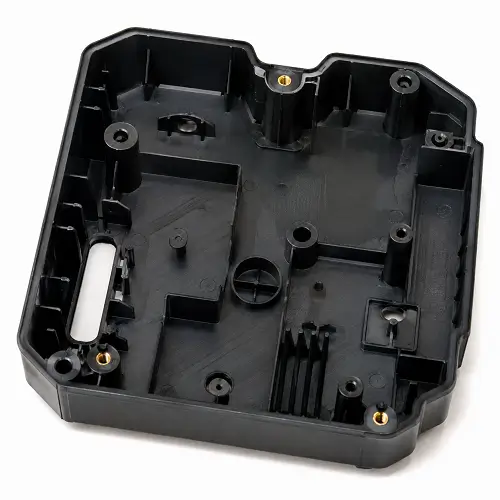
Plastic bosses are molded mounting features built directly into an injection molded part. Their main purpose is to provide a secure location for screws, printed circuit boards, battery compartments, internal brackets, or other components that need to be fixed inside a product. Because they are molded as part of the plastic component, they eliminate the need for many additional support parts and help keep product assembly simple.
Most customers rarely notice bosses because they are hidden inside the finished product. Remove the back cover of a router, a medical device, a handheld controller, or a household appliance, and several bosses are usually visible around the internal structure. Some only support lightweight electronic components, while others must withstand repeated screw assembly throughout the product’s service life.
Although every boss performs a similar function, their design is rarely identical. A boss used inside a television housing is very different from one supporting an automotive control module or an industrial enclosure. The surrounding structure, selected material, expected load, and production method all influence how the boss should be designed.
For this reason, experienced injection molding suppliers usually evaluate boss geometry during the DFM review rather than treating it as an isolated feature. A small adjustment before tooling is often much easier than modifying the mold after the first trial.
Why Plastic Bosses Are Used
Every plastic product needs a practical way to secure its internal components. Circuit boards must remain stable, battery compartments cannot move during use, and housing halves need reliable fastening points after assembly. Plastic bosses provide these mounting locations without adding extra brackets or complicated hardware.
Since bosses are molded during the injection molding process, they become part of the component itself. This allows manufacturers to reduce part count and simplify assembly while maintaining a clean exterior appearance. For products that are manufactured in large quantities, eliminating even one additional support component can reduce assembly time throughout the production cycle.
Bosses also give designers greater flexibility when arranging the internal layout of a product. They can be positioned wherever support is needed instead of being limited by standard metal brackets or secondary fastening methods. This makes them especially useful for electronic housings, battery covers, medical equipment, automotive interior components, and many other plastic products where internal space is limited.
Even though bosses appear to be simple cylindrical features, they influence much more than screw installation. Their location, diameter, surrounding wall thickness, and relationship with nearby ribs or snap fits can all affect molding quality, assembly performance, and tooling complexity. A boss that is easy to draw in CAD may require additional work during mold manufacturing if these factors are not considered early in the project.
Why Plastic Bosses Crack
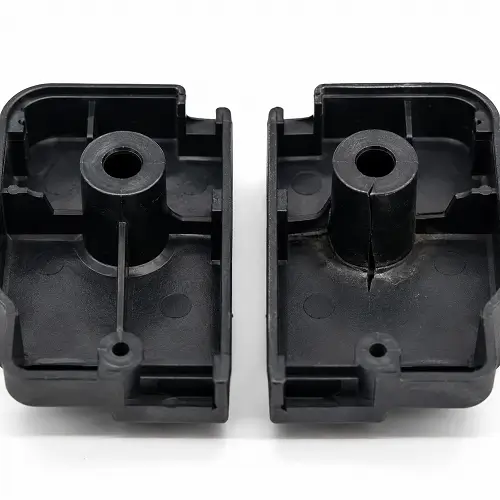
Most cracked bosses are not caused by a single mistake. In many projects, several small design decisions combine to create more stress than the plastic can safely withstand. The boss may survive the first assembly test, but repeated screw installation or long-term use eventually causes the material to crack around its base or along the screw hole.
Material selection is often one of the first factors to review. Some plastics can absorb more deformation before failure, while others are much less forgiving when the screw is tightened. Changing from polypropylene to ABS or another engineering plastic without adjusting the boss design may produce completely different assembly results, even when the CAD model remains unchanged.
The surrounding structure also plays an important role. A tall boss without adequate support may flex during assembly, while a boss positioned too close to an outside wall can transfer stress directly to the housing. In some cases, the screw itself becomes the problem if its size or thread type does not match the boss dimensions.
Assembly methods should not be ignored either. Using excessive tightening force or driving screws too quickly can create stress that was never considered during the original design. This is why many manufacturers test boss performance using the same assembly conditions that will be used during production rather than relying only on CAD analysis.
When a boss begins to crack, replacing the material is not always the best solution. Small adjustments to geometry, wall thickness, support ribs, or screw selection often improve reliability without increasing manufacturing cost.
Why Sink Marks Appear Around Bosses
Many customers first notice a boss problem from the outside of the product rather than inside it. After molding, the housing surface may show small depressions or uneven areas even though the boss itself looks completely normal. These visible defects are commonly known as sink marks.
Sink marks usually appear because the plastic cools unevenly during molding. Since a boss adds extra material beneath the outer surface, that area naturally takes longer to cool than the surrounding wall. As the plastic shrinks, the outside surface can be pulled inward, leaving a visible mark that affects product appearance.
This issue is especially noticeable on products with glossy finishes, painted surfaces, or cosmetic exterior housings. A customer may never see the boss itself, but even a small sink mark on the outside of the product can reduce perceived quality.
Fortunately, sink marks are often easier to prevent than to repair. Adjusting boss dimensions, improving the surrounding wall design, or changing the relationship between the boss and nearby ribs can significantly reduce the risk before tooling is completed. Material selection and molding conditions may also influence the final result, but the basic geometry of the boss usually has the greatest impact.
For products where appearance is important, experienced mold manufacturers normally review boss locations together with the exterior surface during the DFM stage. Preventing sink marks before the mold is built is usually faster and less expensive than modifying tooling after sampling.
Best Materials for Plastic Bosses
Not every plastic boss works under the same conditions. Some only need to hold a lightweight cover in place, while others support circuit boards, motors, or structural components that experience repeated assembly throughout the product’s life. Because the requirements vary from one product to another, the same material is rarely the best choice for every boss design.
ABS is one of the most common materials used in consumer electronics and household products. It offers a good balance between cost, appearance, and mechanical performance, making it suitable for many screw bosses found inside plastic housings. When the boss is properly designed, ABS provides reliable performance for products that are assembled once or only serviced occasionally.
Polypropylene behaves differently. It is more flexible than ABS and is often chosen for products that require repeated assembly or parts that experience more movement during use. Although PP is less rigid, its ability to deform without cracking makes it a practical choice for certain snap features and lightweight boss designs.
PC/ABS combines the toughness of polycarbonate with the easier processing characteristics of ABS. It is widely used in automotive electronics, medical devices, and industrial equipment where higher impact resistance is required. For products that may experience vibration or rough handling, PC/ABS often provides better long-term durability than standard ABS.
Nylon is commonly selected for functional components that carry higher mechanical loads. Bosses molded in nylon can provide excellent strength, but they should always be designed with the material’s characteristics in mind. Different nylon grades behave differently, especially when exposed to moisture or changing temperatures, so material selection should always match the product’s actual working environment.
Rather than searching for the strongest material, it is usually more effective to choose the material that matches the product’s assembly method, expected service life, and production requirements. A well-designed ABS boss often performs better than a poorly designed nylon boss simply because the overall structure has been developed for the intended application.
How Thick Should a Plastic Boss Be?
One of the most common questions during product development is whether a boss should be made thicker to improve its strength. At first glance, this seems logical. A larger boss appears stronger, and adding more material often feels like the safest option. In practice, however, increasing the wall thickness does not always improve performance.
When a boss becomes too thick, the surrounding plastic cools more slowly than the rest of the part. This uneven cooling increases the possibility of sink marks on the outside surface, especially when the boss is located behind a visible cosmetic area. The extra material may also create internal stress that affects dimensional stability after molding.
Making the boss too thin creates a different problem. The screw may not have enough material to grip, the boss can deform during assembly, or the feature may crack when tightening torque increases. Finding the right balance is usually more important than simply making the boss larger.
The surrounding structure should also be considered. Support ribs, wall thickness, and the distance between the boss and the outer wall all influence how loads are transferred through the part. A moderate boss with proper support often performs better than a thick boss without reinforcement.
For this reason, experienced mold designers normally review the entire surrounding structure rather than evaluating the boss by itself. Looking at the complete assembly usually produces a more reliable solution than changing only one feature.
How Boss Design Affects Mold Cost
Many customers focus on the external appearance of a plastic part because that is what users will eventually see. Internal features such as bosses often receive less attention during the early design stage. However, these small structures can influence tooling complexity more than expected.
A simple boss that follows standard molding practices usually has very little effect on tooling cost. It can often be machined directly into the mold without adding extra components or extending production time. In these situations, the boss becomes part of the normal mold structure.
The situation changes when the boss includes deep undercuts, difficult release directions, or locations that interfere with mold opening. Depending on the design, additional machining, inserts, sliders, or lifters may be required to manufacture the part successfully. These features increase both tooling complexity and mold cost.
The difference is not always dramatic, but it is important to understand that mold cost is influenced by design complexity rather than the number of bosses alone. A product with several simple bosses may be easier to manufacture than another product containing only one complicated feature.
Production volume should also be considered. For high-volume manufacturing, investing in a better boss design may reduce assembly time and improve product consistency over thousands of parts. In lower-volume projects, simplifying the boss may reduce tooling investment while still meeting product requirements.
Reviewing boss geometry before tooling begins usually provides the greatest opportunity to balance mold cost, assembly efficiency, and long-term product reliability.
Common Plastic Boss Design Mistakes
Boss problems are rarely caused by unusual engineering challenges. More often, they result from small design decisions that seem harmless during CAD development but become obvious once molded parts are assembled.
One common mistake is placing the boss too close to the outside wall of the housing. This increases the chance of sink marks appearing on the visible surface and can also make cooling less uniform during molding.
Another issue is making the boss much taller than necessary without providing adequate support. During screw installation, the feature may flex more than expected, causing stress to concentrate around the base. Over time, repeated loading can reduce durability even if the first assembly appears successful.
Ignoring the relationship between the boss and nearby ribs is another frequent problem. Support ribs are intended to improve stiffness, but they should work together with the boss rather than creating additional thick sections that increase shrinkage or cosmetic defects.
Material changes can also create unexpected results. A boss that performs well in one plastic may not behave the same way after switching to another resin. This is why design reviews normally consider the material before approving the final geometry instead of assuming one design works for every application.
Good boss design is not about making the feature as large or as strong as possible. It is about creating a structure that can be molded consistently, assembled efficiently, and perform reliably throughout the product’s expected service life.
Plastic Bosses in Custom Housings
Plastic bosses are used in almost every custom plastic housing, even though they are rarely visible after assembly. Open a router, smart home controller, medical device, industrial enclosure, or automotive electronic module, and the internal bosses are usually responsible for securing circuit boards, joining housing halves, or supporting internal components.
Because bosses work together with ribs, snap fits, and the surrounding wall structure, they should never be designed as independent features. Changing the height or location of a boss may affect screw assembly, housing strength, cosmetic appearance, and even the complexity of the mold itself.
During product development, it is often more effective to review the entire housing rather than focusing on a single boss. A small adjustment to the housing layout can sometimes improve assembly while reducing molding risks at the same time.
For products that use multiple fastening methods, reviewing bosses together with snap fits and housing geometry usually produces a more balanced design before tooling begins.
Plastic Bosses vs Metal Inserts
Not every product should rely on plastic bosses alone. Some applications require greater fastening strength, repeated assembly, or higher tightening torque than plastic can comfortably support. In these situations, threaded metal inserts may become the better solution.
Plastic bosses are often sufficient for consumer electronics, appliance housings, battery covers, and many products that are assembled once or serviced only occasionally. They simplify manufacturing because no secondary insert installation is required, helping reduce both part count and assembly time.
Metal inserts become more valuable when products are repeatedly assembled and disassembled, when higher clamp loads are required, or when long-term thread durability is important. Medical equipment, industrial machinery, and some automotive applications commonly use inserts to improve fastening reliability.
Choosing between a plastic boss and a metal insert is not simply a question of strength. Production quantity, product life, assembly method, and manufacturing cost should all be considered before deciding which solution is more appropriate.
Before Building the Mold
Many boss-related problems can be prevented long before steel is cut. Once tooling has been manufactured, even a small change to boss geometry may require mold modifications, additional machining, or repeated sampling. Reviewing the design early is usually faster, less expensive, and far less disruptive than making corrections after the first molded parts are produced.
A DFM review normally looks beyond the boss itself. The relationship between the boss, surrounding wall thickness, support ribs, screw type, material selection, and mold opening direction all contribute to the final result. Looking at these features together helps identify potential risks before they become production problems.
Experienced injection molding suppliers also consider how the part will actually be assembled. A design that performs well in CAD should also be practical for operators on the production line and reliable throughout the product’s service life. That practical review often prevents issues that cannot be identified by dimensions alone.
Request a Factory Quote
A well-designed plastic boss does much more than hold a screw. It supports assembly, improves product reliability, and can help reduce manufacturing costs when it is matched with the right material and housing design.
If you are developing an injection molded product, reviewing the boss design before tooling can help identify potential issues such as cracking, sink marks, weak fastening points, or unnecessary mold complexity.
Upload your CAD file to request a factory quote. The JeekMould engineering team can review your boss design, material selection, housing structure, and production requirements before mold manufacturing begins, helping you move from design to production with greater confidence.