
In real manufacturing work, polystyrene usually appears when the part must look clean, hold tight tolerances, and run in volume without creating problems on the shop floor.
For housings, covers, trays, and packaging components that demand consistent dimensions and short cycle times, PS often keeps production moving smoothly. Strength and heat resistance rarely drive this choice. Engineers pick PS because the material flows well, cools fast, and behaves predictably across thousands of shots.
Most engineering teams only lock in PS after impact and temperature limits are already checked. Once those constraints are cleared, PS becomes an efficient solution for high-volume injection molding programs focused on appearance, consistency, and cost control.
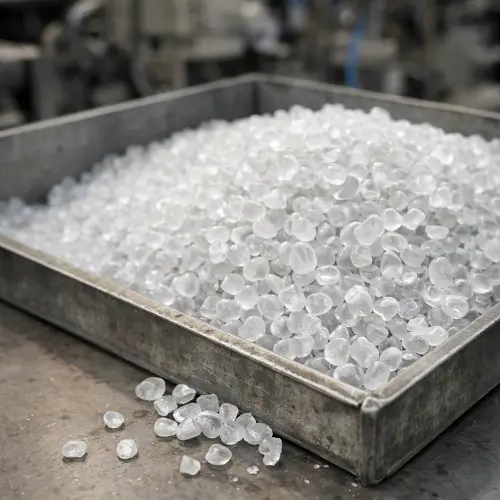
What Is Polystyrene (PS)?
Polystyrene (PS) is a rigid, amorphous thermoplastic widely used in injection molding for producing parts that require clean surface appearance, tight dimensional control, and stable high-volume production. In most manufacturing programs, PS is selected not for strength or heat resistance, but for how consistently it runs in the mold.
From a materials standpoint, PS is produced from styrene monomers and forms a stiff molecular structure that gives the material its characteristic rigidity and excellent mold detail reproduction. Typical PS grades show a density of 1.04–1.06 g/cm³, tensile strength between 35–55 MPa, and a flexural modulus of approximately 3.0–3.5 GPa. In practical terms, molded parts feel rigid in hand and hold their shape well under normal service loads.
PS does not tolerate deformation. Elongation at break remains low, around 2–3%, which means fracture occurs suddenly when parts are overstressed. On the shop floor, this usually appears as cracking from over-tightened screws, aggressive snap-fits, or rough handling during assembly.
Thermal performance stays within a moderate window. Most PS grades exhibit a heat deflection temperature between 85 and 100 °C. Beyond this range, parts soften and dimensional stability becomes difficult to maintain.
Moisture absorption remains minimal, typically below 0.1%, while molding shrinkage stays predictable at roughly 0.4–0.7%. These behaviors simplify tooling design and tolerance control, particularly in high-volume injection molding production.
Classification of Polystyrene for Injection Molding
In material discussions, polystyrene is commonly grouped into expanded polystyrene (EPS), high-impact polystyrene (HIPS), and syndiotactic polystyrene (SPS).
In practical injection molding production, standard PS and HIPS account for most applications. EPS is mainly used for foam packaging and insulation, while SPS appears in specialized high-performance parts where higher heat and chemical resistance are required.
Material Properties and Performance Characteristics of PS
High stiffness and strong dimensional control define PS in molded components. With tensile strength of 35–55 MPa and flexural modulus around 3.0–3.5 GPa, parts resist deformation under normal service loads and maintain geometry over long production runs. That performance explains why housings, frames, and cosmetic structural components frequently rely on PS.
Failure behavior, however, remains abrupt. The low elongation at break (2–3%) leaves little warning before fracture.
Thermal Performance and Heat Resistance
PS parts perform reliably below roughly 85–100 °C. Above that range, parts soften, creep increases, and dimensional accuracy starts to drift. PS is therefore not suitable for components exposed to sustained heat or located near heat-generating elements.
Surface Quality and Moisture Behavior
Few commodity plastics match PS for surface appearance. High-gloss finishes, fine textures, and sharp cosmetic details reproduce extremely well. Moisture absorption stays below 0.1%, allowing PS parts to remain dimensionally stable even in humid environments.
Shrinkage stays consistent at about 0.4–0.7%, simplifying mold design and tolerance control.
Flow Behavior and Processing Stability
PS flows smoothly, fills thin sections easily, and cools quickly. Those characteristics produce short cycle times, stable part weights, and excellent repeatability.
The same rigid molecular structure that delivers these advantages also limits impact strength and shock resistance.
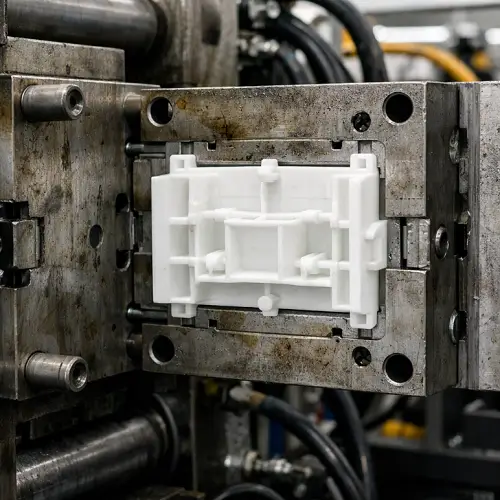
Processing Considerations for PS Injection Molding
Temperature Control
Typical melt temperature ranges from 180–260 °C. Excessive temperature or long residence time leads to discoloration and molecular degradation.
Mold temperature is commonly held between 30–60 °C to stabilize surface finish and part dimensions.
Part Design and Stress Management
Avoid sharp corners and abrupt wall-thickness changes. These features concentrate stress and trigger cracking.
Maintain uniform wall thickness and apply generous fillets.
Use at least 1° draft for reliable demolding.
Tooling and Surface Finish
Because PS reproduces cavity finish so faithfully, mold quality directly controls final appearance. Polished cavities dominate cosmetic PS tooling. Cooling must be balanced to control cycle time and shrinkage consistency.
Advantages and Disadvantages of PS in Injection Molding
Advantages
PS offers low material cost, excellent surface finish, stable processing behavior, and short molding cycles. The material’s predictable shrinkage and low moisture absorption simplify dimensional control and reduce tooling complexity. These characteristics make PS especially attractive for high-volume production of visually critical components.
Disadvantages
PS exhibits limited impact resistance and relatively low heat tolerance. The material is prone to brittle fracture under mechanical shock and is unsuitable for applications involving sustained load, vibration, or elevated temperature environments. These limitations restrict PS from being used as a structural engineering plastic.
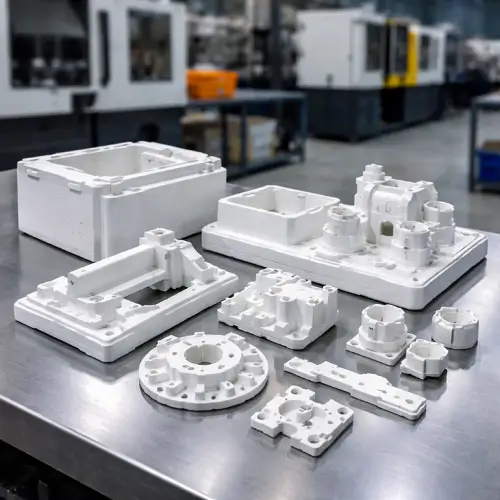
Typical Applications of PS Injection Molded Parts
PS is widely used in industries where appearance, dimensional stability, and production efficiency are more critical than high mechanical strength.
Common applications include:
-
Transparent and cosmetic packaging components
-
Disposable medical and laboratory products
-
Consumer electronics housings and covers
-
Appliance trim and interior panels
-
Display components and optical housings
-
Office equipment enclosures
-
Food service containers and disposable utensils
PS Injection Molding Compared with Other Materials
Compared with ABS, PS offers better surface finish and lower material cost, but significantly lower impact resistance and heat tolerance. Compared with PP, PS provides higher stiffness and superior surface quality, while PP delivers better toughness and fatigue resistance. Compared with PC, PS has much lower heat resistance and impact strength but processes more easily and at lower cost.
This comparison framework helps engineers quickly determine whether PS fits the functional and economic targets of a given injection molding project.
FAQs
Is PS suitable for thin-wall injection molding?
Yes. PS flows well and cools quickly, making it suitable for thin-wall parts when wall thickness is kept uniform and proper gating is applied.
Why do PS parts crack easily during assembly?
PS is brittle and sensitive to stress concentration. Sharp corners, excessive press-fit force, and improper screw design often lead to cracking.
What is the typical service temperature range of PS parts?
PS parts generally perform reliably below 80–90 °C. Prolonged exposure above this range may cause softening and dimensional distortion.
Can PS parts be bonded or welded?
Yes. PS can be bonded using solvent-based adhesives and can be ultrasonically welded for certain joint designs.