
Anyone who has molded ABS knows it behaves predictably only when temperature and flow energy stay within a narrow range. Housings, bezels, interior trim, appliance covers—ABS shows up everywhere because it balances toughness, appearance, and ease of processing. In many ABS plastic molding programs, once surface gloss, weld-line visibility, or shrink balance becomes critical, the material starts revealing every small variation in tooling or process. In most ABS injection molding jobs, these surface reactions directly reflect melt temperature, mold temperature, and shear stability.
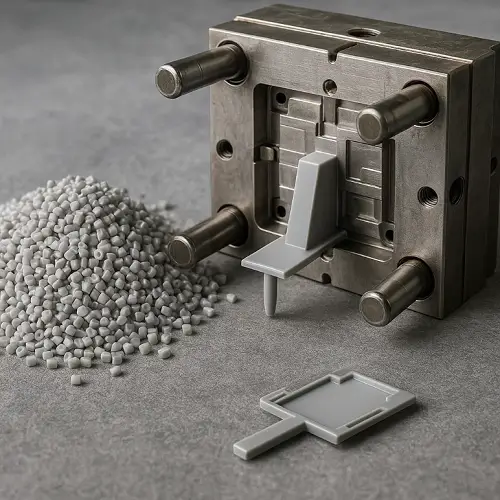
If you’ve handled ABS plastic before, you’ve probably seen how quickly it reacts to mold-temperature shifts or to a gate that shears the melt too aggressively. Those reactions aren’t random—they come from the structure of the polymer itself, and they tend to show up in common ABS molding defects such as flow lines, sink marks, and weld-line definition.
What Is ABS Injection Molding?
ABS (Acrylonitrile–Butadiene–Styrene) is an amorphous thermoplastic whose performance comes from the combination of a rigid matrix and an impact-modifying rubber phase. Because the material does not crystallize, it avoids the strong directional warp seen in semi-crystalline polymers. Instead, ABS plastic reflects temperature, shear, and cooling balance directly on the surface or through dimensional drift. This is why ABS molding parameters—melt temperature, mold temperature, shear load, cooling—affect cosmetic quality more than most materials.
ABS injection molding relies on holding melt temperature steady, controlling shear at the gate, and keeping the steel warm enough to avoid gloss swings. When one of these conditions drifts, the part immediately shows it, especially in areas with thin-wall flow or weld-line convergence typical of ABS plastic injection molding.
ABS Material Properties
| Property | Typical Range | Notes |
|---|---|---|
| Melt Temperature | 210–260°C | Higher melt improves flow and weld strength |
| Mold Temperature | 50–80°C | Strong driver of gloss and flow-line visibility |
| Density | ~1.04 g/cm³ | Consistent among grades |
| Melt Flow Rate (MFR) | 5–30 g/10 min | High MFR grades suit thin-walls |
| Shrinkage | 0.4–0.7% | Sensitive to wall-thickness transitions, affects ABS shrinkage rate |
| Tensile Strength | 40–50 MPa | Impact grades differ noticeably |
| Heat Deflection Temperature | 85–100°C | Higher in heat-resistant ABS |
You’ll notice most of these values push the engineer to think about balance: surface, flow, and internal stress rarely respond to a single adjustment in ABS molding process settings, especially with certain ABS plastic grades.
Material Behavior in ABS Injection Molding
Melt Behavior
ABS flows easily, but the melt loses stability as soon as temperature drops near the lower limit. If you’ve watched thin-wall parts fill at borderline temperature, you’ve probably seen the surface dull or the flow front break up. Too much heat, however, pushes the rubber phase toward degradation. Gate design controls much of this behavior—sharp restrictions increase shear and trigger cosmetic inconsistency before the cavity is even half filled. These are typical early indicators in ABS injection molding troubleshooting, especially with heat-sensitive ABS plastic compounds.
Thermal Stability
ABS reacts quickly to thermal history. Slight overheating creates yellow tones or faint dark streaks near the gate. Extended residence time in hot runners accelerates this effect. If you’ve ever opened a mold and smelled oxidized butadiene, you already know what too much heat does to ABS plastic. Stability in the barrel is not optional for consistent appearance, especially when molding high-gloss surfaces.
Cooling Behavior
ABS cools without a crystallization step, but that doesn’t make it immune to cooling variation. Mold surfaces that differ by only a few degrees can shift gloss, highlight ABS flow lines, or change weld-line visibility. Thick sections hold heat and carry internal stress, which later shows up as warp or whitening during assembly. Uniform cooling tends to solve more ABS plastic molding problems than most parameter tweaks.
Surface Sensitivity
ABS exposes every detail on the steel. Polishing quality, texture variation, vent location, and cold spots appear instantly on the molded surface. If your part requires Class-A appearance, mold temperature uniformity and steel finish matter more than nearly any machine parameter. This sensitivity is one reason ABS plastic is preferred for consumer-facing housings.
Shrinkage and Warpage Characteristics
Shrinkage Range
ABS typically shrinks between 0.4% and 0.7%. The number itself seems manageable, but the gradient across a part is what causes trouble. Thick regions shrink more, pulling down the surface; thin regions freeze early and lock in stress. If you’ve seen sink marks on rib-supported walls, you’ve already seen this effect. This uneven movement is the core of ABS shrinkage rate behavior and a frequent topic in ABS plastic molding reviews.
Warpage Drivers
Warp in ABS comes from uneven cooling, aggressive packing, or wall-thickness imbalance. Since the material doesn’t crystallize, internal stress dominates the result. Long, flat housings often warp when stress concentrates near ribs or unsupported corners. A balanced wall and controlled cooling go further than chasing warp through machine settings. Engineers handling ABS injection molding defects often find warp tied to geometry, not the machine—especially in large ABS plastic housings.
Design Considerations for ABS Injection Molding
ABS rewards simple, uniform geometry. ABS wall thickness should stay consistent to avoid gloss shifts or sink. When stiffness is needed, ribs work well as long as they do not exceed proper thickness ratios. Corners need radii to avoid stress whitening—something you’ve likely seen on snap-fit features when the part flexes.
Gate placement directly influences final appearance. Gates feeding cosmetic surfaces often create blush or emphasize weld lines. Moving the gate to the back side or a structural region usually improves cosmetic stability. Many ABS plastic components use hidden gating to avoid surface disturbances.
For high-gloss parts, mold temperature uniformity is non-negotiable. Even small differences in steel temperature show up clearly on ABS, especially for polished parts in ABS injection molding programs.
Material-Driven Defect Tendencies
Weld Lines
ABS weld lines appear when the melt fronts meet at reduced temperature. They stay visible because the material does not self-level after contact. If you’ve molded large covers, you’ve likely seen welds show up even when the part is fully packed, especially on high-visibility ABS plastic surfaces.
Sink Marks
ABS highlights sink more readily than semi-crystalline materials. Thick ribs or wall transitions cool slowly and collapse inward slightly. A well-balanced wall usually prevents most of these impressions before they appear, particularly in ABS plastic housings with broad cosmetic regions.
Burn Marks
Restricted flow paths or excessive shear cause localized heating. ABS responds by producing brown or black marks, often close to the gate or end-of-fill areas. Although venting helps, most burn marks originate from thermal stress inside the melt stream. This behavior is typical across most ABS plastic grades.
Flow Lines
ABS forms flow lines when mold temperature varies across the cavity or when the flow front cools too quickly. If you’ve seen wave-like patterns or gloss changes tracing the melt path, that’s the surface reacting directly to steel temperature. These are among the most commonly searched ABS molding defects and appear frequently in ABS plastic injection molding evaluations.
Applications of ABS Injection Molded Parts
Consumer Electronics Housings
ABS offers impact strength and surface consistency for handheld devices and enclosures.
Automotive Interior Components
Dashboard trim, vents, covers, and interior structural pieces benefit from ABS stability.
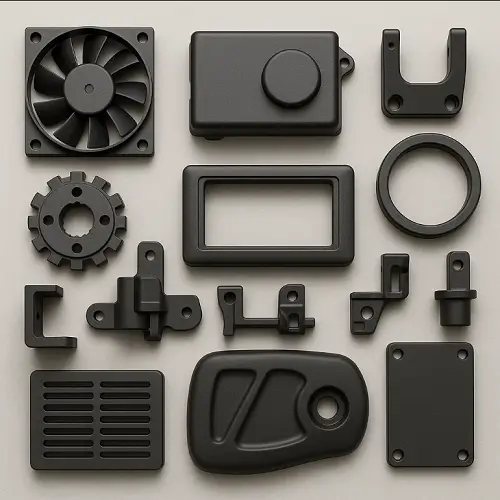
Household Appliance Parts
Dryers, vacuums, kitchen appliances, and handheld tools frequently rely on ABS housings.
Industrial Covers and Panels
ABS provides repeatability and toughness for protective covers and equipment shells.
Connector and Interface Components
Stable dielectric performance supports mid-current electrical housings and inserts.
Commercial and Office Equipment
Printers, scanners, and terminals rely on ABS for dimensional consistency under moderate heat.
Conclusion
ABS behaves consistently once its melt energy, cooling pattern, and wall design are aligned with the material’s tendencies. Most cosmetic shifts—gloss swings, weld-line definition, sink, and flow marks—trace back to how the melt enters the cavity and how the steel carries temperature. If your part depends on appearance or tight assembly fit, a quick review of the geometry and the grade usually prevents days of troubleshooting later on.
If you want an assessment of how your ABS part will mold—or you’re ready for a production quote for ABS injection molding—you can send the model directly. We typically respond within 24 hours with tooling notes, molding risks, and a clear cost window for your ABS plastic project.Click to get a quote for ABS plastic parts.
FAQ — ABS Injection Molding
Why does ABS show yellowing during molding?
Thermal exposure affects the rubber phase. Even mild overheating produces yellow tint or dark streaks near the gate.
What mold temperature works best for high-gloss ABS?
Temperatures around 70–80°C improve gloss and reduce flow-line visibility on polished steel.
Why are weld lines easy to see on ABS?
ABS does not self-level after flow fronts meet, so welds remain visible unless the melt temperature is high enough.
Does ABS warp easily?
Warp originates from internal stress and uneven cooling. Balanced wall thickness and controlled packing reduce the effect.
What causes sink marks on ABS?
Thick regions cool slowly and shrink more, pulling the surface down. Rib design and cooling layout directly influence sink depth.
Is ABS suitable for thin-wall parts?
Yes, especially with high-flow grades. Stable shear and mold-temperature balance help maintain surface quality.