
Choosing the right injection molding material is one of the first decisions in a plastic part project. The material affects how the part looks, how strong it is, how much heat it can handle, whether it can bend, whether it can stay transparent, and how stable the part will be after molding.
Many customers already know they need an injection molded plastic part, but they may not know which resin is suitable. ABS, PP, PC, PMMA, nylon, POM, PBT, TPU, and high-performance plastics can all be used in injection molding, but they are not used for the same type of part.
A good material choice should match the part function, working environment, surface requirement, production quantity, and cost target. A clear cover, a soft grip, an automotive bracket, an electrical connector, and a consumer product housing all need different materials.
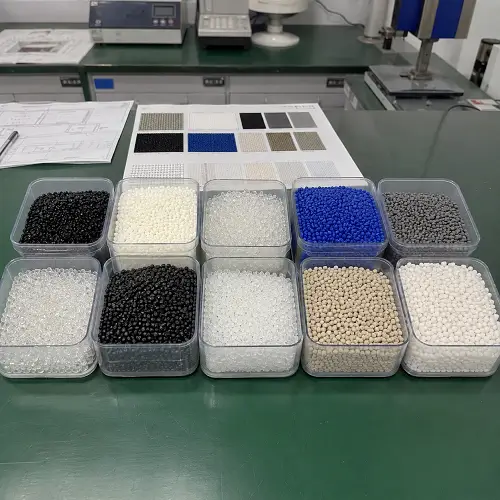
What Are Injection Molding Materials?
Injection molding materials are plastic resins that can be melted, injected into a mold, cooled, and formed into finished plastic parts. Most materials used in injection molding are thermoplastics, which means they soften when heated and harden again when cooled.
The material choice affects more than the part price. It also affects mold design, shrinkage, wall thickness, surface finish, strength, flexibility, heat resistance, chemical resistance, and long-term part performance.
For example, ABS may be a good choice for a clean-looking product housing. PP may be better for a lightweight container or automotive trim part. PC may be better for a strong transparent cover. Nylon may be better for a bracket or gear that needs strength. TPU or TPE may be better when the part needs a soft grip or flexible seal.
There is no single “best” plastic for injection molding. The best material depends on what the part needs to do.
How to Choose the Right Injection Molding Material
Many molding problems start from material selection. A part can have a good mold and still fail if the resin does not match the application.
If the material is too brittle, the part may crack during assembly. If the material is too soft, the part may not hold shape. If the heat resistance is too low, the part may deform in use. If the material shrinks too much or warps easily, the part may not fit the assembly. If the surface requirement is high, the wrong resin may produce poor gloss, flow marks, or visible defects.
Material also affects cost. Some plastics are easy to mold and suitable for large-volume production. Some engineering plastics cost more and require tighter processing control. High-performance materials such as PEEK, PPS, or PEI can be useful in demanding applications, but they are not necessary for ordinary covers, housings, or consumer parts.
The right material choice keeps the project practical. It should meet the part requirement without adding unnecessary cost or molding difficulty.
ABS
ABS is one of the most common injection molding materials because it offers a good balance of appearance, strength, cost, and processing stability.
ABS is usually easy to mold. It flows well, fills molds reliably, and can produce a clean surface finish with stable color and texture. This makes it a safe material for many product housings, covers, panels, and consumer plastic parts.
ABS is commonly used in electronic housings, appliance parts, instrument covers, automotive interior trim, toys, and general consumer products. It works well when the part needs a good-looking surface but does not need extreme heat resistance or outdoor weather resistance.
The cost of ABS is usually moderate. It is more expensive than some low-cost materials such as PP in many cases, but much more affordable than engineering plastics such as PC, PBT, PEEK, or PEI.
The main limit of ABS is heat and weather resistance. It is not ideal for engine-area parts, long-term outdoor exposure, or applications that require strong UV resistance. If the part needs better outdoor performance or higher toughness, PC/ABS, ASA, PC, or another engineering plastic may be a better choice.
PP
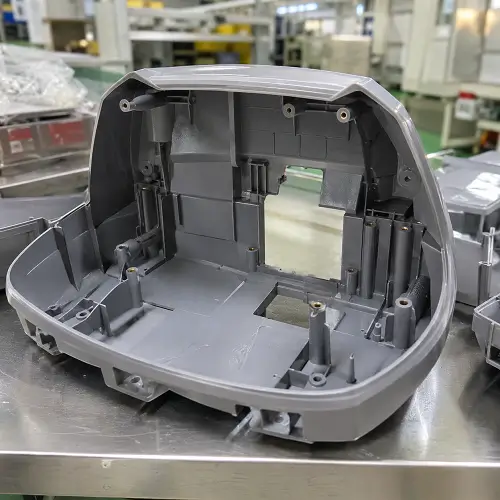
PP, or polypropylene, is one of the most widely used injection molding materials. It is lightweight, cost-effective, chemically resistant, and suitable for high-volume plastic parts.
PP is usually easy to process and works well in mass production. It is often chosen when the part needs low cost, low weight, and practical durability. For projects where material cost matters, PP is often one of the first materials to consider.
PP is common in automotive interior parts, storage boxes, containers, caps, packaging components, medical products, household goods, and living hinge parts. One of its strongest advantages is fatigue resistance, which makes it useful for parts that need to bend repeatedly.
The cost of PP is generally low compared with many engineering plastics. Its heat resistance is moderate, and it can handle many everyday applications, but it is not the best choice for high-temperature parts.
The main limitation is stiffness and dimensional control. PP is more flexible than ABS or PC/ABS and has higher shrinkage. For tight-fit parts, large flat surfaces, or parts that need a premium cosmetic finish, PP may require more design attention.
PP is a good choice when the part needs low cost, light weight, chemical resistance, and toughness rather than high gloss or high stiffness.
PE, HDPE, and LDPE
PE, or polyethylene, is commonly used for tough, flexible, and chemically resistant plastic parts. HDPE is stiffer and stronger, while LDPE is softer and more flexible.
PE materials are usually easy to process, but they are not always the best choice for tight-tolerance molded parts because shrinkage can be higher. They work best when the part needs toughness and chemical resistance rather than fine detail or high dimensional accuracy.
HDPE is often used for caps, containers, industrial parts, packaging components, household products, and chemical-resistant parts. LDPE is used when softness and flexibility matter more than rigidity.
PE is usually a low-cost material. It has good chemical resistance and impact toughness, which makes it useful for practical parts in packaging, consumer goods, and industrial applications.
The main limitation is appearance and precision. PE is not usually selected for high-gloss cosmetic housings, transparent parts, or precision mechanical components. It is better for durable, practical parts where function matters more than appearance.
PC
PC, or polycarbonate, is known for high impact strength, good heat resistance, and transparency. It is used when a plastic part needs toughness, strength, or a clear appearance.
PC is more difficult to mold than ABS or PP. It usually requires more careful drying, higher processing temperatures, and better mold control. If it is not processed correctly, the part may show stress, haze, bubbles, or surface defects.
PC is commonly used for transparent covers, protective housings, lenses, medical device components, electrical parts, safety covers, lighting parts, and strong plastic enclosures. It is also used when a part needs better heat resistance than many general-purpose plastics.
PC usually costs more than ABS and PP. The higher cost can be worth it when the part needs impact resistance, heat resistance, or transparency. For protective covers and stronger housings, PC is often a practical choice.
The main limits are cost, processing difficulty, and scratch resistance. PC is tough, but its surface is softer than acrylic and may need a coating if scratch resistance is important.
PC is a strong choice when the part needs toughness, transparency, and performance.
PC/ABS
PC/ABS combines the toughness of polycarbonate with the easier processing and better appearance of ABS. It is a common engineering plastic for molded housings and automotive parts.
PC/ABS is usually easier to process than pure PC and stronger than ABS. It offers a good balance of impact resistance, heat resistance, appearance, and molding stability. This makes it useful when ABS is not strong enough but pure PC may be more than the project needs.
PC/ABS is widely used in automotive interior parts, electronic housings, instrument enclosures, medical device housings, power tool covers, and industrial plastic parts.
The cost is higher than ABS but usually lower than pure PC or high-performance engineering materials. Its heat resistance and toughness are better than ABS, making it a practical upgrade for parts that need stronger performance.
The main limitation is that PC/ABS is still not the best choice for very high-temperature, outdoor, or chemical-heavy environments unless the correct grade is selected. It also does not provide the same optical clarity as PC or PMMA.
PC/ABS is often a good middle ground for housings that need appearance and durability.
PMMA / Acrylic
PMMA, also known as acrylic, is used for clear plastic parts that need high transparency, gloss, and a glass-like appearance.
PMMA can be injection molded into beautiful clear parts, but it is not as easy to process as ABS or PP. It needs proper drying, good mold polishing, and careful control of gate location and wall thickness. Clear acrylic parts show defects easily, so bubbles, silver streaks, flow marks, weld lines, and scratches can become serious problems.
Acrylic is commonly used for display windows, transparent covers, light guides, lighting lenses, cosmetic packaging, instrument panels, decorative clear parts, and visual components.
The cost of PMMA is usually moderate. It is not as low-cost as PP, but it is far less expensive than high-performance materials. Its heat resistance is moderate, and it is more suitable for clear appearance parts than high-impact or high-heat applications.
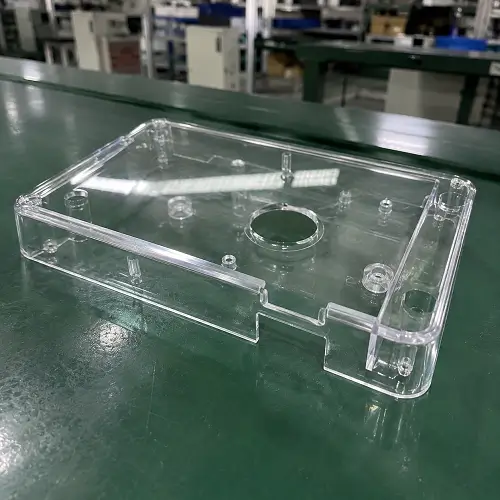
The biggest advantage of PMMA is optical appearance. It can look clearer and more glass-like than many other plastics. The main weakness is impact strength. Acrylic is more brittle than polycarbonate and may crack if used in high-impact or stressed assembly parts.
PMMA is a good choice when clarity and surface appearance matter more than impact strength.
PA / Nylon
PA, commonly called nylon, is an engineering plastic used when a part needs strength, wear resistance, and better heat performance.
Nylon is more difficult to process than ABS or PP. It absorbs moisture, and its shrinkage and warpage need to be controlled. Glass-filled nylon adds strength and stiffness, but it can also increase mold wear and make warpage more difficult to manage.
Nylon is commonly used for gears, brackets, clips, bushings, under-hood automotive parts, industrial components, housings, and mechanical parts. It is often selected when the part needs to handle load, friction, or higher temperature.
The cost of nylon is usually higher than general-purpose plastics such as PP and ABS, but lower than specialty high-performance plastics. Its heat resistance and mechanical strength are better than many common materials.
The main challenge is moisture absorption. Nylon can absorb water from the environment, which may affect dimensions and mechanical behavior over time. For precision parts, this should be considered before choosing the material.
Nylon is a good choice for functional plastic parts, but the design and molding process need more control than simple consumer materials.
POM / Acetal
POM, also called acetal, is known for wear resistance, low friction, and dimensional stability. It is often used for moving parts.
POM is generally moldable, but processing needs care because overheating can cause material degradation. A good supplier should understand the correct processing window and venting requirements for POM.
POM is commonly used for gears, bearings, rollers, sliding parts, clips, levers, pump components, precision mechanical parts, and small functional components.
The cost of POM is usually higher than PP and ABS but lower than high-performance materials such as PEEK or PEI. Its heat resistance is good enough for many mechanical applications, but it is not usually selected for extreme high-temperature environments.
The main advantage of POM is smooth movement. It works well when a plastic part needs to slide, rotate, or resist wear. The main limitation is appearance and material compatibility. It is rarely chosen for cosmetic parts, transparent parts, or applications that require strong bonding or painting.
POM is a strong choice for gears, sliding features, and precision moving parts.
PBT
PBT is an engineering plastic often used for electrical and automotive components. It has good dimensional stability, electrical insulation, and heat resistance.
PBT is usually moldable with stable results, but it still requires proper drying and mold control. It is commonly used when a part needs to hold shape and work reliably in electrical or mechanical assemblies.
PBT is widely used for connectors, sensor housings, terminal blocks, electrical covers, automotive electronic parts, relay housings, and appliance components.
The cost of PBT is higher than PP and ABS but lower than many specialty plastics. Its heat resistance and dimensional stability are better than most general-purpose materials, which makes it useful in electrical and automotive applications.
The main limitation is that PBT is not usually selected for soft parts, transparent parts, or low-cost general housings. It is more suitable for engineering applications where electrical performance and stable dimensions matter.
PBT is a strong choice for connectors and electrical components.
PET
PET is well known from packaging, but it can also be used in injection molding for certain engineering and industrial parts.
PET needs proper drying before molding because moisture can affect quality. When processed correctly, it can provide good stiffness, wear resistance, and dimensional stability.
Injection molded PET is used in electrical parts, mechanical components, industrial parts, housings, and some precision applications. It may also be used when the part needs good surface quality and stable performance.
The cost of PET is usually moderate. It can be practical in the right application, but it is not always the first material customers consider for injection molded parts because PET is strongly associated with bottles and packaging.
The main limitation is processing sensitivity. Drying and grade selection matter. If the part needs high impact strength, very high heat resistance, or easy molding, another material may be more suitable.
PET can be useful, but it should be selected based on the specific part requirement rather than only the material name.
PS and HIPS
PS, or polystyrene, is a low-cost material that is easy to mold. It can produce clear or rigid parts, but it is brittle compared with many other plastics.
HIPS, or high-impact polystyrene, is a modified version with better impact resistance. It is still relatively easy to process and cost-effective.
PS and HIPS are used for packaging, disposable products, consumer goods, display parts, appliance components, trays, housings, and light-duty plastic parts.
The main advantage is easy molding and low cost. These materials work well when the part does not need high strength, high heat resistance, or long-term mechanical performance.
The main weakness is durability. PS is brittle, and HIPS is tougher but still not suitable for demanding load-bearing applications. Heat resistance is also limited compared with engineering plastics.
PS and HIPS are practical for simple, cost-sensitive molded parts.
PVC
PVC can be injection molded, but it requires more care than many general-purpose plastics. The material can be sensitive to heat, and processing conditions must be controlled to avoid degradation.
PVC is used for fittings, pipe components, electrical parts, medical components, seals, and some industrial products. It can be rigid or flexible depending on formulation.
The main advantage of PVC is chemical resistance, flame resistance, and formulation flexibility. It can be useful in applications where these properties matter.
PVC is usually not treated as an easy material by every molding supplier. It can release corrosive gases if overheated, so tooling, equipment, and processing control must be suitable. Heat stability and processing safety need attention.
PVC can be a good material for the right application, but it should be discussed carefully before tooling and production.
TPU and TPE
TPU and TPE are soft or flexible injection molding materials. They are used when a part needs grip, sealing, flexibility, soft touch, or impact cushioning.
These materials are more difficult to mold than rigid plastics in some cases. They can stick in the mold, require careful ejection, and need proper gate design. Some grades are easy to process, while others require more control.
TPU is often used for flexible covers, protective cases, seals, wheels, grips, wear-resistant parts, and soft-touch components. TPE is common in grips, overmolded handles, flexible seals, consumer products, and comfort-touch surfaces.
The cost is usually moderate to higher than common rigid plastics, depending on hardness and grade. Heat resistance varies by formulation, so the exact grade matters if the part will work in a warm environment.
The main advantage is flexibility. These materials can bend, stretch, absorb impact, or create a soft feel. The main challenge is part design and material matching. When used in overmolding, the soft material must bond or mechanically lock to the base material correctly.
TPU and TPE are good choices when the part needs softness, grip, sealing, or flexibility.
PEEK, PPS, and PEI
PEEK, PPS, and PEI are high-performance injection molding materials. They are used when ordinary plastics cannot meet heat, strength, chemical, or performance requirements.
These materials are much more difficult to mold than ABS, PP, or PC/ABS. They require higher processing temperatures, better mold control, and more experienced molding conditions. They are also much more expensive.
PEEK is used in medical, aerospace, automotive, electronics, and high-performance industrial parts. It offers excellent heat resistance, chemical resistance, and mechanical performance.
PPS is often used in electrical, automotive, and industrial applications where heat resistance, chemical resistance, and dimensional stability are important.
PEI is used for high-temperature electrical parts, medical components, aerospace-related parts, and applications requiring strength and flame resistance.
The main advantage of these materials is performance. The main limitation is cost and processing difficulty. They are not chosen for ordinary plastic covers or simple consumer parts. They are used when the working environment demands performance that standard plastics cannot provide.
Glass-Filled Injection Molding Materials
Glass-filled plastics are not a single material family. They are base resins such as nylon, PP, PBT, or PC reinforced with glass fiber to improve strength, stiffness, and heat performance.
Glass-filled nylon is one of the most common choices for functional plastic parts. It is widely used in automotive brackets, fan housings, under-hood covers, industrial supports, clips, and structural plastic components where standard nylon may not provide enough stiffness.
Glass-filled PP is often used when a part needs better rigidity than regular PP but still needs cost control and light weight. It can be useful for automotive interior supports, covers, appliance parts, and some industrial components.
Glass-filled PBT is common in electrical and automotive connector applications. It provides good dimensional stability, insulation performance, and better stiffness than unfilled PBT. Connector housings, relay cases, sensor housings, and electrical parts often use glass-filled PBT grades.
The benefit of glass-filled materials is stronger and stiffer molded parts. The trade-off is that molding becomes less forgiving. Glass fiber can increase warpage, create rougher surfaces, reduce impact toughness in some designs, and cause more mold wear. Fiber direction can also affect shrinkage, so gate location and part design matter more.
Glass-filled materials are good choices when the part needs strength, stiffness, or heat resistance. They should be reviewed carefully when the part has large flat surfaces, tight cosmetic requirements, snap-fit features, or strict flatness requirements.
ABS vs PP, PMMA vs PC, and Other Material Comparisons
Some injection molding materials are often compared because they appear to solve similar problems. The better choice depends on the part function, not only the material name.
ABS vs PP is a common comparison for housings, covers, and general plastic parts. ABS usually gives a better surface appearance and higher stiffness. PP is usually lower cost, lighter, and more chemically resistant. If the part needs a clean cosmetic housing, ABS is often safer. If the part needs low cost, light weight, or chemical resistance, PP may be better.
PMMA vs PC is common for clear plastic parts. PMMA gives better optical clarity and a more glass-like appearance. PC gives much better impact resistance. A display window or lighting cover may use PMMA when appearance is the main requirement. A protective cover, machine guard, or impact-resistant transparent housing is usually safer in PC.
Nylon vs POM is often considered for functional moving parts. Nylon is stronger and better for brackets, clips, and load-bearing components. POM has lower friction and better wear behavior for gears, rollers, sliding parts, and small precision mechanisms. If the part carries load, nylon may be better. If the part moves or slides, POM is often the first material to review.
TPU vs TPE is common for soft-touch and flexible parts. TPU usually offers better wear resistance and toughness. TPE can be easier to process and is often used for grips, seals, soft-touch surfaces, and overmolded consumer products. The final choice depends on hardness, flexibility, bonding requirement, and use environment.
PBT vs Nylon is common for automotive and electrical parts. PBT has good dimensional stability and electrical insulation, making it common for connectors and electrical housings. Nylon is stronger and often used for brackets, clips, and mechanical parts. For electrical stability, PBT is often preferred. For higher mechanical load, nylon may be better.
How to Choose the Right Injection Molding Material
The right material depends on the part’s function, not only the part shape. A plastic cover, gear, connector, soft grip, and transparent window may all be injection molded, but they should not use the same resin.
For clear parts, PMMA and PC are common choices. PMMA is better when the part needs a glass-like appearance and high clarity. PC is better when the part needs impact resistance and toughness.
For general product housings, ABS and PC/ABS are common choices. ABS is easier and more cost-effective. PC/ABS gives better toughness and heat resistance when the part needs stronger performance.
For low-cost, lightweight, high-volume parts, PP is often considered. It is common in containers, automotive trim, packaging parts, and living hinge products.
For gears, sliding parts, and precision moving components, POM is often a good choice because of its wear resistance and low friction.
For automotive brackets, clips, and under-hood parts, nylon or glass-filled nylon is often used because of strength and heat resistance.
For electrical connectors and electronic housings, PBT and PA are common because they provide dimensional stability and electrical performance.
For flexible parts, soft grips, seals, and overmolded surfaces, TPU or TPE may be the right choice.
For high-temperature, chemical, medical, aerospace, or demanding industrial parts, high-performance materials such as PEEK, PPS, or PEI may be needed.
A good material selection should balance performance, cost, moldability, and production risk. Choosing the strongest or most expensive material is not always better. The best choice is the material that meets the real part requirement without adding unnecessary cost or molding difficulty.
Conclusion
Common injection molding materials include ABS, PP, PE, PC, PC/ABS, PMMA, nylon, POM, PBT, PET, PS, PVC, TPU, TPE, and high-performance plastics such as PEEK, PPS, and PEI. Each material can be useful, but each one has its own molding behavior, cost level, strengths, and limits.
For customers, the most practical way to choose a material is to start with the part function. Does the part need to look good, stay clear, resist impact, handle heat, move smoothly, seal, bend, or hold a load? The answer usually points to a smaller group of suitable plastics.
Material choice should also consider the application industry. Automotive parts, medical device parts, consumer products, electrical connectors, industrial components, and clear display parts often use different materials for different reasons.
JeekMould can help review the part design, application requirement, material choice, expected quantity, and molding difficulty before tooling begins. If the material is already selected, the team can check whether it matches the part geometry and application. If the material is not confirmed, JeekMould can help compare practical options based on appearance, strength, cost, heat resistance, and moldability.
Not sure which plastic is right for your part? JeekMould can review your CAD file, material requirements, and production quantity before tooling, then provide a practical factory quote.