
The plastic melting point varies widely because plastics do not share the same molecular structure or thermal behavior. LDPE may melt slightly above 100°C, while high-performance thermoplastics such as PEEK require temperatures above 300°C. ABS, polycarbonate, acrylic, and polystyrene behave differently because they soften gradually rather than melting at one sharply defined temperature.
These thermal differences affect more than the barrel settings on an injection molding machine. The selected plastic can change the required mold temperature, heater capacity, hot-runner components, gate dimensions, venting, cooling layout, molding cycle, and tool cost. A mold designed for PP or ABS cannot always be used for PPS or PEEK simply by increasing the processing temperature.
The melting point of plastic is also different from its processing temperature, mold temperature, heat-deflection temperature, and continuous operating temperature. Understanding these values helps product designers select a suitable material and allows mold engineers to develop stable processing conditions before tooling begins.
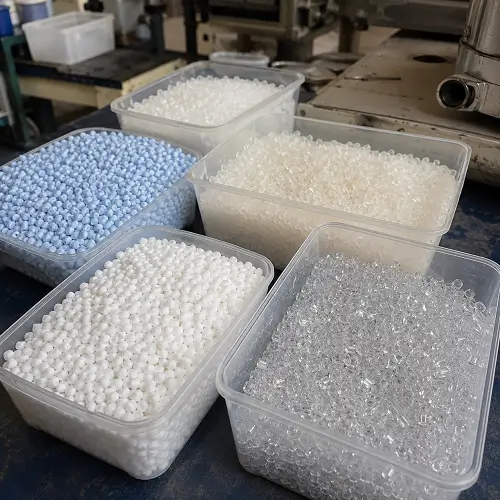
What Is the Melting Point of Plastic?
The melting point of plastic depends on the polymer because plastic is a broad material family rather than one substance. Semi-crystalline plastics such as polyethylene, polypropylene, nylon, POM, PBT, PPS, and PEEK contain ordered crystalline regions that melt within a measurable temperature range.
Amorphous plastics such as ABS, polycarbonate, PMMA, and polystyrene do not contain the same crystalline structure. As these materials are heated, molecular movement increases through the glass-transition region and the plastic gradually softens until it becomes fluid enough for manufacturing.
A plastic melting point chart must therefore distinguish between melting temperature, glass-transition temperature, softening behavior, and injection molding melt temperature. A value listed for PP or PA66 may represent a crystalline melting peak, while a figure described as an “ABS melting point” may actually refer to its glass transition, Vicat softening temperature, or processing range.
Thermal testing can identify the beginning, peak, and end of a melting transition rather than one universal temperature at which an entire plastic part instantly becomes liquid. Glass transition is also measured across a temperature region, and the reported value can depend on the testing method and heating rate.
The exact behavior varies between resin grades. Copolymer composition, molecular weight, crystallinity, reinforcement, additives, and previous heat exposure can change the measured transition and the temperature required for molding. General figures are useful for comparison, but the exact supplier datasheet should determine production settings.
Plastic Melting Point Chart for Common Plastics
The following plastic melting point chart compares common materials with typical injection molding melt ranges. Values vary by resin grade, so the chart should be used for preliminary material comparison rather than final machine setup.
| Plastic | Polymer Structure | Typical Melting Point or Thermal Transition | Typical Injection Melt Temperature |
|---|---|---|---|
| LDPE | Semi-crystalline | 100–115°C / 212–239°F | 150–200°C |
| HDPE | Semi-crystalline | 125–135°C / 257–275°F | 190–260°C |
| PP | Semi-crystalline | 145–165°C / 293–329°F | 200–260°C |
| PET | Semi-crystalline | 245–260°C / 473–500°F | 260–290°C |
| POM | Semi-crystalline | 165–175°C / 329–347°F | 190–230°C |
| PA6 | Semi-crystalline | 215–225°C / 419–437°F | 240–280°C |
| PA66 | Semi-crystalline | 255–265°C / 491–509°F | 280–300°C |
| PBT | Semi-crystalline | 220–230°C / 428–446°F | 240–280°C |
| PPS | Semi-crystalline | 280–290°C / 536–554°F | 300–340°C |
| PEEK | Semi-crystalline | About 343°C / 649°F | 360–400°C |
| ABS | Amorphous | No sharp melting point; Tg commonly near 100–110°C | 230–260°C |
| PC | Amorphous | No sharp melting point; Tg commonly near 143–150°C | 280–320°C |
| PMMA | Amorphous | No sharp melting point; softens above Tg | 220–260°C |
| PS | Amorphous | No sharp melting point; softens above Tg | Grade-dependent |
| PVC | Mainly amorphous | No useful universal melting point; thermal stability is critical | Compound-dependent |
| TPU | Grade-dependent | Broad softening or melting behavior | Commonly about 170–230°C |
Representative supplier data show how much individual grades can differ. Dow lists melting points around 107–112°C for selected LDPE grades and approximately 130–133°C for selected HDPE grades. LyondellBasell polypropylene grades range from about 136°C for some copolymers to approximately 161–162°C for homopolymer and impact-copolymer examples. PET suppliers publish representative values near 247–254°C.
BASF, Celanese, Covestro, Victrex, INEOS Styrolution, Röhm, and Lubrizol data also demonstrate the difference between a thermal transition and the higher melt temperature used for injection molding.
Why Do Plastics Have Different Melting Points?
Plastic melting temperatures vary because polymer chains contain different chemical structures and intermolecular forces. Flexible carbon chains, rigid aromatic rings, polar groups, and hydrogen-bonding sites change the amount of thermal energy needed for the chains to move.
Polyethylene has a relatively simple molecular structure and melts at a lower temperature than PPS or PEEK. Nylon contains polar amide groups that create stronger interactions between neighboring chains. PEEK contains rigid aromatic structures and requires much higher melting and processing temperatures.
The ability of polymer chains to form crystalline regions also affects thermal behavior. More ordered crystalline structures require heat to disrupt that order. Cooling rate, mold temperature, annealing, and nucleating agents can change how much crystallinity forms in the molded part.
Copolymer composition creates further differences within the same plastic family. Random copolymer PP generally has different melting behavior from PP homopolymer. PA6 and PA66 are both called nylon, but their melting temperatures and processing ranges are not the same.
These molecular differences also affect injection molding. A higher melting point does not automatically mean a resin has poorer or better flow. Melt viscosity, shear rate, reinforcement, molecular weight, and material grade determine whether the plastic can fill a thin wall or a long flow path.
Semi-Crystalline vs Amorphous Plastic Melting Behavior
Semi-Crystalline Plastics
Semi-crystalline plastics contain ordered crystalline regions surrounded by amorphous regions. PE, PP, PA, POM, PET, PBT, PPS, and PEEK belong to this group.
As temperature increases, the amorphous regions become more mobile around the glass transition. The crystalline regions remain until the plastic reaches its melting range. This produces a more recognizable melting peak, although the entire molded part does not instantly become liquid at one exact temperature.
The material forms crystalline regions again during cooling. Mold temperature and cooling rate can therefore affect shrinkage, warpage, stiffness, chemical resistance, surface appearance, and dimensional stability.
For injection molding, this means the mold is not simply a cold shape that solidifies the resin. Its temperature helps control crystallization. A mold that is too cold may freeze the surface quickly while the center continues shrinking, producing unstable dimensions or uneven internal structure.
Processing guidance for POM and PPS shows that molding conditions and temperature control can influence crystallization, dimensional stability, and the final properties of molded parts.
Amorphous Plastics
Amorphous plastics do not contain the same long-range crystalline structure. ABS, PC, PMMA, PS, SAN, and PEI are common examples.
These materials gradually soften as the temperature rises above the glass-transition region. Additional heat reduces melt viscosity until the resin can flow through the machine, runner, gate, and mold cavity.
Polycarbonate demonstrates this behavior clearly. Representative grades have a Tg around 143–148°C but use injection molding melt temperatures around 280–320°C. The resin becomes progressively more fluid across a broad range instead of passing through a narrow PP-like melting peak.
Amorphous materials often have lower molding shrinkage than many semi-crystalline plastics, but they can retain internal stress if the melt temperature, mold temperature, packing, or cooling is unsuitable. Transparent parts also require controlled drying, polished mold surfaces, balanced flow, and suitable venting.
Plastic Melting Point vs Glass Transition Temperature
The melting temperature, or Tm, relates to the loss of ordered crystalline structure. It is mainly used for semi-crystalline plastics such as PP, PA, POM, PBT, PPS, and PEEK.
The glass-transition temperature, or Tg, describes the temperature region in which amorphous polymer segments gain greater mobility. Below Tg, the material is more glass-like. Above Tg, it becomes softer and more flexible.
A semi-crystalline plastic can have both Tg and Tm because it contains amorphous and crystalline regions. The amorphous portion passes through its glass transition before the crystalline regions reach their melting temperature.
An amorphous plastic normally has a meaningful Tg but no equivalent sharp crystalline melting point. ABS may begin softening significantly around its glass transition, but it still requires a much higher temperature to develop the flow needed for injection molding.
PEEK illustrates both values within one polymer. Representative Victrex grades have a Tg around 143°C and a melting point around 343°C, while typical molding melt temperatures are approximately 375°C or higher.
Plastic Melting Point vs Processing Temperature
The melting point of plastic does not automatically provide the correct injection molding temperature.
A semi-crystalline resin that has only just reached its melting range may remain too viscous to pass through the nozzle, runner, gate, thin walls, ribs, and detailed mold features. Additional heat is normally required to produce a stable, homogeneous melt.
PA66 may melt near 260°C but commonly uses an injection molding melt temperature around 280–300°C. PEEK melts near 343°C, while processing temperatures are usually closer to 375°C and may approach 400°C for certain grades.
The required processing range depends on material viscosity, flow length, wall thickness, gate design, screw speed, back pressure, reinforcement, and residence time.
Processing too close to the melting transition may result in a stiff melt, excessive pressure, short shots, weak weld lines, and incomplete surface replication. Raising the temperature improves flow, but only within the safe thermal window of the material.
Plastic Melting Point vs Mold Temperature
Melt temperature and mold temperature describe two different conditions in injection molding.
The melt temperature is the temperature of the plastic as it leaves the barrel and enters the cavity. Mold temperature is the temperature of the cavity and core surfaces that remove heat from the resin.
Mold temperature affects how quickly the flow front freezes, how well the plastic reproduces texture and polish, and how packing pressure reaches thicker areas. It also influences crystallinity, shrinkage, warpage, internal stress, and cycle time.
Polycarbonate may use a melt temperature near 280–320°C but a mold temperature around 80–120°C. PEEK may require a melt temperature near 375°C and a mold temperature around 180–200°C.
A mold developed for ABS or PP may use conventional water-temperature control. A mold for PPS or PEEK may need cartridge heaters, oil-temperature control, thermal insulation, high-temperature seals, heat-resistant wiring, and hot-runner components rated for much higher temperatures.
Plastic Melting Point vs Heat Resistance
A high plastic melting point does not mean that a finished component can operate continuously near that temperature.
A part may lose stiffness, creep under load, expand, or become dimensionally unstable far below its melting point. Tg, heat-deflection temperature, continuous-use temperature, thermal aging, part geometry, and mechanical load are often more useful when evaluating the real operating limit.
For example, a bracket may remain physically solid but deform under continuous load. A connector housing may maintain its shape but lose dimensional accuracy or electrical performance after long-term heat exposure.
PEEK melts near 343°C, but this does not mean every PEEK part can operate continuously at 340°C. Actual service capability depends on grade, load, exposure time, environment, geometry, and required property retention.
Melting point is therefore useful for understanding the polymer and its processing requirements. Product heat resistance must be assessed using a wider set of thermal and mechanical values.
Melting Temperatures of Common Plastics
ABS Plastic Melting Point
ABS is an amorphous thermoplastic, so its thermal behavior cannot be represented by one sharply defined crystalline melting point. It gradually softens above its glass-transition region and reaches the flow needed for injection molding at a much higher temperature.
Representative ABS grades are commonly molded at approximately 230–260°C. Grade formulation matters because heat-resistant ABS, flame-retardant ABS, plating grades, and high-flow materials do not use identical processing conditions.
For mold design, increasing ABS melt temperature can improve filling and surface gloss, but it can also increase flash, gas, odor, and degradation when residence time is too long. Cosmetic housings may need a higher mold-surface temperature, controlled injection speed, suitable venting, and a gate position that avoids visible weld lines.
Polyethylene Melting Point
Polyethylene melting temperature changes with density, chain branching, crystallinity, and comonomer content.
LDPE has more branching, so its chains cannot pack as closely. Representative LDPE grades melt near approximately 107–112°C. HDPE contains less branching and develops greater crystallinity, with representative grades near approximately 130–133°C.
The injection molding temperature is higher than the crystalline melting point because the resin needs enough flow to fill the cavity. PE also has relatively high molding shrinkage, so gate size, packing, wall thickness, and cooling balance affect the final dimensions.
A small gate may freeze early and block packing pressure from reaching a thick section. Raising melt temperature can delay gate freeze, but redesigning the gate or reducing local wall thickness may provide a more stable solution.
Polypropylene Melting Point
Polypropylene commonly melts between approximately 145°C and 165°C, although copolymer grades can be lower. Supplier examples show values around 136–147°C for certain random copolymers and approximately 161–162°C for homopolymer or impact-copolymer materials.
PP is generally injected at approximately 200–260°C, depending on flow grade, wall thickness, gate design, filler content, and part size.
Because PP is semi-crystalline, mold temperature and cooling influence crystallinity, shrinkage, and warpage. A higher melt temperature may help fill a thin-wall container or long flow path, but it cannot correct an unbalanced gate, excessive wall variation, or poor rib layout.
PVC Melting Point
PVC does not have one universal melting-point value that is useful for all products because its behavior depends heavily on plasticizers, stabilizers, fillers, and other formulation ingredients.
Rigid pipe compounds, flexible cable materials, medical tubing, and injection molding PVC can have very different softening and processing behavior.
PVC requires heat stabilizers because the polymer can decompose during processing. Excessive heat may cause discoloration and release decomposition products, so processing temperature and residence time must be controlled carefully.
The mold, runner, screw, and barrel should also avoid dead zones where material can remain hot for too long. Venting and material-change procedures require attention because degraded residue can affect future production.
PET Plastic Melting Point
Semi-crystalline PET commonly melts around 245–260°C. Representative supplier grades publish DSC melting points near approximately 247–254°C.
PET is hygroscopic, so drying is essential before high-temperature processing. Moisture can cause hydrolytic degradation, reducing molecular weight, viscosity, and part strength.
PET parts may also require controlled mold temperature to manage crystallization. Transparent preforms and amorphous parts use different cooling strategies from heat-resistant crystalline PET components.
A material change from ABS or PP to PET can therefore affect drying equipment, gate design, mold temperature, shrinkage allowance, and cooling time rather than only the barrel setting.
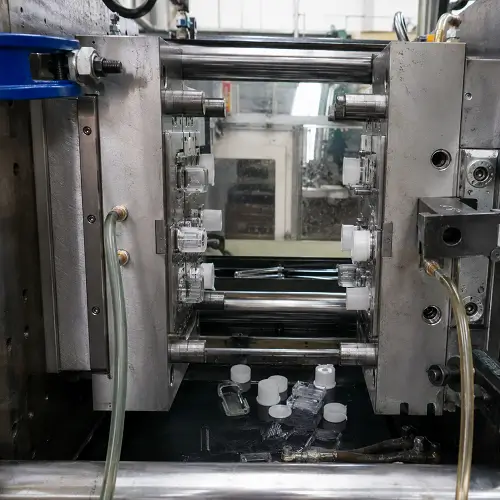
Nylon Melting Point
Nylon includes several polyamide families, so a single nylon melting point is not accurate enough for mold design.
PA6 commonly melts near approximately 220°C, while PA66 is near approximately 260°C. Other materials such as PA12, PA46, copolyamides, and PPA have different melting and processing ranges.
Nylon requires controlled drying. Moisture can lower melt viscosity and damage the polymer during processing, affecting appearance, strength, and dimensional stability.
Glass-filled nylon also changes the manufacturing problem. It increases stiffness and tool wear, changes flow orientation, reduces shrinkage in some directions, and may increase warpage in others. Gate location, gate size, venting, steel selection, and shrinkage allowance should be reviewed for the exact grade.
Polycarbonate Melting Point
Polycarbonate is amorphous and does not have a sharp crystalline melting point.
Representative grades have a glass-transition temperature near 143–148°C, while injection molding temperatures are commonly around 280–320°C.
PC must usually be dried to a low moisture level before molding. Moisture and excessive residence time can cause degradation, discoloration, gas, black specks, and reduced mechanical performance.
Transparent PC parts also require smooth flow paths, suitable polishing, balanced gates, and effective venting. Raising melt temperature may improve flow, but excessive temperature can increase yellowing and internal stress.
POM Melting Point
POM, also known as acetal, is a semi-crystalline plastic with a relatively narrow melting range near approximately 165–175°C.
Typical POM melt processing temperatures are about 190–230°C, depending on grade. warns against excessive temperature and residence time because overheating can release formaldehyde and damage the material.
Mold and machine cleanliness are especially important. POM should not be mixed with incompatible materials or processed using temperatures intended for PC, PPS, or PEEK.
Gate location and cooling balance also influence shrinkage and dimensional stability because POM is highly crystalline and commonly used for precision gears, latches, bearings, and sliding parts.
Acrylic Plastic Melting Point
Acrylic, usually referring to PMMA, is amorphous and has no sharply defined crystalline melting point.
Representative PMMA grades are injection molded at approximately 220–260°C, with mold temperatures often around 60–90°C.
Transparent acrylic parts require controlled drying, polished mold surfaces, gradual flow transitions, and suitable venting. Excess moisture or overheating may cause bubbles, silver streaks, yellowing, and reduced optical quality.
A small gate may create high shear or visible flow marks. Gate location should therefore be selected with the optical area and weld-line position in mind.
Polystyrene Melting Point
General-purpose polystyrene is amorphous and does not pass through one narrow crystalline melting temperature.
PS softens above its glass transition and becomes sufficiently fluid at higher processing temperatures. HIPS contains impact modifiers and can have different viscosity and thermal behavior from clear general-purpose PS.
Thin PS parts often fill easily, but sharp thickness changes or poor venting can still create burn marks, weld lines, or brittle areas. EPS should be treated separately because it is a cellular material produced through a foaming process rather than conventional solid injection molding.
PBT Melting Point
PBT is a semi-crystalline engineering thermoplastic with a relatively narrow melting range around 220–230°C. Typical injection molding temperatures are approximately 240–280°C.
PBT is commonly used for thin electrical connectors, sensor housings, and automotive components. These parts often contain narrow walls, terminals, ribs, and small gates, so flow grade and gate design matter as much as melting point.
PBT must also be dried correctly. Moisture can cause degradation, reducing mechanical properties and creating unstable dimensions.
PPS Melting Point
PPS has a melting temperature near approximately 285°C and is generally processed above 300°C.
PPS molds may require higher mold temperatures, suitable heater systems, controlled venting, and steels or surface treatments that withstand reinforced compounds. Glass-filled PPS can also be abrasive and may produce visible fiber orientation.
PEEK Melting Point
PEEK has a melting point near 343°C, making it one of the higher-melting thermoplastics commonly used for precision injection molding.
Typical PEEK processing temperatures are approximately 360–400°C, while mold temperatures are often around 170–200°C. Victrex data for representative grades show melt temperatures around 375–395°C and mold temperatures around 180–200°C.
A mold originally developed for ABS or PP cannot normally be converted to PEEK by raising the machine temperature. Heater capacity, screw and barrel suitability, nozzle design, hot-runner ratings, thermal insulation, mold heating, tool expansion, and shutdown procedures all require review.
Gate dimensions also need attention because a small gate may freeze prematurely or generate excessive shear. High resin cost makes runner volume, startup scrap, and process stability commercially important.
TPU and TPE Melting Temperature
TPU and TPE describe broad groups of flexible thermoplastics rather than one material.
Processing temperatures vary according to hardness, polymer chemistry, and grade. Lubrizol guides show that some TPU materials are processed around 180–220°C, while harder grades can approach approximately 230°C. Moisture control is critical because TPU can degrade during high-temperature processing when it has not been dried properly.
Soft TPU parts can also stick to the mold or deform during ejection. Draft angle, surface finish, cooling time, and ejector design must therefore be reviewed together with melt temperature.
How Melting Point Affects Injection Molding Equipment and Mold Design
A higher plastic melting point usually requires more than a higher barrel setting. The injection molding machine must maintain a consistent melt from the screw to the nozzle without leaving cold material or holding the resin at high temperature for too long.
High-temperature polymers may require heater bands with greater capacity, suitable screw and barrel materials, high-temperature nozzles, heat-resistant seals, and temperature controllers capable of maintaining a narrow processing window.
The hot runner must also be compatible with the selected material. A system designed for PP may not be suitable for PPS or PEEK. Heater wattage, manifold expansion, nozzle tips, valve-gate seals, wiring, thermocouples, and residence volume all need to withstand the required temperature.
Mold-temperature control changes as well. Conventional plastics may use water-controlled molds, while high-temperature materials can require pressurized water, oil controllers, cartridge heaters, insulated plates, or a combination of heating and cooling circuits.
These requirements affect mold cost, machine selection, startup time, energy use, maintenance, and production stability. High-temperature tooling should be planned before mold steel is cut rather than treated as a later processing adjustment.
How Plastic Temperature Affects Part and Gate Design
A plastic with a high melting point does not automatically have good or poor flow. Melt viscosity, shear rate, reinforcement, material grade, temperature, and part geometry work together.
Thin walls, long flow paths, narrow ribs, small holes, and distant features may require a higher-flow grade or a different gate location. Raising the melt temperature can improve flow, but it may also increase degradation, flashing, residence-time damage, and cycle time.
Gate size determines how quickly the entrance to the cavity freezes. If the gate freezes too early, packing pressure cannot reach thick sections and sink marks or internal voids may form.
A larger gate can improve packing but leaves a larger vestige and may require a longer cooling time. A smaller gate may reduce the mark but create high shear or freeze before the part is fully packed.
Temperature should therefore be reviewed together with:
- wall thickness
- flow length
- gate type and location
- runner size
- rib and boss dimensions
- venting
- mold temperature
- packing pressure
- cooling balance
These factors should not be adjusted independently. A temperature change may temporarily hide a geometry problem without creating a stable production process.
Injection Molding Temperature Example
Consider a thin equipment housing initially designed in ABS. The design is later changed to glass-filled PA66 because the final product requires greater stiffness and heat resistance.
This change affects much more than the polymer melting point. PA66 requires a higher melt temperature and controlled drying. The glass-filled grade also has different flow, shrinkage, fiber orientation, surface appearance, tool wear, and warpage behavior.
The original ABS gate may be too small or located in a position that creates excessive fiber orientation. The mold-temperature system may be inadequate for PA66, and the original shrinkage allowance may no longer produce the required dimensions.
The mold engineer may need to revise the gate size, gate location, venting, steel allowance, cooling balance, and cavity surface expectations before manufacturing the mold.
This is why melting point and processing temperature are not only machine settings. They can influence the complete mold structure and the dimensional behavior of the finished plastic part.
What Happens If the Plastic Melt Temperature Is Too Low?
A plastic melt temperature below the suitable processing range leaves the material more viscous and less able to pass through thin or distant areas of the cavity.
The part may develop short shots, incomplete ribs, hesitation marks, weak weld lines, poor texture replication, and early gate freezing. Injection pressure may rise because the machine must force a colder melt through the runner and cavity.
Increasing injection pressure may help temporarily, but it can also create flash, internal stress, machine-capacity problems, or uneven cavity filling.
The more stable solution may involve increasing wall thickness slightly, moving the gate, enlarging the gate, shortening the runner, improving venting, or choosing a higher-flow resin grade.
What Happens If the Plastic Melt Temperature Is Too High?
A melt temperature above the recommended range can reduce viscosity excessively and increase flash, drooling, or overpacking.
The greater risk is polymer degradation. Excessive temperature or residence time can create discoloration, black specks, odor, gas, bubbles, silver streaks, brittleness, and unstable dimensions.
PVC and POM require particular care because of their thermal sensitivity. PET, PA, PC, PBT, and TPU also need correct drying because moisture-related degradation becomes more severe at processing temperature.
Raising temperature cannot permanently compensate for a poor gate, an excessive flow length, an unsuitable wall thickness, inadequate venting, or the wrong resin grade.
Can All Plastics Be Melted?
Thermoplastics can normally soften or melt when heated and harden again during cooling. PE, PP, ABS, PC, PA, POM, PBT, PPS, and PEEK are commonly processed in a molten state.
Thermosetting plastics form a crosslinked network during curing. Reheating does not return them to an ordinary processable melt; continued heating eventually causes degradation or charring.
Some polymer materials may also degrade before developing a useful low-viscosity melt. The statement that every plastic can simply be melted and remolded is therefore incorrect.
This distinction affects recycling and manufacturing. Thermoplastic runner waste may sometimes be reground and reused under controlled conditions, while cured thermoset runners cannot be remelted through the same process.
How to Choose a Plastic Based on Melting Point
Melting point can help compare polymer families and estimate the required molding equipment, but it should not be the only reason for selecting a plastic.
The product may need to withstand continuous heat, short temperature peaks, impact, chemicals, moisture, UV exposure, friction, or long-term mechanical load. Glass transition, heat-deflection temperature, creep, thermal expansion, and long-term aging may be more important than Tm.
Manufacturing capability must also be considered. A high-melting material may require higher barrel and mold temperatures, controlled drying, specialized hot runners, insulated tooling, and longer startup procedures.
Higher temperature can also affect the tooling budget and production cost through heater requirements, energy use, mold components, cycle time, machine availability, and process-control demands.
The final material and processing conditions should be based on the exact supplier grade, CAD geometry, wall thickness, tolerances, surface requirements, operating environment, and annual production quantity.
Conclusion
Plastic does not have one universal melting point. Thermal behavior depends on polymer structure, crystallinity, copolymer composition, material grade, additives, reinforcement, and processing history.
Semi-crystalline plastics such as PE, PP, PA, POM, PBT, PPS, and PEEK have measurable melting ranges. Amorphous plastics such as ABS, PC, PMMA, and PS soften gradually and are more accurately described through glass transition, softening behavior, and processing temperature.
Plastic melting point is different from injection molding melt temperature, mold temperature, heat-deflection temperature, and continuous operating temperature. These values affect not only material selection but also machine capability, hot-runner design, gate size, mold heating, cooling, part shrinkage, warpage, cycle time, and tooling cost.
JeekMould supports plastic material selection, injection molding DFM, mold manufacturing, trial molding, and plastic part production. Upload your 3D CAD model, selected resin grade, operating temperature, and production quantity to receive an injection molding review and quotation.